Beyond the Algorithm: Patent Eligibility of AI-Enabled Physical Devices
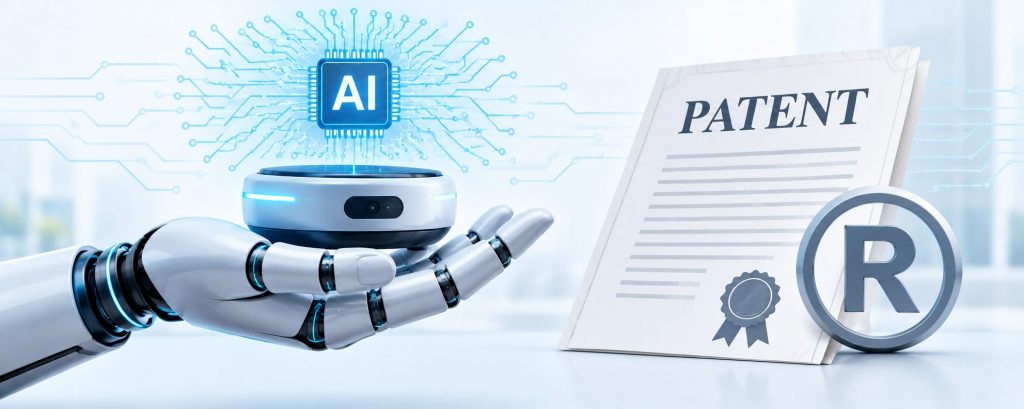
Introduction : The surgical robot with a self-adjusting grip, the smart sensor able to flag a bearing failure before it jams, and the hand-held device that diagnoses a blood sample all have a trained model behind them, and all of them are physical products. Patent authorities are increasingly treating such products differently from standalone algorithms and from AI that was simply used to help the inventor arrive at his invention. This post explores how India, the United States, the European Patent Office (EPO) and the United Kingdom make this distinction, how such embedding could be beneficial to the claim, and what should be done about claim drafting.
Legal Framework
India: The Patents Act, 1970
An invention should be a new and useful product or process involving an inventive step and capable of industrial application. An invention cannot be a mathematical method, a business method, a computer programme per se or an algorithm. This provision represents the chief impediment to claiming AI-related inventions because a trained model, at the very least, is an algorithm. In addition, the revised Guidelines for Examination of Computer Related Inventions, 2025, notified by the Controller General of Patents, Designs and Trade Marks (CGPDTM), include an entire chapter dealing specifically with AI, machine learning and deep learning. They acknowledge the abstract nature of such inventions but treat them as potentially patentable if they provide tangible applications in the real world with a certain technical effect. At the same time, sufficient disclosure under Section 10(4) is required, which means that speculative or vague claims might fall on that ground alone.
United States: Section 101 and USPTO Guidance
Any new and useful process, machine, manufacture or composition of matter is deemed to be eligible. However, this provision is supplemented by the Alice/Mayo test, where the court is required to establish, first, whether a claim is directed to a judicial exception, such as an abstract idea, and, second, whether there is something “significantly more” in it. The July 2024 USPTO update of the Eligibility Guidance applied this test to the context of AI-related inventions, using Examples 47–49 and stressing that claims describing an improvement to a computer or some other technological device could integrate an exception into a practical application. In September 2025, the panel in Ex parte Desjardins vacated a §101 rejection because the machine-learning method in question improved the operation of the claimed model itself. This ruling was made precedential in November 2025 and included in the Manual of Patent Examining Procedure through a memo from the USPTO in December 2025. In September 2026, USPTO Director John Squires told the Senate Subcommittee that the USPTO wants AI-related applications to be filed even when there are eligibility concerns, although the USPTO guidance binds the examiners and not the federal courts.
Europe and the United Kingdom
Articles 52(2) and (3) of the European Patent Convention exclude mathematical methods and computer programs “as such”. The EPO guidelines treat AI and machine learning models as abstract by themselves, yet recognise their technical character in cases involving a technical purpose, with the most popular example being a neural network used in a heart-monitoring apparatus to identify irregular heartbeats. The UKSC, in Emotional Perception AI (February 2026), abandoned the longstanding Aerotel test and brought UK law into compliance with the EPO’s “any hardware” approach.
Legal Analysis
Two Different Roles for AI
Patent authorities distinguish between two roles played by AI. In the case of using AI as a development tool, the question is one of inventorship and not eligibility. According to the 2024 update of the USPTO Eligibility Guidance, the method of invention development, including the use of AI, has no bearing upon eligibility. In its November 2025 guidance, it stated that only natural persons could be inventors and that the ordinary conception standard applies to cases of AI-assisted invention development, consistently with Thaler v. Vidal. India takes the same approach: AI-generated inventions are unpatentable because AI is not a person, while AI-assisted inventions may be patentable, provided they satisfy all the normal criteria.
When AI is embedded in the device or process claimed, however, the analysis changes. Eligibility becomes dependent on how the claim uses the model, and this is where hardware comes in.
Why the Device Changes the Analysis
A standalone algorithm is just a set of calculations. A physical device provides an input, an output and an effect upon the world. The EPO’s heart-monitoring example is relevant for this reason because technical character is established in the sensing system rather than in the classification itself. The same was held by the Supreme Court of the United States in Diamond v. Diehr, where a computer-controlled process of curing rubber was deemed patent-eligible because the equation was used to transform a physical substance. Federal Circuit courts also approved patents based upon sensors and monitoring devices operating in a particular improved way, as happened in Thales Visionix and CardioNet, though none of those cases concerned AI.
Three caveats must be made. First, mere hardware recital is not enough. As the EPO warns, “neural network” terms might be understood as merely denoting an abstract model, and a generic purpose such as “controlling a technical system” does not provide technical character. Secondly, in Recentive Analytics v. Fox Corp. (2025), the Federal Circuit found that applying generic machine learning to a new data environment, without improving the model, is ineligible. In December 2025, the Supreme Court refused to grant certiorari. Similarly, claims for a smart device with “apply a model to sensor data” as the sole element are subject to the same reasoning. Thirdly, in the UK, hardware helps the claim pass the exclusion test but is not enough for inventiveness.
The Indian Position
Indian courts have shifted away from the novelty-in-hardware requirement but retain the requirement of a technical contribution over and above the algorithm. Ferid Allani found that computer-related inventions with a technical effect are not precluded by Section 3(k). In Microsoft Technology Licensing, the rejection of an application was reversed due to the absence of the novelty-hardware criterion, as an invention that improved the functioning and efficiency of a system was not a computer program. The BlackBerry case illustrates the limits of these rulings: while one appeal was dismissed because the invention was basically a logical algorithm controlling the data flow, another appeal succeeded. With regard to embedded AI, the takeaway from this line of cases is that, in India, a claim needs to describe the model in action in terms of speed, accuracy and resources consumed. The Madras High Court clarified that AI-related claims need to disclose the details of implementation, allowing the reproduction of the model’s functioning.
Relevant Case Laws
Ferid Allani v. Union of India, (Del. HC Dec. 12, 2019): Computer-related inventions showing a technical effect or technical contribution are not excluded by Section 3(k), even when implemented through software. This is the starting point for embedded-AI claims in India.
Microsoft Technology Licensing, LLC v. Assistant Controller of Patents & Designs, (Del. HC 2024): The Court criticised the Patent Office for applying the novel-hardware criterion and ruled that a technical effect improving the system’s functioning took the invention out of the scope of Section 3(k).
BlackBerry Ltd. v. Assistant Controller of Patents & Designs (Del. HC Aug. 30, 2024): Two appeals with different outcomes. A technical contribution over and above logical instructions needs to be proven, not merely asserted.
Diamond v. Diehr, 450 U.S. 175 (1981): Using a mathematical formula in a computer-controlled rubber-curing process was patent-eligible, as the claim as a whole transformed a physical material.
Recentive Analytics, Inc. v. Fox Corp: Claims applying established machine learning to a new data environment without disclosing improvements to the model are ineligible. Certiorari was denied on December 8, 2025.
Ex parte Desjardins, (precedential): Claims reciting specific improvements to the operation of a machine-learning model, such as reducing system complexity and prevention of “catastrophic forgetting,” are not abstract.
Emotional Perception AI Ltd v. Comptroller-General of Patents, Designs and Trade Marks: An artificial neural network is a computer program, but a claim requiring hardware is not excluded as a program “as such“. The decision superseded that of Aerotel by adopting the approach of the European Patent Office.
Practical Implications
The important point to take away from the case for enterprises engaged in product development is not to focus on the model but instead to describe the device and the technical effect achieved through it. The following five steps are a guide to follow.
- Identify a technical problem to solve. Describe what the problem is in physical terms that the model helps to solve. Some examples are noise in sensor data, lag in the control loop, and power consumption of the edge device.
- Connect the model with hardware. Describe the sensor input, the signal pre-processing, the place of the model in the control or diagnostics chain, and the output driven by the model, whether it is a motor control signal, alert or dosage change. Just “processor configured to apply a trained model” is prone to the Recentive objection.
- Claim a measurable technical effect. Measure the improvement against a known baseline, such as lower detection latency, greater accuracy at a given false positive rate, reduced memory usage or energy consumption, or decreased calibration drift. Per the Desjardins decision, the examiner should seek the specific benefit set out in the claims and demonstrated in the specification as the Guidelines of India also call for a tangible technical effect. In cases of insufficient support, the Memorandum on Subject Matter Eligibility Declarations from December 2025 issued by USPTO presents an option to provide additional evidence, yet the specification cannot be amended in this manner.
- Provide details of how the invention can be reproduced. Provide the architecture of the model, unique aspects of the training data set, the training method and the validation results. This is the answer to section 10(4) of India and the demonstration of practical application in the United States.
- Structure the claims and preserve the file wrapper. Combine the independent claim on the device with the method claim, and append dependent claims for training or in-device optimization as improvements to the model as they are the most solid arguments in Desjardins and Recentive. As AI-assisted inventions are always human creations, document the inventor of the invention. Finally, unify across the filings: the claim demonstrating a technical purpose of the invention will generally fare well at the EPO, while the US draftsmanship needs to have the model-level improvements as a back-up.
Companies should examine their portfolios for the claims on inventions called “AI for X”, which are stated solely in terms of results, as these claims are most susceptible to challenge.
Conclusion
The question of patent eligibility of AI has become a question of where the AI resides in the claims. AI as a research tool poses questions regarding inventorship but leaves patent eligibility untouched. A standalone model is likely to be treated as an abstract algorithm in India, the United States and Europe. A model embedded in a sensor, robot or diagnostic device, and shown to provide a measurable technical effect, is the case to which patent offices are most responsive.
While the law continues to develop and USPTO guidance is not binding on courts, the trend is clear: describe the technical problem, connect the model with hardware, measure the effect and describe how it works. Companies that draft this way will be better placed to protect AI-powered products than those that claim the algorithm alone. India would also benefit from objective, worked examples of how technical effect is to be measured, so that examiners and applicants share one standard.
Author:- Sadgamaya Kudapa, in case of any queries please contact/write back to us at support@ipandlegalfilings.com or IP & Legal Filing.