Design Infringement and Prior-Art Evidence
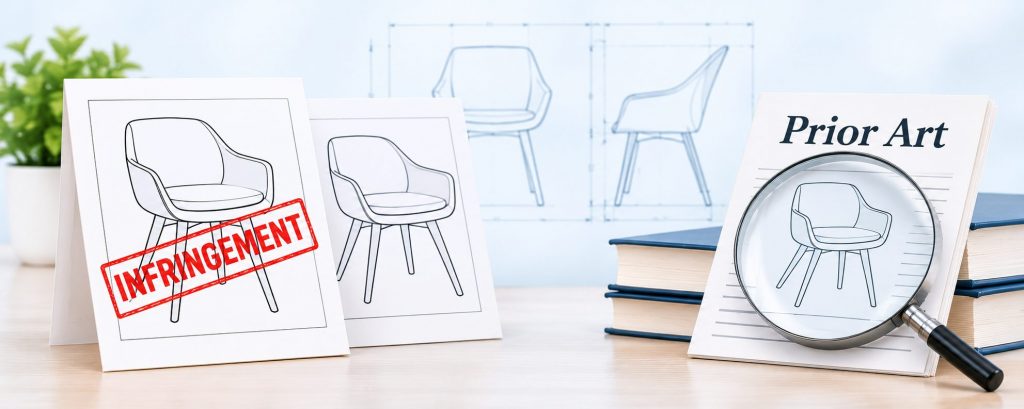
Introduction : Registered designs are intended to provide a reward for creativity in design. However, when a design case goes to court, the first question is rarely “did the defendant copy?” Rather, it is usually “was this design really new when it was registered?”
Defendants in design cases are aware of this. Their first move is to hunt for older catalogues, trade-show leaflets, invoices, shipping documents, or anything else that could show that the design was already seen before the registration date. If they find something, the registration and the claim of infringement falls apart.
This blog studies the effect of three types of commercial record on the validity of evidence:
– Catalogues and other printed or digital publications;
– Consignment notes and invoices that document the sale of goods and their movement;
– Product launches such as web sites or marketplace listings.
It also reviews two questions that may determine the outcome of many cases:
– Timing: when a piece of evidence must be produced;
– Admissibility vs. probative value; even if a piece of evidence is admissible, it does not mean it can prove anything.
Legal Provisions
Section 2(D) – Design
A design is defined as the aspects of shape, configuration, layout, ornament or arrangement of lines or colours applied to an article which can be two-dimensional, three-dimensional or both forms. It does not include mere mechanical procedures nor do the trademarks or “artistic works” as defined in the Copyright Act. This is the reason why the boundary between copyright and design is significant in these disputes.
Section 4 – Ban On Registration
A design cannot be registered unless it is new or original. Registration shall also not be granted if it has been made public anywhere in India or abroad in any manner before the application filing date or priority date, through any publication in tangible form, use, or other means. Section 4 uses the statutory test “not significantly distinguishable from known designs or combination of known designs.”
Section 19 – Cancellation
Any person who has an interest can submit an application for cancellation. The reasons are:
- The design was registered in India prior to the application;
- The design was published, in India or elsewhere before applying for registration;
- The design is neither original nor new;
- The design is not registrable according to the provisions of the said Act;
- The design has not been defined as a “design” under Clause 2(d).
The distinction between prior registration and prior publication is important. The Delhi High Court in India clarified that prior publication as a criterion would not be restricted to publishing in India only and would include publishing anywhere in the world. Which means prior registration abroad would not trigger the applicability of Section 19(1)(a). However, prior publication made abroad would lead to the applicability of Section 19(1)(b).
Section 22- Counterfeiting Of A Registered Design
Section 22 offers the owner relief from the unlawful use of a registered design for commercial purposes. Section 22(3) serves as crucial defensive mechanism. Any reason used to cancel a registration in Section 19 can be used as defence against an infringement. Under Section 22(4), where such defence is raised, the matter should be transferred to the High Court.
Evidence Law
This is a reaffirmation of the admissibility of documentary and electronic evidence according to the Evidence Act. The Act in Section 63 requires a certificate for electronic records for the admissibility of electronic records and the requirements for production and certification.
Legal Analysis
Why Prior Publication Is So Powerful
The purpose of design protection is to reward the exclusive usage of something new. If the design was disclosed in public before the applicable date, that disclosure may undermine the validity of a subsequent registration. The legislation makes no analysis of who was the first publisher or why he has published it. It is only interested in the fact whether the design was revealed before the critical moment.
The considerable breadth of the statutory text can be attributed to three characteristics:
- The geographical coverage. The term “published” can mean “anywhere in India or abroad”. An Indian registration could be defeated by foreign trade fair brochures.
- The manner of publication. The term “published” is broad enough to include the publication in a material or tangible form or in any other means. The Delhi High Court clarified that Section 4(b) is more than just an expression because the design should have been presented to the public through one of these methods.
- The previous action of the owner is as significant as that of any third party. This is one of the biggest self-inflicted injuries. Prior disclosure need not originate from the competitor. Businesses should consider the timing of design filings before commercialising a product.
Catalogues
A catalogue is a conventional document in the field of prior art. It has a distribution trail and pictures and a publication date printed in it. A catalogue will help only if it reflects the subject matter of the same article. The publication in respect of the design must be in a physically tangible form. Prior trade catalogues, brochures, books, journals, magazines or newspapers that contain images of the same design qualify as publications. However, use of a description of some different product or not-so-clear drawing will not help.
Proving the date and circulation is an even tougher task. Essentially, the date shown on a catalogue shows the publisher’s claim. The challenger must now prove when the item was actually printed and to whom it was distributed. Records of printing jobs, acknowledgements from distributors, registrations at trade shows and testimony by the printer or recipients help to establish this.
Consignment Notes, Invoices And Sale Records
The documents show the usage and sale. Selling to the public goods with design is a use disclosure. Consignment notes and invoices provide three things:
1.when the goods were moved or sold;
2.who purchased or transported the goods;
3.what goods were sold (description) or model number linking goods to design.
The vulnerability pertains to the connection involved. A consignment note that states “10 units, Model Z” does not confirm anything in terms of the design, it has to be possible to connect Model Z with the design that is being contested. Because of these challenges, combine sales records with pictures, samples of products, price lists or catalogue pages.
Sales records are also risky because business owners create them as part of their normal business activities and may not know how important they are in the eyes of the law. A sale that took place some time ago before the date of the application is considered to be a publication, irrespective of the name of the brand, under which the product was sold.
Product launch events, news, social networking announcements, online retail data and the website run by the inventor are the primary sources of prior art today. They can be easily dated through platform timestamps, which represent the most significant feature. Providing a proof of what existed at the given moment is just to present archived captures or official screenshots.
Timing Of Eveidence
Two separate “timing” questions arise.
The priority date. The reference point is either the filing date, or the priority date where a valid. Convention priority is claimed. Anything that discloses the design to the public before that date is potentially fatal. Everything afterwards is irrelevant to novelty, though it may be relevant to infringement. I do not know of any general grace period in the Designs Act for the proprietor’s own pre filing disclosures. The Act does include limited provisions on exhibitions and Convention priority, so the present text and rules should be consulted prior to depending on any sort of relief.
The timing of proof. Evidence must be called at a suitable point in the proceedings. In injunction proceedings, a defendant need only raise a credible challenge to validity. At trial, the responsibility is to establish the facts.
Admissibility Vs. Probative Value
It is here that many a fight is in fact determined.
- Admissibility is whether or not the document can be received at all. It depends on relevance, a proper foundation, and for electronic records, the statutory certificate. An uncertified print of a web page may fail at this threshold.
- Probative value (weight) asks, once the document is in, how much it proves. A catalogue may be allowed as evidence yet prove little if nobody shows when it was circulated. An invoice may be entirely competent, but it does not specify what design the goods have.
The prior publication must be established by documentary proof and not by impression by documentary proof and not by impression. In a matter concerning a registered design for a “Construction Rod”, that court’s analysis turned on what the evidence actually showed. The lesson is that comparing the registered design to a general impression of the market is not sufficient. The challenger must demonstrate, with dated documents, what was shown and at what time.
The Supreme Court’s decisions on electronic evidence, Anvar P.V. v. P.K. Basheer and Arjun Panditrao Khotkar v. Kailash Kushanrao Gorantyal, are relevant to online launch evidence, particularly the certificate requirement under Section 65B.
Case Laws
Reckitt Benckiser (India) Ltd V. Wyeth Ltd (Delhi High Court, 2013)
The case is the leading authority on the meaning of “publication”. The court considered whether prior registration abroad was a ground under section 19(1)(a) and concluded it was not. It also considered what “prior publication” means, and noted prior publication as a ground for cancellation also applies to publication in any other country. On the facts, the spatula in the question was found to have been in actual use before registration in India. Publication by a design can be invalidated by use, not just by print.
Anuradha Doval V. Controller Of Patent And Designs (Calcutta High Court, 2017)
The design in dispute was a bottle cap. The court’s main reasoning was that cancellation is permitted in circumstances where the alleged design is substantially similar to the prior published design. The court upheld the Controller’s decision to cancel the registration. The case shows that the comparison is not about identical copies. Substantial similarity to the published design is enough.
Novamax Industries LLP V. Prem Appliances & ANR (Delhi High Court, Decided 19 June)
2026). And that recent decision is the clearest illustration of the theme of this post. Novamax’s own invoices indicated that coolers featuring the suit design were sold prior to the application date of 19 October 2019, and its own website offered the cooler for sale as early as 24 March 2019. The court held that what mattered under Section 19(1)(b) was whether the design itself had been published in India before registration, not what name appeared on the product. The design infringement claim was dismissed on summary dismissed even though the passing off claim was to be tried. The plaintiff’s commercial records, not the defendant’s research, defeated the claim. The passing of survival also shows that a failed design claim need not end the dispute where goodwill can be proved.
Practical Implications
For Design Owners
Consider your own commercial records as possible evidence that could be used against you. The Novamax facts illustrate how a website listing and early invoices can defeat a registration filed months later. File before you sell, advertise, list online or show the product publicly. If a sample has already gone out which raises the issue to be addressed prior to filing, consider appropriate confidentiality arrangements and maintain records of the recipients and terms of disclosure.
For Defendants
Construct your prior art file early. Search catalogues, archived web pages, marketplace listings, trade fair records and foreign publications. Prove each document properly: date, circulation, and link to the same article. The defendant may raise the Section 22(3) defence in the written statement and in the opposition to an injunction wherever appropriate.
For Both Sides
Differentiate admissibility from weight when preparing. Get electronic record certificates ready. Prepare witnesses who can testify about printing, circulation and sale. Line up the chain from document to design, since a stack of dated papers is not proof until each is attached to the design in suit.
Design- Diligence Checklist
Prior to filing
- Have you Displayed, sold, dispatched, listed or marketed the design anywhere (either in India or elsewhere) prior to your intended filing date?
- Have you dispatched samples to agents, distributors, purchasers and exhibitions? Under a written agreement of confidentiality?
- Do you have a catalogue, brochure, price list or presentation of the design?
- Have you gone through all social media, website and marketplace posts, ensuring they are dated?
- Have you carried out a search of third party and foreign publications?
- If claiming priority have you established that the priority period is still current?
At acquisition/licensing
- Ensure you know when the design was first: Sold, Displayed, listed.
- Compare against the filing date and priority date
- Check through past invoices/consigned notes to determine if any of the model numbers correspond
- Ensure that the registered design can be described as “significantly distinguishable” from any previous designs.
Prior to suing
- Carry out validity checks as the defendant
- Identify the date of your earliest public use. Ensure it is after any of the filing.
- Keep dated evidence. Certificates should be obtained for electronic documents.
- Consider whether passing off or copyright would be a good alternative.
Documentation
- Keep a dated design development log.
- Ensure samples are controlled prior to filing
- Ensure the relationship between model numbers of the design and registered designs are close.
Conclusion
A design dispute is won or lost on the evidence. It is a simple principle that if a design has been published prior to the priority date then it cannot be validly registered. This can be used as a defence against infringement under section 22(3). However, this is difficult to prove. Catalogues, consignment notes, invoices and launch documentation will only count if proved, dated and related to the design.
Two main points can be taken away from this. Firstly, often the most damaging prior art will come from the proprietor’s own commercial activities. As seen with Novamax. Secondly, just because something is admissible does not mean that it will be convincing. The court will look at what the evidence can actually prove.
Businesses that file prior to publication, keep clear records of commercialisation and carry out a due diligence check prior to suing or purchasing will be in a much better position than those that find out about the issue from a written statement.
Author:- Anushka Kalaskar, in case of any queries please contact/write back to us at support@ipandlegalfilings.com or IP & Legal Filing.