17+Years, More than 25000 Clients, and over
1000 FTO searches conducted





















Overview
Before the release of a product/technology, from a commercial standpoint, it is necessary to conduct a freedom to operate search (FTO search), which is also popularly known as a Clearance Search or the Right to Use search. The FTO search helps assure the company that releases the product/technology into the market that the desired product can be safely launched in a specific market of a country or a specific region without any possibility of a potential infringement or a violation of a valid and live, or a pre-existing, patent within that particular jurisdiction.
An FTO search is usually conducted prior to the commercial release of a new product in a specific country or region. It can also be conducted prior to the initiation of the process of Research and Development (R&D) of a particular product. Conducting an FTO search can essentially reduce the chances of patent infringement and the risk of patent litigation. An FTO search can also be helpful in enhancing the competitive strength of the product since it keeps the company aware of the already existing technologies and products. It can also help in meeting investor expectations before funding, or help the company in identifying the possible acquisition targets. In furtherance of this, an FTO helps the company facilitate the enhancement of the strength of its existing product portfolio.
We, at IP and Legal Filings(IPLF), have a long-standing, acumen, and enriching working experience in conducting FTO searches in several domains in fields including but not limited to Biotechnology, Biomedical, Healthcare, Mechanical, Chemical, Pharmaceuticals, Electrical, Electronics, Telecommunications, Metallurgy, Semiconductor, Software, and Information Technology. IPLF endeavours to conduct robust patent research on a myriad of paid and free databases, with both local and global coverage. We also conduct searches on country-specific regional databases in order to ensure that the product/technology does not face any legal impediment or problem in a specific country. In order to provide the best efficiency, enhance the surety and accuracy of determining the legal status of the patent, we do not rely solely on the automatic databases, but also manually cross-verify the legal history on each country-specific database, which include, but are not limited to, databases such as DPMA register, KIPRIS, SIPO, USPTO, etc.
What Is The Process Of Freedom to Operate (FTO) Search?
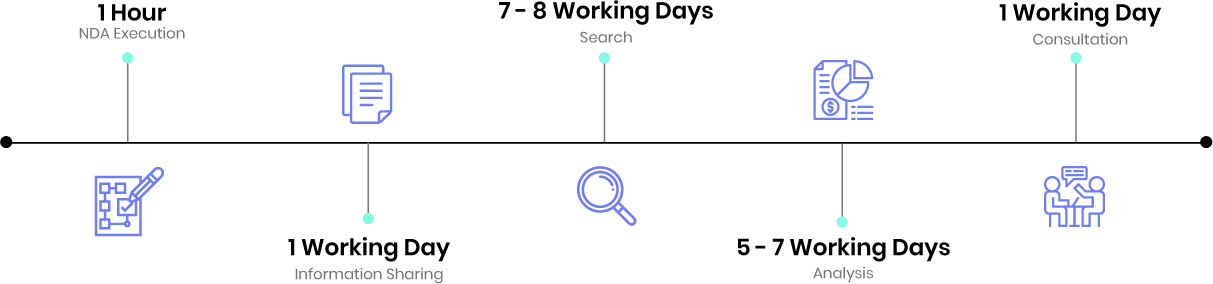
1. Non-Disclosure Agreement (NDA)
Confidentiality is of concern to any investor. We completely understand that. To give you complete assurance that your invention will be confidential with us, we sign a Non-Disclosure Agreement (NDA) and only then we initiate the project.
2. Search
Once we receive the detailed description of the product that is intended to be launched/commercialized along with the features and the market/territory/country in which the product is intended to be launched, we initiate the FTO search through our in- house team of professionals with strong experience in various technical domains. Thereafter, we design appropriate and comprehensive search strategies that include a selection of keywords, forming the search strings and thereafter conducting searches on free or paid databases. Usually, at least 3-4 people are part of the search team to bring a complete 360-degree perspective to the search.
3. Analysis
Once we obtain results after searching various databases, a comprehensive analysis is carried out. Our years of experience in various aspects of patenting help us in separating the wheat from the chaff.
4. Consultation
Based on our in-depth analysis, we conclude whether the product is likely to infringe on any granted patent/pending patent application in the country of interest, and we certify whether the product is good to proceed with the commercialization along with the associated risks.
Details Required
- Product description.
- Features and/or sub-components that require clearance.
- Territorial/Geographical scope of the search
Timeline
Testimonials


Get Started
Frequently Asked Questions
1. When Should a Freedom to Operate Search be Conducted?
A freedom to operate search should be carried out as early in the product or process development cycle as possible.
2. What does an FTO search focus on identifying?
An FTO search focuses only on active patents/applications that have a claimed scope which can cover the product that is intended to be commercialized.
3. What Is a Freedom to Operate Analysis?
A Freedom to Operate (FTO) analysis mainly focuses on the claims of the identified patents/pending applications to determine whether the product that is intended to be commercially released or monetized falls within the scope of the claimed subject matter or overlaps in any manner with the identified patents/pending applications. During such analysis, other sections of a patent application such as the specification and the drawings are not given high priority but are key to determining the overall scope of the patent/application
4. What Is a Freedom to Operate Opinion?
An FTO opinion is a written document that states the legal opinion of a Patent Attorney about any infringement of a product or process upon other patents.
5. If FTO exists for a product, does it mean that the product is patentable as well?
Freedom to operate (FTO) does not guarantee the patentability of a product in any manner. In ascertaining FTO, the process determines whether a product or a feature of the product violates any rights of an active patent/application. Typically, an FTO search is limited to the country where the company intends to commercially launch/release the product, where the product is supposed to be sold, used, and/or manufactured. In simple terms, in an FTO, the search and analysis would be restricted to active patents in the country or countries where the product or feature is to be launched, sold, used, or manufactured. The process of ascertaining the patentability of a product is entirely different from this process. Under this process, the product or technology is searched and analysed on the considerations of novelty and non-obviousness with reference to all available prior art.
Here, for reference, the prior art could be a patent as well as non-patent literature. On the other hand, there is no requirement per se to look for non-patent literature in an FTO study as it is only concerned about determining and analysing whether the product is free to be put into the market without infringing any patent rights. In a nutshell, a patentability search must cover all publications, including prior art and non-patent literature, to determine whether the product or process at issue is novel and can indeed be patented. On the other hand, an FTO search shifts this focus entirely to patents, especially active patents (and not other types of documents) that give the holder(s) the right to pursue litigation. Patentability Search All publications (Patent Documents as well as Non-Patent Literature) Usually faster and not as expensive FTO Search Granted patents, pending patent applications, and potential PCT applications that may enter into the country of interest – Usually more complicated, time-consuming, and expensive.