13+Years, More than 25000 Clients and
2000+ Opposition Matters





















Overview
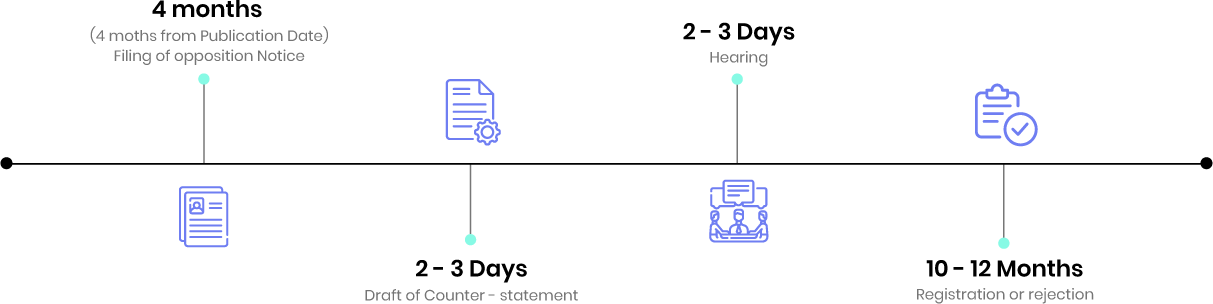
Trademark Opposition is basically filed by a third party who is interested in the trademark application, inasmuch as its registration is concerned. The third-party files an opposition against the registration of a trademark that has been published in the trademark journal by the TM Registry. After a Trademark application has been accepted for advertisement in the journal, there is a period of 4 months wherein an opposition against the mark could be filed by an interested third party. In case there is no opposition filed within this time period, the trademark is granted registration by the TM Registry.
If a trademark is opposed, the applicant can file a counter statement against such opposition putting forward its views on why the mark should be registered in the applicant’s name. A trademark opposition is done mostly on two grounds viz. absolute ground(s) for refusal under Section 9 of the Trademark Act or on relative grounds of refusal under Section 11 of the Trademark Act. An individual filing an opposition need not be a registered owner of any trademark. Any individual may oppose a trademark, such as a buyer, client, or a member of the public likely to use the goods or avail the services. This includes individuals, companies, partnership firms, and trusts. In fact, if two or more people have similar objections against a trademark, they can be joined as opponents. The reasoning behind this is that the opponent is not just representing himself but the general public at large, because having two similar marks in the market can only cause confusion.
What Is The Process?
1. Notice of opposition
Once the examiner approves the trademark application, it is published in the trademark journal by the Registry for a period of four months. During this period of four months, any third party can file a notice of opposition against the trademark application. Such notice of opposition is first filed with the TM Registry for its perusal and if the registry is convinced of the grounds, the notice is then issued to the Applicant.
2. Counter statement
A counter-statement is basically the reply to the notice of opposition that is filed by a third party against the applicant’s trademark application. A counter-statement is to be filed within 2 months of the receipt of notice of opposition. There is no extension for filing a counter-statement; thus, if it is not filed within two months, the Applicant is deemed to have abandoned the Trademark application. Like the opposition notice, a counter-statement is likewise first sent to the Registry for its perusal; if convinced, the Registry will then serve the counter-statement on the Opponent.
3. Evidence in support of opposition
After the Applicant has recorded the Counter-Statement against the notice of opposition, the party must document proof supporting its opposition, by the method of an Affidavit, within 2 months (extendable by one month) of the receipt of the counter-statement. The Opponent additionally has an alternative to keep in touch with the Registrar stating that he doesn’t want to record proof yet instead intends to depend on the realities recently expressed in the Notice of Opposition given. In any case, if the proof or the intimation of waiver isn’t informed within two months, at that point the opposition will be considered deserted.
4. Evidence in support of application
The Applicant may file evidence, if any, in support of its application within two months (extendable by one month) of receipt of the evidence of the Opponent. On the other hand, the Applicant may likewise decide to waive his right to file any evidence.
5. Evidence in reply
Furthermore, the Opponent has the choice of filing additional evidence in support of the opposition in response to the Applicant’s evidence, within one month (extendable by one month) of receipt of the Evidence by Applicant. This alternative is given to accomplish a type of finality in the proceedings, to counter the evidence filed by the Applicant.
6. Hearing
The Registrar, in light of the opposition notice, counter-statement, and evidence filed, may call for a hearing, if required. Within 14 days of the receipt of the notice of hearing by the registrar, both parties involved are required to inform their intention to appear at the hearing. Any request for adjournment of the hearing may be filed by either party, not less than 3 days prior to the hearing, in Form TM-M. However, such a hearing can be adjourned only twice and the total duration of the adjournments should not exceed 30 days. As and when agreed by both parties, the hearing is scheduled before the registrar who takes up the arguments and decides on the merits.
7. Registration or rejection
In the event that the Registrar is convinced by the arguments of the applicant and rules in its favor, then such a trademark application is accepted and the mark is registered and registration certificate granted to the applicant. Alternatively, in case the Registry rules in favor of the opponent, the application stands rejected. However, if any party feels aggrieved with the ruling of the registry, he/she can file an appeal before the Intellectual Property Appellate Board.
Details Required
- Power of Attorney
- Evidence supporting Trademark Registration / Opposition.
Timeline
Testimonials


Get Started
Frequently Asked Questions
1. Who can file the Notice of Opposition?
As per Section 21 of the Trademark Act, 1999 ‘any individual’ can file the notice of opposition. This includes individuals, organizations, association firms, and trusts. In fact, if two or more people have similar issues against a brand name, they can be joined together as opponents.
2. What is the time period for filing the Notice of Opposition?
According to Section 21 of the Trademark Act, 1999, any individual may file such opposition within 4 months from the date of publication of the trademark by the registry.
3. Do I need to submit a Power of Attorney at the time of filing the Notice of Opposition?
Generally, the power of attorney should be submitted with the application under Section 145 in Form TM-48. But in case such is not filed at the time of opposition, it can be submitted at a later point within a reasonable time.
4. My Mark is not registered in India; can I file an Opposition based on my pending Application and use?
The TM Registry recognizes common law rights and hence, regardless of whether the registration is in India or elsewhere, a notice of opposition can be filed against any application published in the journal by the registry.
5. Out of the five Trademark registry(s) in India, where can I file the Opposition?
Generally, the notice of opposition is filed in the registry wherein the application of a similar mark has been made.
6. What is the next stage once I file the Notice of Opposition?
Once the notice of opposition is filed, the same is considered by the registry and served on the applicant. The applicant then produces a counter statement against such notice within 2 months. If the applicant fails to furnish a counter-statement, the application shall be dismissed. If the counter statement is filed, then it is served on the opposition party and the process goes on to the evidence stage.
7. What are the timelines to be followed for adducing Evidence by the Parties?
The evidence stage has 2 filings. One is the evidence produced bythe opponent supporting their notice of opposition and the second is the evidence produced by the applicant supporting their counter-statement. Moreover, if required, the parties can file additional evidence after this or rely on the evidence already filed. The time frame for filing evidence is two months from the date of counter-statement or two months from the date of receipt of the evidence, as the case may be. The time can be further extended for a period of one month. The additional evidence, if filed by the opponent, has a time frame of one month and is extendable by another month.
8. If I am not able to file the Evidence within the time frame, are there provisions to file Evidence at a later stage?
As per Rule 48 of the Trademark Rules, 2017 if the evidence isn’t furnished within the recommended time it can be filed later as ‘additional evidence’, which lies at the discretion of the Registrar. However, this should be accompanied by an interlocutory application explaining the reasons for the delay and seeking the Registrar’s authorization to condone the delay.
9. Once Evidence is submitted by both Parties, what is the next stage of proceeding?
The next stage of proceeding after evidence has been submitted is the hearing stage wherein oral submissions are made by the parties with respect to their contentions. The registrar gives notice of hearing to both parties, which has to be acknowledged by both parties and the date of hearing is generally one month from the receipt of notice of hearing. After hearing both sides, the Registrar issues an order either accepting or rejecting the trademark application. Any party aggrieved with such an order has the right to file an appeal before the Intellectual Property Appellate Board within three months of receipt of the order of the TM Registry.
10. What is the time period for an Opposition to be decided?
Considering the colossal backlog at the Trademarks Registry, it is hard to estimate the specific time-frame for the completion of the opposition proceedings. The matter for hearing is generally taken up on a seniority basis and hence the pending cases are given priority. Considering this, the entire process could take up to 3-4 years depending on the number of oppositions received and other technicalities involved.