Patent Annuities and Portfolio Pruning: A Legal Framework for Cost-Conscious Businesses in India
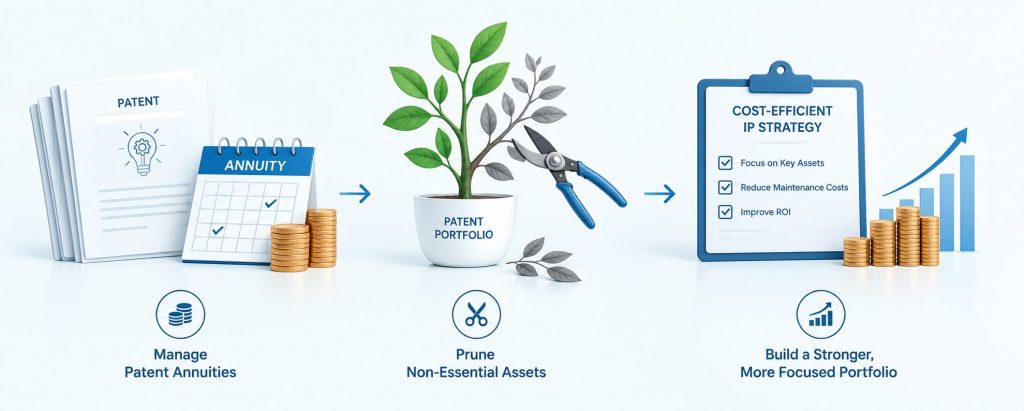
Introduction : Companies usually view a growing patent portfolio as a signifier of progress and strength in their field. However, with each patent, there is an annual cost in the form of annuity payments that rises dramatically as the life of the patent progresses. The cost of maintaining a portfolio increases dramatically as the number of patents grows, particularly in various technologies, industries and countries. The cumulative effect of keeping patents that have no commercial value can be considerable. Leading research conducted worldwide reveals that for a lot of patents granted, the duration of protection is considerably less than the time in relation to which they were granted. The above information, provided by the World Intellectual Property Organization in its World Intellectual Property Indicators 2025 report indicates that the rate of patents retained becomes rather low after the first ten years of the patent. Most patents actually expire before the end of their maximum duration.
The above mentioned trend signifies a smart reaction to the growing cost structure of almost all patenting regimes, India included. Recently, the Indian patenting system was modified in accordance with the Patent (Amendment) Rules, 2024. The new rules were put into effect by the Ministry of Commerce and Industry on March 15, 2024, and involved major changes to the renewal fee structure, the cycle of Form 27 endorsement, and the restoration process. For those companies operating on a budget it is not the matter of whether or not to cut costs, but the method of a cautious budget cutting within the new legal framework. There can be serious consequences for any desperate cost cutting decision, especially since a company may lose an important patent, without which it is impossible to sell a product to the consumers, secure licensing negotiations, or prevent the entrance of the competitors in to a selected market. In this blog the legal regulations regarding patent renewals in India, penalties for infringing them and the approach toward a proper portfolio optimization that takes into account strategic risks and the necessity to economize are discussed.
Legal Provisions
The Patents Act, 1970, which has been amended from time to time, and the Patent Rules, 2003, which have gone through certain changes thanks to the Patent (Amendment) Rules, 2024 govern the Indian patent renewal system. According to Section 53 of the act, the patent will be effective for twenty years after the application date, and if the renewal fee is not paid within the time limit, the patent will cease. The cessation occurs automatically, without requiring any action on the part of the Controller. Section 60 allows for the patentee’s application for restoration during the next eighteen months after the cessation, provided that the default was unintentional and that there was no unwarranted delay. Sections 61 and 62 deal with the general rights of patentee after revalidation and assures the rights of third parties that may have used the invention while a patent was invalid.
The intent of Section 83 is to provide the legislative intent of granting patents in order to stimulate inventions and that such inventions are duly used in India commercially to the maximum extent. While it cannot be termed as a renewal provision, Section 83 is still relevant to the pruning decision because a patent which is not put to use could lose its strategic significance and may also invite compulsory licensing under Section 84 after three years from the date of grant of patency. Section 146 grants the Controller the power to obtain information from the patent holder regarding the commercial use of the patented invention. The Patent (Amendment) Rules of 2024 have amended Rule 131 and introduced a requirement that the statement of working in Form 27 shall be filed once every three financial years instead once the administrative burden on the patent holder has now become lighter.
The 2024 amendment has also introduced Rule 80(1A) which allows for a 10% reduction in the renewal fee where the renewal fee has been paid in advance electronically for a minimum period of four years giving a financial incentive to a patent holder to remain committed in the longer term. Rule 80 lays down the schedule and calendar for the payment of renewal fees, which are due with effect from the lapse of the second year from the date of the grant of patent and every subsequent year thereafter. The First Schedule of the Patent Rules contains the existing fee chart providing for the renewal fee payable by a natural person, a start-up, a small entity, an educational institution, and any other entities at any stage of the life of the patent. Rule 82 states the procedural requirements for filing a restoration application, including the use of Form 15 and the onus of proof on the applicant.
Legal Analysis
The schedule of renewal fees specified in Rule 80 and the First Schedule is designed to escalate over the duration of the patent’s life instead of being a fixed annual fee. The fees associated with later years of the patent are expected to be much higher than the fees from early years of the patent. This approach is in line with a widely accepted objective in patent systems around the world, which is to make it possible for patent holders to give up their rights to inventions that do not have commercial value any longer, thus putting them back in the public domain. According to the publications by the World Intellectual Property Organization, patent fees must be structured in a way that the expense of ownership of the patent gradually increases so high that only the inventions that can generate enough profit remain in the patent system. The Indian system follows this model quite accurately and the discount introduced in the 2024 amendment won’t change the escalation.
By the time the patent reaches its second decade, the cost of renewing it may be as much as the initial filing and prosecution fees themselves, thus obliging its holder to evaluate its worth each year regardless of whether a formal review process is available. A significant difference that companies need to know is about lapse in Section 53 and revocation in Section 64. Even if the lapse is an administrative outcome of a failure to make payments; it can still be restored by means of the restoration procedure provided for in Section 60, revocation can make a conclusion that the patent has never been valid with regard to novelty, inventive step and industrial applicability. But the reversibility of lapse is often overstated. The restoration time in Section 60 is only eighteen months, the applicant is required to show that the non-payment was unintentional, and Section 62 gives permanent protection to any third party who started using the invention during the lapse period.
Thus, the restoration process may not have been very effective, as restoration of the patent does not retroactively protect its owner from competition. It is important to note that the decision of renewal must be made alongside the obligations under Section 83 and 146 Indian patent law requires that patents be worked in India and that they be worked to the fullest extent possible. In general, a patent which is not worked or licensed is not lucrative from any point of view and can even lead the patent owner to the compulsory licensing application under Section 84 after three years of the grant. The new Patents (Amendment) Rules, 2024 made the process more efficient as Form 27 needs to be submitted every three years instead of every year; however, the owner must continue to demonstrate that the patent is worked and this makes the risk of compulsory licensing unchanged in this regard. In this way, the non-worked patent does not generate any income, has obligations regarding compliance, and keeps facing higher renewal fees, thus making itself an excellent candidate for removal from the registry.
India’s yearly renewal mechanism has been simplified due to the introduction of the four-year advance payment discount starting in 2024. In contrast, the maintenance fees in the U.S. must be paid at three pre-defined periods in time, at 3.5, 7.5, and 11.5 years following grant, as mandated by the U.S. Patent and Trademark Office. The American mechanism results in three separate checkpoints corresponding to the usual life cycle of a product. The European Patent Office is operating under the same system as India – an annual payment model with fee increases beginning from the third year. All of these data, available on the relevant governmental websites, confirm that the issue of the pruning is typical for patent systems although the degree of intensity is different in various countries.
Case Laws
In the case of Novartis AG v. Union of India, found in (2013) 6 SCC 1, the Supreme Court scrutinized the issue of whether the beta-crystalline form of imatinib mesylate meets the requirements of patentability based on Section 3(d) of the Patents Act. Though the verdict particularly deals with the matter of patentability, the discussion in the ruling about the concept of patent bargain is critical to understanding the legal principle of increasing renewals. The Supreme Court concludes that a patent can be viewed as a “quid pro quo” whereby a patentee surrenders the exclusive rights to exploit the invention for a consideration in the form of monopoly rights granted based on the information provided and commercial exploitation of the invention. Additionally, the apex court points out that Section 3(d) aims to prevent monopolies through trivial modifications which strengthens the argument about the need for patent renewals. The Court describes as well the balance between private patent interests and the public interest emphasizing that patent system should target more than just private benefit of inventors. Finally, the notes concerning paragraphs 188 – 191 affirm that, under Indian legislation, patent rights are conditional meaning that patentee has to demonstrate the possibility of retaining patent monopoly by means of information dissemination, commercial utilization of the invention, and payment of fees.
In Bayer Corporation v. Union of India, reported at 2014 SCC OnLine Bom 963, the Bombay High Court turned down Bayer’s plea against the issuance of a compulsory license to Natco Pharma for its cancer medication Sorafenib Tosylate (compound of Carboxyaryl Substituted Diphenyl Ureas) sold under brand name Nexavar (patented drug). The court discussed at length the relationship between Sections 83 and 84 of the Act, to find out if the patentee has made the patented creation available to the public at reasonable prices and in sufficient amounts. The Court agreed with the findings made by the Controller to uphold that the patent is not being utilized in the country to the fullest extent possible and affirmed that the public interest in gaining access to affordable medication supersedes the rights of the patent holder in this particular case. The significant portions dealing with the principles embodied in Section 83 and the understanding of the term “worked” according to Section 84(1)(c) must be mentioned in the context of conducting the pruning analysis since they establish that the worth of a patent according to the provisions of the law of India is closely connected with how the patent is being commercially applied in practice.
The patent infringement controversy in Bajaj Auto Ltd. v. TVS Motor Company Ltd. (2009) 9 SCC 797 was addressed by the Supreme Court and revolved around twin-spark plug engine technology. The Court has hinted at the concept of pith and marrow, as well as the limitations of patent law, underscoring the practical importance attached to patent rights and need for effective measures against infringements. The ruling proves that the strategic significance of a patent surpasses the revenues generated from licensing. The patent serves as a barrier for competitors to get to the relevant technology field and allows justifying the costs associated with maintaining the patent yearly, even though patent holders do not benefit from it at all. This highlights how important the trimmed analysis is in indicating that patents should not only be evaluated on their revenue potential.
Practical Implications
It is important for firms to conduct an annual audit of their intellectual property, which is where a company must review every patent it owns against certain business-related criteria. The guidelines on intellectual property published by World Intellectual Property Organization for small and medium-sized enterprises recommend that patents be sorted into tiers on the basis of how valuable they are commercially. According to the guidelines, there are three categories of patents. Core patents are those patents which relate to technologies, products, and processes that are crucial for the operation of a company and should be kept at any cost. Secondly come strategic patents which are important for preventing competitors’ actions, carrying out licensing as well as being valuable assets in the new markets.
To conclude, the final type of patents is known as peripheral patents which incur no costs for their utilization. The newly adopted Patent (Amendment) Rules, 2024 have brought new elements into the process of annual patent review. Specifically, the advantage described in rule 80(1A) stipulates that patent owners may benefit from a 10% discount when paying renewal fees in advance for a period of four years. Moreover, this situation is really attractive in terms of retaining and keeping key patents. At the same time, in the case of patents that are in less favorable situations than others, such an issue must be treated with caution because it leads to the irrevocable payments that cannot be returned in a rapidly changing business landscape.
It must be noted that the most expensive error of pruning is the case when a patent is lost and it turns out to be a very important asset in terms of product range, freedom to operate, or licensing contract. Before approving any patent lapsing, the reviewing committee must establish that there is no output, legal action in progress, licensing agreement operative, or planned introduction of the product onto the market contingent upon the patent. The limitations and ambiguities related to Section 60 restoration mechanism entail that the fallout of wrongly made decision of this kind will be irreversible.
Geographical cutting is usually the most effective way to save costs for corporations that hold international patent families. Patents that cover different jurisdictions may incur hefty renewal costs and if certain markets are no longer profitable or the success of a patent in a certain jurisdiction does not justify its renewal costs, not renewing that patent will make sense. The data provided by the World Intellectual Property Organization and the European Patent Office about national-phase entry and maintenance confirms that geographical cutting is common practice among sophisticated patent owners across the globe.
The amendment passed in 2024 that switched compliance for Form 27 from annual filing to tri-annual filing has lowered the administrative burden of managing the portfolio, which may lead to a small change in the cost-benefit equation towards retention. However, the substantive risk of mandatory licensing of unworked patents persists, and the three-year filing period still necessitates filing proof of commercial working. Before letting a patent lapse, companies must also consider whether the asset can be monetized via a sale, licensing or contribution into a patent pool.
Conclusion
Patent portfolios can be a valuable investment, but if handled incorrectly, they may end up costing money. Indian patents allow for the renewal of a patent each year through the renewal fee set forth in Rule 80, and Section 60 prohibits using the law to retain dormant patents. Patentees must justify the cost of renewing their patents every year, and findings from this study reveal that the great challenge of patent portfolio management is not renewing too many patents, but rather letting go of a patent with value. Although Sections 60 to 62 of the Act provide some security, once a patent lapses all rights are forfeited. As of 2024, the Patent Amendment Rules have lightened the pressures on patentees by offering new strategies to mitigate the problems relating to understanding how much it costs to keep a patent and how to renew it. The World Intellectual Property Organization says that businesses must perform formal, routine annual audits pertaining to their intellectual property, create patent categories, and make renewal choices based on good business principles rather than outdated administrative practices. It would be helpful for businesses if the Indian Patent Office provided greater transparency with lapse and restoration statistics, and the compliance framework is continued to be simplified in line with the 2024 amendment and thus companies can benchmark their portfolios.
Author:- Sainika Saren, in case of any queries please contact/write back to us at support@ipandlegalfilings.com or IP & Legal Filing.
References
- Patents Act, 1970, No. 39 of 1970, §§ 53, 60–62, 64, 83, 84, 142, 146 (India).
- Patent Rules, 2003, Rules 80, 80(1A), 82, 131, First Schedule, G.S.R. 55(E) (India).
- Patent (Amendment) Rules, 2024, G.S.R. 178(E), dated March 15, 2024, Ministry of Commerce and Industry (India).
- Novartis AG v. Union of India, (2013) 6 SCC 1 : AIR 2013 SC 1311.
- Bayer Corporation v. Union of India, 2014 SCC OnLine Bom 963 (Bom).
- Bajaj Auto Ltd. v. TVS Motor Company Ltd., (2009) 9 SCC 797.
- World Intellectual Property Organization, World Intellectual Property Indicators 2023, WIPO Publication No. 941E/23 (Geneva, 2023), available at https://www.wipo.int/publications/en/details.jsp?id=4660.
- World Intellectual Property Organization, Inventing the Future: An Introduction to Patents for Small and Medium-Sized Enterprises, WIPO Publication No. 479E (Geneva, 2006), available at https://www.wipo.int/sme/en/.
- Office of the Controller General of Patents, Designs and Trade Marks, Annual Report 2022–23, Ministry of Commerce and Industry, Government of India, available at https://cgpdtm.gov.in.
- United States Patent and Trademark Office, Maintenance Fees, available at https://www.uspto.gov/patents/maintaining/maintenance-fees (last visited 2025).
- European Patent Office, Renewal Fees, available at https://www.epo.org/en/applying-for-a-patent/costs/renewal-fees (last visited 2025).