Singapore’s AI-IP Consultation and the Future of Copyright and Patent Law
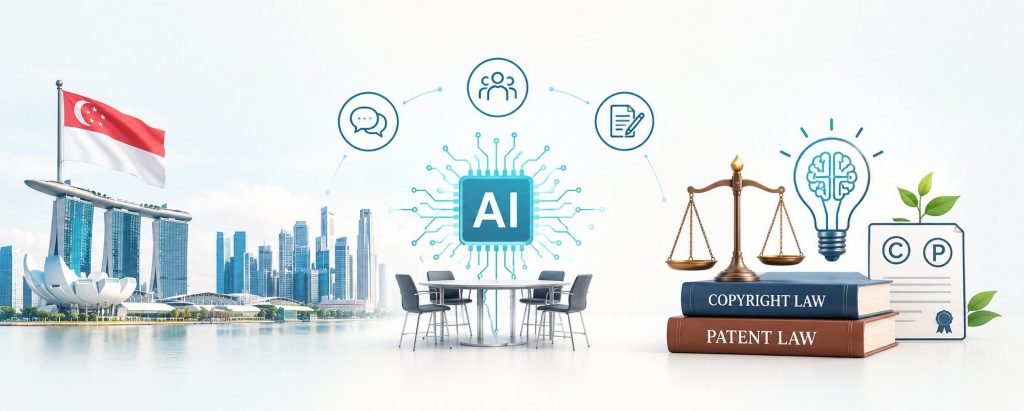
Introduction : Artificial intelligence is no longer merely a tool operating at the margins of intellectual property law. Generative AI can produce text, images, music and software, while AI-assisted systems are increasingly involved in research, technical problem-solving and product development. This creates a difficulty for intellectual property law because the traditional framework is built around concepts such as the author, inventor, creative contribution and human ingenuity.
Singapore has now placed these questions at the centre of its IP policy. On 26 August 2026, the Ministry of Law and the Intellectual Property Office of Singapore (IPOS) launched a public consultation on the impact of AI on Singapore’s intellectual property regime. The consultation, open until 22 October 2026, focuses principally on copyright and patents. It asks how existing rules should operate when AI is used to train models, generate content, assist human creativity, develop inventions or produce technical disclosures.
The significance of this consultation lies not merely in the possibility of future legislative change. It demonstrates that the central question is shifting from whether AI should be accommodated within existing IP law to whether the assumptions underlying that law remain adequate when the processes of creation and invention themselves are changing.
From AI as a Tool to AI as a Participant in Creation
Singapore’s existing IP framework did not emerge in an environment in which machines could generate material resembling human creative or inventive output. Yet its policy approach has historically been designed to accommodate technological development without weakening the incentives that intellectual property provides.
This is particularly visible in Singapore’s Copyright Act 2021. The Act introduced a computational data analysis exception permitting certain copying of copyright works for computational analysis, including machine learning, subject to specified conditions. The material must, among other things, have been lawfully accessed and the copies must be used for the permitted analytical purposes.
When this framework was introduced, it provided a relatively clear legal basis for activities such as text and data mining and machine learning. The difficulty is that generative AI has significantly expanded both the scale and commercial importance of such activities. Training is no longer merely an intermediate research step. It can underpin commercially deployed systems capable of producing competing creative outputs.
The August 2026 consultation therefore asks whether the existing computational data analysis exception remains sufficiently clear and whether its safeguards adequately address contemporary AI training. It specifically raises questions concerning lawful access, rights-holder safeguards and the possible role of technical measures developed by industry.
The issue is consequently not simply whether AI training should be permitted. It is whether the law can provide sufficient certainty to AI developers without allowing the permitted use of copyright material to become disconnected from the interests that copyright is intended to protect.
Copyright Training and the Problem of the Input
The first significant copyright question concerns what happens before an AI system generates anything at all.
Generative AI systems require large quantities of data. Where those datasets contain copyright works, the legal question begins with the act of copying or processing the underlying material. Singapore’s computational data analysis exception already recognises the importance of allowing certain forms of machine learning while requiring lawful access and limiting how copies made under the exception may be used.
The consultation suggests that the Government is examining whether this balance remains appropriate. This matters because lawful access and permission are not necessarily the same thing. A work may be lawfully accessed while being used under an exception rather than through an individual licence. The policy question is therefore whether the existing exception gives rights holders enough practical control while preserving an environment in which AI research and development can occur.
Technical measures may become increasingly important here. The consultation considers whether non-binding technical measures could assist rights holders and AI developers in managing training practices. This potentially moves part of the solution away from an exclusively legal model. Rather than requiring every training use to be determined through litigation or individual licensing, technical standards could help communicate permissions, restrictions or provenance information at scale.
That approach has advantages, but it also raises questions about interoperability and effectiveness. If technical measures are voluntary, their usefulness will depend on widespread adoption. If they become practically necessary for responsible AI development, their effect may extend beyond what the formal legal rules require. The consultation is therefore significant because it recognises that AI-related copyright governance may require cooperation between law, technology and industry practice rather than relying solely on statutory prohibitions.
The Output Problem: Who Bears Responsibility
The second copyright problem arises at the other end of the AI process. An AI system may generate an output that resembles, reproduces or substantially incorporates protected material. The legal question then becomes one of responsibility. Should liability primarily attach to the developer that created the model, the entity that deployed it, or the user who generated and commercially exploited the output?
The Singapore consultation expressly asks how existing copyright principles should apply where AI-generated output infringes copyright and how responsibility should be assessed among AI developers, deployers and end users.
This is important because responsibility in AI systems can be distributed across several actors. A model developer may have no control over a particular user’s prompt or commercial activity. Conversely, an end user may have little understanding of the training processes that produced the model. A deployment company may have greater control over safeguards, but not over the foundational model itself.
A workable framework therefore has to distinguish between different stages of the AI lifecycle. Treating every participant as equally responsible could discourage legitimate AI development and use. At the same time, assigning responsibility exclusively to the end user may leave significant structural risks outside effective regulation.
The consultation’s approach of examining risk management, rather than merely asking whether an output is generated by AI, is consequently important. It focuses attention on the conduct of the different actors and on the technical measures available to reduce infringement risks.
Human Creativity and the Question of Authorship
Perhaps the most fundamental copyright question concerns the status of the human creator.
Traditional copyright law assumes that a protected work results from human creative activity. AI complicates this assumption because the human contribution can range from substantial creative direction to a relatively simple instruction given to a generative system.
Singapore’s consultation therefore asks how human contribution should be understood, recognised and evidenced when generative AI is used as a tool in creative and business workflows.
The distinction between AI-assisted and AI-generated material is particularly important. Where a person uses AI to generate alternatives and then selects, edits, rearranges and substantially develops the material, the human contribution may be easier to identify. The harder question arises where the human input is limited to a prompt and the system independently determines the expressive elements of the final output.
This is not merely an abstract question of whether AI is creative. It determines the boundary of the copyright incentive itself. If protection follows every output automatically, AI could dramatically expand the quantity of protected material without a corresponding increase in human creative labour. If protection is denied whenever AI contributes materially, however, creators who use AI as an advanced creative instrument may lose protection over works involving genuine human creativity.
Singapore’s own academic discussion illustrates the difficulty. Scholarship published in the Singapore Academy of Law Journal has identified the absence of clear criteria for authorship and the separate infringement questions associated with both training inputs and generated outputs. Other scholarship has examined whether AI should be understood as a tool, a genuinely creative participant, or something between those categories.
The consultation’s emphasis on understanding and evidencing human contribution is therefore potentially more useful than simply creating a binary rule of “AI-generated” v. “human-generated”. A contribution-based approach could allow the law to focus on the actual creative process rather than on the mere presence of AI.
Patents: When AI Becomes Part of the Inventive Process
The consultation extends the same conceptual difficulty into patent law, but the problem is structurally different.
Patent law is concerned with inventions rather than expressive works. Singapore’s Patents Act provides that a patent may be granted primarily to the inventor or joint inventors, subject to the statutory rules governing entitlement. At the same time, patentability depends upon requirements including novelty, inventive step and industrial applicability.
AI can now participate in several stages of this process. A researcher may use AI to identify a technical problem, generate possible solutions, test alternatives, or refine an existing invention. The human contribution can consequently be substantial even when AI performs part of the inventive work.
The consultation asks whether existing inventorship principles remain appropriate across these different forms of human-AI interaction and, if clarification is needed, what level or type of human contribution should be sufficient for inventorship.
This is an important distinction. The legal question does not necessarily have to be whether AI itself should become an inventor. A more immediate question is how the law should identify the human inventor when AI has materially contributed to the inventive process.
That approach preserves the function of inventorship while recognising that modern research may not resemble the traditional image of an individual scientist independently developing an invention. The challenge is establishing a meaningful threshold of human intellectual contribution without making patent protection dependent upon an arbitrary measurement of how much work was performed by a machine.
AI-Generated Prior Art and the Patent System
The consultation raises another patent issue that is less visible but potentially more consequential: AI-generated prior art.
Under Singapore’s Patents Act, novelty is assessed against the state of the art, which includes matter made available to the public before the relevant priority date. Generative AI could substantially increase the volume of technical material made publicly available.
That creates two connected problems.
First, AI systems may generate technical disclosures at a scale that makes prior-art searching considerably more difficult. Patent applicants and examiners could face a much larger body of material that must be evaluated for relevance.
Second, the quality of that material may vary significantly. AI-generated technical content can contain incomplete explanations, inaccuracies or internally inconsistent claims. The mere existence of a large quantity of publicly accessible material does not necessarily make that material useful prior art in a practical examination process.
The consultation therefore asks how large-scale publication of AI-generated technical disclosures could affect patent searches, examination, patentability assessments and incentives for innovation.
This issue demonstrates why AI may affect not only the definition of an inventor but also the operation of the patent system itself. If AI increases the quantity of potentially relevant technical disclosures faster than examination systems can reliably evaluate them, the challenge becomes institutional as much as doctrinal.
Rethinking IP Without Abandoning Its Incentive
The consultation should not be understood as evidence that Singapore has decided to replace its existing copyright or patent framework. It is a request for evidence and views on whether that framework remains fit for purpose. The authorities have specifically described the exercise as seeking practical feedback before determining the appropriate policy response.
Its broader significance lies in the fact that Singapore is examining the AI-IP relationship across the entire innovation cycle. Copyright raises questions about training inputs, generated outputs and human creativity. Patents raise questions about human contribution to invention and the effect of AI-generated disclosures on prior art.
This interconnected approach is important because isolated amendments may create new inconsistencies. A rule that makes AI training easier, for example, may increase the quantity of AI-generated content and consequently intensify questions about output protection. Similarly, easier AI-assisted invention may increase the number of patent applications while simultaneously complicating inventorship and prior-art assessment.
Singapore’s earlier IP policy work has already recognised AI as an area requiring continued review, including through its collaboration with the Singapore Management University Centre for AI and Data Governance. The 2026 consultation therefore represents a continuation of an existing policy examination rather than an isolated response to generative AI.
Conclusion
Singapore’s August 2026 consultation marks an important stage in the development of AI-related IP policy because it addresses the underlying assumptions of copyright and patent law rather than merely adding AI-specific rules around the edges.
The most difficult question is ultimately one of attribution. Copyright must determine when human creative contribution is sufficient to justify protection, while patent law must determine when human participation in an AI-assisted process is sufficient to establish inventorship. At the same time, the system must allocate responsibility for AI training and infringing outputs without making innovation legally unworkable.
The consultation does not yet answer these questions. Its importance lies instead in recognising that AI has changed the factual circumstances to which existing legal concepts are being applied.
A durable framework will ultimately have to preserve the incentive function of IP while recognising that creativity and invention are increasingly collaborative processes involving both humans and machines. Singapore’s consultation provides an opportunity to determine how that balance can be maintained without treating technological progress itself as either a justification for unrestricted use of existing IP or a reason to freeze traditional concepts of authorship and inventorship.
Author:- Amrita Pradhan, in case of any queries please contact/write back to us at support@ipandlegalfilings.com or IP & Legal Filing.
References
- Ministry of Law and Intellectual Property Office of Singapore, ‘Public Consultation on Artificial Intelligence and Singapore’s Intellectual Property Regime’ (26 August 2026) https://www.mlaw.gov.sg/public-consultation-on-artificial-intelligence-and-singapore-s-intellectual-property-regime/
- Intellectual Property Office of Singapore, ‘Is it IP as usual? Singapore IP Week tackles the big questions facing IP in the age of AI’ (26 August 2026) https://www.acra.gov.sg/news-events/event-highlights/singapore-ip-week-2026/
- Singapore, Copyright Act 2021, Sections 243-244.
- Intellectual Property Office of Singapore, ‘Can I use copyright works for text and data mining and machine learning?’ AskGov, https://ask.gov.sg/ipos/questions/clglxzrrv00f8l4082ur0u5to
- Singapore, Patents Act 1994, Section19.
- Singapore, Patents Act 1994, Sections 13-14.
- Singapore, Patents Act 1994, Section 14.
- Rajah & Tann Asia, ‘Public Consultation on the Impact of Artificial Intelligence on Singapore’s Intellectual Property Regime’ (September 2026) https://www.rajahtannasia.com/viewpoints/public-consultation-on-the-impact-of-artificial-intelligence-on-singapores-intellectual-property-regime/
- Baker McKenzie, ‘Singapore: Public Consultation on AI and IP Regime’ (31 August 2026) https://www.bakermckenzie.com/en/insight/publications/2026/08/singapore-public-consultation-on-ai-and-ip-regime
- Joshua Yuvaraj, ‘“Does This Unit Have a Soul?” AI-Generated Works, Creativity Research, and Copyright Policy’ (2025) 37 Singapore Academy of Law Journal 710 https://journalsonline.academypublishing.org.sg/Journals/Singapore-Academy-of-Law-Journal-Special-Issue/Current-Issue/ctl/eFirstSALPDFJournalView/mid/503/ArticleId/2150/Citation/JournalsOnlinePDF