Copyright Registration, Ownership and Assignment Issues in India’s OTT Content Ecosystem
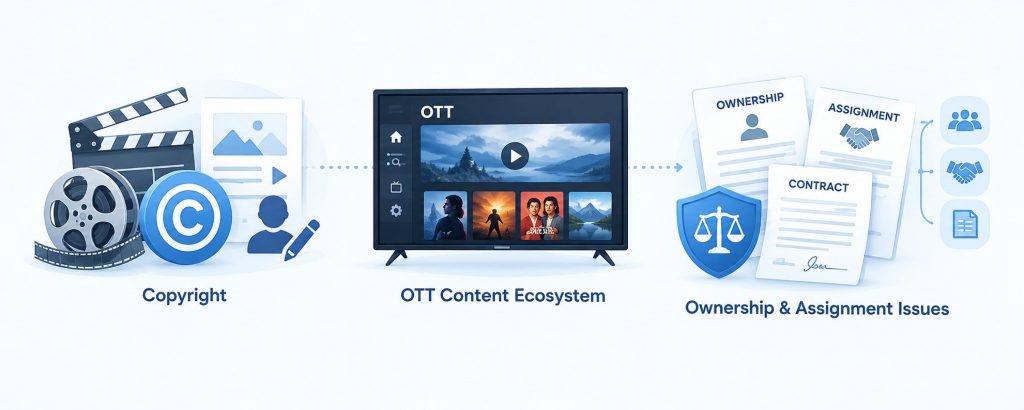
Introduction : An OTT original may appear to be one finished work on a streaming platform, but copyright law sees a much more complicated structure. A web series can simultaneously contain a screenplay, dialogue, music, lyrics, sound recordings, artwork and the final cinematograph film. The commercial contract may then add another layer by transferring or licensing some of those rights to a platform, producer or distributor. Registration therefore becomes less a ceremonial exercise and more an exercise in reconstructing who owns what. Recent Indian cases illustrate why that distinction matters, particularly when exclusive streaming rights have to be demonstrated quickly.
Registration not necessarily the source of copyright
Indian copyright does not arise because a work has been entered in the Copyright Register. Section 13 of the Copyright Act, 1957 recognises copyright in original literary, dramatic, musical and artistic works, cinematograph films and sound recordings, while section 45 permits an author, publisher, owner or other interested person to seek registration. Registration is consequently evidentiary rather than constitutive. Section 48 gives registration entries prima facie evidentiary value in court, which can be commercially important when an OTT platform needs to establish its rights without rebuilding the entire history of a production from scratch.
The distinction is particularly important for streaming-exclusive works. A platform may already possess enforceable rights even without registration, but the party seeking urgent protection still has to prove ownership, title and the scope of its rights. A well-prepared registration file can therefore operate as part of the evidence architecture supporting enforcement. Recent litigation involving streaming content demonstrates how frequently ownership documents, assignments and production records become central to that exercise.
Saregama v. Vels – the finished film does not erase the underlying rights
In Saregama India Ltd v Vels Film International Ltd. the court dealt with the relationship between the cinematograph film and the works incorporated into it. It recognised that copyright in a cinematograph film exists separately from copyright in the underlying works from which the film is made. That distinction is easy to overlook when an OTT production is treated commercially as one package.
Consider a typical streaming series. The producer may be the author of the cinematograph film for the purposes of section 2(d), but the screenplay writer may retain rights in the literary work, the composer rights in the musical work, and separate rights may exist in sound recordings or artistic material. Section 13(4) expressly preserves the separate copyright in underlying works.
The practical lesson for registration is therefore to avoid using a single registration as a substitute for an ownership audit. The application for the completed series should identify the applicant’s status accurately, while the production file should separately preserve contracts concerning the script, music, lyrics, commissioned artwork and other incorporated material. Otherwise, a registration certificate for the finished film may establish one layer of ownership while leaving another layer vulnerable to challenge.
JioStar v. Serialmaza – OTT exclusivity depends on a chain, not a label
In Jiostar India Pvt Ltd v. Serialmaza.My, a case concerning unauthorised online dissemination of films, television content and original web series. JioStar’s case included content that it produced itself as well as content in which it claimed rights as an exclusive assignee or licensee. The court treated the relevant web-series and other audiovisual content as cinematograph films protected under sections 2(f) and 13 of the Copyright Act.
That factual structure captures a recurring OTT problem. The phrase “platform original” does not by itself answer the ownership question. A platform might commission production, acquire a completed programme from an independent production house, obtain an exclusive licence, or receive an assignment of specified rights. Those arrangements can produce different legal positions even where the programme is marketed identically to viewers.
Accordingly, the registration applicant should not merely state that the work is an “OTT original”. It should establish the precise basis on which the applicant claims ownership. If the producer is the applicant, the production agreement should support that position. If a platform claims ownership by assignment, the assignment should be traceable to the party that actually owned the relevant right. If only distribution or communication-to-the-public rights have been acquired, the application and later litigation documents should not silently convert a limited licence into ownership of the underlying copyright.
Section 19 turns the assignment chain into a filing issue
The statutory requirements for assignment make this distinction concrete. Section 19 requires an assignment to be in writing and signed by the assignor or an authorised agent, identify the work, specify the rights assigned, and state the duration and territorial extent of the assignment. It also addresses royalty and consideration.
This becomes especially important with older material incorporated into a new streaming production. Suppose a producer acquires a pre-existing story, commissions a screenplay, licenses music from an existing catalogue and then produces the finished series. The producer cannot safely treat the presence of all those materials in the final episode as proof that every underlying right has moved to it. A registration application should therefore be supported by an intelligible chain showing the route by which each material right reached the applicant.
The point is reinforced by the 2026 Delhi High Court proceedings in Saregama India Ltd v. Ilaiyaraaja. The plaintiff relied on historical assignment agreements from film producers and placed the agreements and detailed schedules identifying films, songs and creators before the court. The court regarded those documents, together with the underlying records, as significant in assessing the plaintiff’s prima facie rights. For OTT businesses, the lesson is straightforward – schedules and annexures are not administrative clutter. They can become the evidentiary bridge between the registered work and the rights claimed over its constituent parts.
Lootere – registration of the film is not registration of the story or title
The Bombay High Court’s decision in Sunil S/O Darshan Saberwal v. Star India Pvt Ltd provides a particularly useful OTT example. The plaintiff relied on copyright registration for the cinematograph film Lootere and on registrations of the title with film-producer associations. A later web series using the same title was released on Disney+ Hotstar. The court distinguished the copyright in the earlier cinematograph film from any possible copyright in the underlying literary work and from claims based merely on the title.
The case demonstrates why filing must identify the right being protected rather than relying on commercial shorthand. Registering a cinematograph film does not automatically establish ownership over every independent work that might have been used to create it. Equally, a title should not be treated as though it necessarily possesses the same protection as the creative work embodied in the film. For a streaming producer, the filing file should therefore distinguish at least the completed audiovisual work from any separately owned script, literary work, music or artwork that has independent commercial significance.
This is also where practical diligence before registration matters. OTT catalogues are frequently assembled through acquisitions, co-productions and commissioned works. A platform that cannot readily identify the source agreement for a particular script or song may discover that the evidentiary weakness becomes more serious when the work itself is being copied online.
Podcasts expose the same problem in a different format
The issue is not confined to web series. In Raj Shamani v. John Doe/Ashok Kumar, the Delhi High Court dealt with unauthorised use and online dissemination of content from the podcast series Figuring Out. The pleadings identified one claimant as the creator and host and another entity as the owner and producer of the podcast series and its audiovisual episodes.
That structure shows how a “single piece of content” can generate different rights positions depending on whether the relevant asset is the episode, the underlying literary material, the sound recording, the audiovisual version, the performer’s contribution or a trademark associated with the show. Registration becomes useful only when the applicant decides exactly which work is being presented to the Copyright Office and on what basis the applicant owns it.
For podcasts that are simultaneously distributed in audio and video formats, this makes record-keeping particularly important. The production agreement should identify ownership of the audio recording and audiovisual version separately where necessary, while the registration strategy should correspond to those legally distinct works rather than treating every manifestation as interchangeable.
The registration form itself should reflect the ownership structure
Rule 70 requires a separate application for each work and prescribes Form XIV and the accompanying particulars. The Copyright Office’s current online system continues to provide separate stages for the application, uploading and payment, with a diary number generated after submission. It also maintains separate categories for deficiencies, applications awaiting work, objections, hearings and the electronic register.
The practical consequence is that an OTT producer should prepare the registration file before release rather than after a dispute begins. The file should contain the final work, the identity and status of the applicant, relevant agreements, author or owner confirmations where required, and a clear documentary explanation of how ownership moved from the creators or original rights holders to the applicant. The Office’s own instructions specifically state that, for cinematograph films, agreements should be enclosed and, where there is no agreement, appropriate no-objection documentation from copyright holders should be obtained.
This is also why a late registration strategy can be unnecessarily fragile. Registration is not a substitute for missing assignments. Nor does the existence of a registration certificate prevent a rights holder from having to answer a credible challenge to the underlying title. It is strongest when the certificate and the contract file tell the same story.
Conclusion
The cases point towards a simple filing discipline. First, identify the legal work or works. Second, identify the author or first owner under the statute. Third, map every subsequent transfer, licence or assignment. Fourth, file the registration in the name of the party whose ownership can be demonstrated from that chain. Finally, retain the underlying documents in exactly the form in which they may later be required in litigation.
This approach matters because streaming magnifies the commercial consequences of ambiguity. In 2025 alone, Indian courts repeatedly dealt with unauthorised streaming, reproduction and communication of films, shows and web series, with right holders obtaining injunctions against online services distributing protected content. The enforcement environment therefore makes a clean rights record more valuable, not less.
The deepest lesson from recent OTT disputes is that copyright registration should be approached as a documentation exercise built around ownership architecture. The streaming platform may be the public face of the work, but the legal identity of that work is layered. A registration strategy that recognises those layers is far better equipped to withstand the question that ultimately matters in litigation, not merely whether the applicant owns the programme, but how the applicant came to own each right it claims.
Author:- Amrita Pradhan, in case of any queries please contact/write back to us at support@ipandlegalfilings.com or IP & Legal Filing.
References
- Saregama India Ltd v. Vels Film International Ltd, CS(COMM) 38/2025, order dated 30 January 2025 (Delhi High Court).
- Jiostar India Pvt Ltd v. Serialmaza.My & Ors, CS(COMM) 810/2025, order dated 8 August 2025 (Delhi High Court).
- Saregama India Ltd v. Ilaiyaraaja, CS(COMM) 143/2026, order dated 13 February 2026 (Delhi High Court).
- Sunil S/O Darshan Saberwal v. Star India Pvt Ltd & Ors, IA-3347-2024-FC, order dated 18 August 2025 (Bombay High Court).
- Raj Shamani & Anr v. John Doe/Ashok Kumar & Ors, CS(COMM) 1233/2025, order dated 17 November 2025 (Delhi High Court).
- Copyright Office, Government of India, General Instructions for Copyright Registration, including requirements concerning agreements and no-objection certificates for sound recordings and cinematograph films https://copyright.gov.in/Copyright_Rules_2013/general_instructions.html
- Warner Bros Entertainment Inc & Ors v. Bolly4U.Tr & Ors, CS(COMM) 442/2025, order dated 9 May 2025 (Delhi High Court).
- Thiagarajan Kumararaja v. M/S Capital Film Works (India) Pvt Ltd, 2018 SCC OnLine Mad 597 (Madras High Court).
- Najma Heptulla v. Orient Longman Ltd, 1989 1 FSR 598 (Delhi High Court).