The IP Behind Virtual Influencers: Who Owns a Digital Persona ?
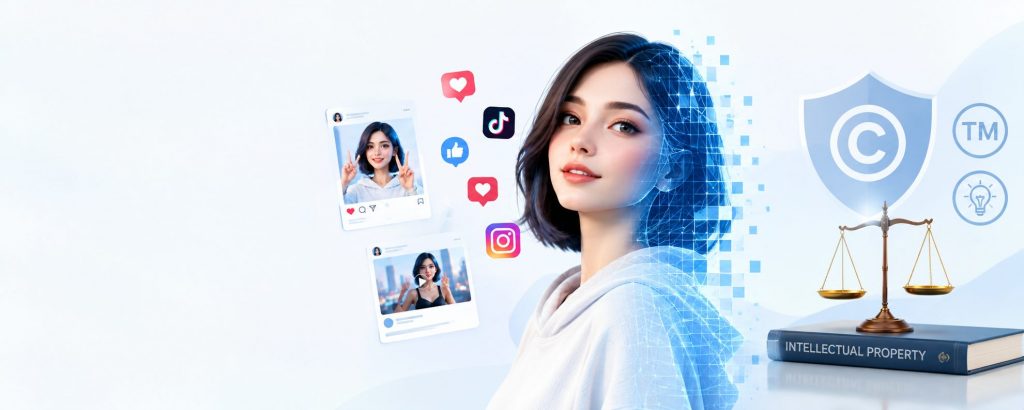
Introduction : The rise of virtual influencers in the digital economy has blurred the lines between technology, intellectual property and entertainment.1 Lil Miquela, a prominent influencer on Instagram has 2.6 million followers. She has signed record deals with music labels and collaborated with brands like Prada and Samsung. Miquela may operate and earn revenue like any human influencer, but she’s a CGI based persona created by a Los Angeles Studio.
Virtual influencers refer to computer generated personas. Like human influencers they create content on social media. But, unlike human influencers who possess enforceable legal rights, digital personas don’t possess any.3 All intellectual property rights and contractual rights associated with these figures belong to the companies that control them. This article argues that while Indian law offers strong protection to Intellectual Property owners, it fails to provide unified protection to virtual influencers.
Main Blog
The multiple authors dilemma
Virtual influencers are usually the work of multiple contributors. Typically, production involves animators, voice artists and writers. Under Section 17 of the Copyright Act, 1957, authorship is awarded to individuals that have produced creative work (or their employer if it is produced during employment). The legal challenge arises as virtual influencing is a multi-author process. Different copyrights may be awarded to different people for the music, character design and script. This can be avoided if the company enters into agreements with each contributor to assign or license their copyrights. Since this process is secure but expensive, it is usually undertaken by resource-backed corporate entities.
AI and authorship
The Indian Copyright Act, 1957 was not catered towards artificial intelligence. Section 2(d)(vi) of the Copyright Act, comes close to addressing AI, as it explains “computer-generated” works. It treats the person who creates the work as the author.6 Experts argue that this provision was introduced for outputs produced by human-controlled programs and not generative AI models that only require prompts. They believe that current computer centric legislations fall short and dynamic AI focused laws are needed to address the problem. Consequentially, Indian IP Law has struggled to explain if prompt-based AI output satisfies the originality requirements under Indian copyright law.7
In the past, the Copyright Office has refused AI ownership and has required applicants to disclose AI usage in their works. It is expected for a studio building virtual influencers using Artificial Intelligence to assume that some of their output may not be legally protectable.8 They should instead build their commercial strategy and brand partnerships focusing on the copyrightable aspects (original dialogues or human designed sketch)
Trademark as an alternate legal protection
Due to the uncertainty of copyrights, trademarks are considered as the practical choice for virtual influencers. A virtual influencer’s name, logo and catchphrase can be registered as a trademark under the Trade Marks Act, 1999.9 This is the same as a human influencer trademarking their identity. It gives the corporate entity controlling the virtual influencer rights against infringement. Registered trademarks can also be commercially licensed easily.
Personality rights for virtual influencers’
Celebrities have long relied on personality rights to protect their “human-ness” or uniqueness. Legal precedents in India, like the ones in the Delhi High Court have continued to recognised personality rights.10 In, Anil Kapoor v. Simply Life India & Ors. (Delhi High Court, 2023) the Court stopped all unauthorised use of Anil Kapoor’s identity, including AI-generated.1 Personality rights are centred around individual autonomy, a trait that virtual influencers lack. Any uniqueness that comes from their personality, can be attributed to the algorithms controlling them. In certain cases, digital personas are modelled after real-life celebrities. Here, the celebrity’s personality rights would extend to the digital persona. Any studio that desires to make such a persona in India would need a personality right’s license or express consent from the celebrity.
Endorsement liability
Indian Laws treat influencers as commercial actors. The “Advertising Standards Council of India” requires transparency from influencers when their content is a paid partnership.12 Since there are no separate guidelines for their virtual counterparts, they are expected to abide by the same rules. The Central Consumer Protection Authority’s guidelines against misleading advertisements also extend to virtual influencers. 13 When a virtual influencer promotes a brand by making a false claim, the brand cannot escape liability simply because the spokesperson responsible isn’t human. If brands create virtual influencers that resemble celebrities they may at times, face personality rights infringement claims. When AI is used to generate a virtual influencer’s content, the output may contain copyrighted elements like clothing designs, background or even dialogues. Such a reproduction could lead to copyright claims.
Both brands and studios must exercise reasonable caution using virtual influencers for commercial purposes. They should utilise legal safeguards like trademark protection and commercial contracts to reduce risks.
Conclusion
Just like human influencers, virtual influencers can generate real revenue and gain audience trust. Indian law gives the companies that operate them three tools: copyright over creative work, trademark over the person’s name and characteristics and personality rights, when needed. But none of these “tools” were designed with AI-generated personas in mind. Such a gap in legislation and practical requirements makes it weak in terms of protection. Until legislation or the judiciary catches up, the strongest protection available to anyone building or commercialising digital persona is with contracts. Through assignment, disclosure and licensing agreements, owners of digital personas and brands can safely practice their work.
Author:- Mahulbonee Biswas, in case of any queries please contact/write back to us at support@ipandlegalfilings.com or IP & Legal Filing.
References
- Mudit Kaushik, Unreal Humans but Real Laws—A Saga of Virtual Influencers, Fashion Law Journal (Dec. 28, 2022) — https://fashionlawjournal.com/unreal-humans-but-real-laws-a-saga-of-virtual-influencers/
- Sunidhi Bansal, Comment: Does the IP Regime in India Need to Change with the Evolution of the Virtual Influencer?, ALG India Law Offices LLP (June 10, 2021) — https://www.algindia.com/comment-does-the-ip-regime-in-india-need-to-change-with-the-evolution-of-the-virtual-influencer/
- Ranjan Narula & Swati Dalal, Inside India’s Legal Playbook for Influencers, Managing IP (Oct. 16, 2025) — https://www.managingip.com/article/2fgqzf9zgtfdtbs9n4lc0/sponsored-content/inside-indias-legal-playbook-for-influencers