Model Weights, Checkpoints and Ownership under Indian IP Law
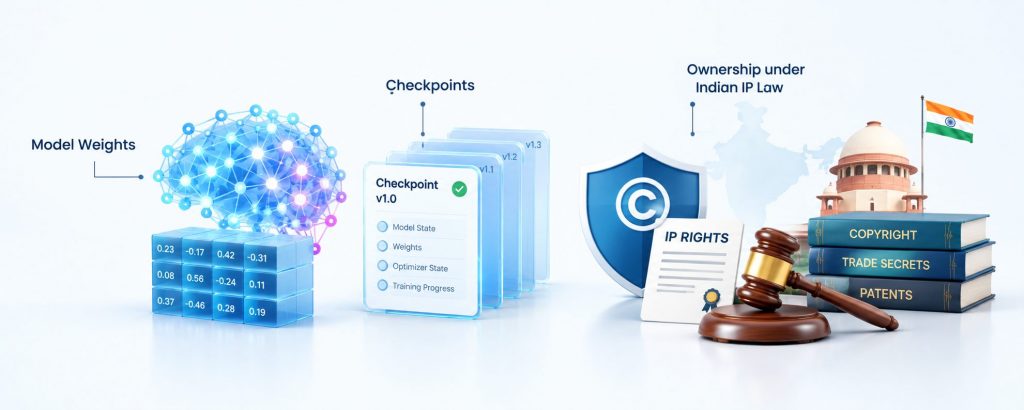
Introduction : The trained LLM is essentially a large file of numbers: billions of floating-point parameters organized into layers, which are optimized over large amounts of data through many iterations and great computing costs. While the source code used to train the pipeline and infer from the model may be one of the most valuable assets of an AI company, it can often be the model weights themselves, and the checkpoints that preserve their state at different points of the training, that’s most commercially valuable. But Indian intellectual property law, which is focused on categories developed for literary works, mechanical inventions and tangible databases does not cater for this sort of asset and none of the doctrinal boxes in which the law operates is quite fitting for the weights file.
This article will discuss the protectability of model weights as a copyrightable software, as a database, as a patentable technical contribution and/or as a confidential information and trade secret under Indian laws. It subsequently addresses the ownership dilemma that arises with the creation of weights from a combination of employees, independent contractors, open-source parts, and cloud infrastructure, and ends with an ownership checklist for Indian AI companies.
Legal Provisions
Copyright Act, 1957
Computer programmes, tables and compilations, such as computer databases, fall within the definition of literary works in Section 2(o) of the Copyright Act, 1957, and Section 2(ffc) of the Copyright Act, 1957 gives a definition of a computer programme as a set of instructions expressed in words, codes, schemes or in any other form, which can be used to cause a computer to perform a particular set of operations. Originality of literary work is recognized under Section 13(1)(a) and this means some modicum of creativity in selection or arrangement which is not merely ‘labour’, as the Supreme Court has explained in Eastern Book Co. v. D.B. Modak. First ownership of a work created by the employee pursuant to a contract of service belongs to the employer unless the parties have agreed otherwise.
Patents Act, 1970
A mathematical method, a business method, a computer program per se, or an algorithm is not a patentable invention because of the exception provided by Section 3(k) of the Patents Act, 1970. In the case of Ferid Allani v. Union of India, the Delhi High Court ruled that this exclusion does not apply if the invention is implemented on the software, but also has a further technical effect or contribution, a view that was later reiterated in the Guidelines for Examination of Computer-Related Inventions issued by the Controller General of Patents, Designs and Trade Marks in 2025.
The Absence of a Trade Secrets Statute
There is no single law in India to deal with trade secrets. Confidential business information is protected under the common law action for breach of confidence, the Indian Contract Act, 1872 and under India’s TRIPS obligations to protect undisclosed information with commercial value under India’s obligations under Article 39 of TRIPS. The Bombay High Court in Beyond Dreams Entertainment Pvt. Ltd. v. Zee Entertainment Enterprises Ltd. has laid down the three-part test: the information must have been communicated or acquired under an “importing obligation of confidence,” it must have the requisite quality of confidence, and there must have been unauthorised disclosure or use of it. While the 22nd Law Commission of India’s 2024 report on trade secrets and economic espionage is pending, there is a draft Protection of Trade Secrets Bill, 2024 available.
Legal Analysis
Copyright’s Uneasy Fit
Model weights are a burden on the copyright law both ways. Weights are not instructions in the traditional sense; they are numerical parameters that are learned by a computer programme and are used by a separate programme and independently copyrightable for inference (inference engine) to give the output. This is an issue that has not been tested in India, whether a weight file would be considered as an extended definition of a computer programme or whether it would be considered as an expression of raw data without expressive quality to which copyright protection would apply. As a compilation or database, it is weaker still: the Eastern Book Co. standard requires a certain creative selection or arrangement of the constituent parts; the selection of weights along the lines of a neural network architecture is a function of the training algorithm and the optimisation process rather than of any creative skill or judgment of the author. One possible explanation is that the copyright does not cover the parameters themselves, but rather the surrounding code and architecture definitions and documentation.
Patent Exclusion and Its Limits
The weights are not an algorithm but rather the result of training; they are not a device, but rather the result of training a given device with a known algorithm; they are close to the algorithm exclusion under 3(k). The post-Ferid Allani framework would allow a specific technical application, created using the weights, to be separately patentable, e.g., a system which provides a demonstrated improvement in a specific defined technical field, but not the weights as such, nor even where a related invention is patentable, without full disclosure of the training methodology in the specification, the commercial secrecy that gives the weights their value in the first place would be extinguished.
Confidential Information as the More Natural Fit, and Its Limits
The doctrinally more comfortable fit for model weights is the doctrine of trade secret, which does not require originality or a fixed expressive form but only that the information be secret, that it be disclosed under an obligation of confidence and that it be misused. A weights file that is controlled, under non-disclosure agreements, and is restricted in terms of deployment may meet each element. The problem with this is, however, behavioural replication: if a competitor doesn’t download the weights file itself but rather gets access to a deployed model to the degree that it can train a model that is comparable, e.g., by distillation or extraction, there is no direct breach of any obligation of confidence, as no confidential information was communicated or acquired in the relevant sense. However, it offers a high level of protection from insiders and contractual counterparties, but less protection against arm’s-length competitors, who are able to deduce capability from behaviour seen, rather than directly obtained.
Ownership Questions in AI Development
Employees
If the models are created by an employee during the course of their contract of service, then copyright in any copyrightable elements will be automatically owned by the employer under Section 17(c) of the Copyright Act. Unlike patent law elsewhere, there is no default in Indian law for an employer to claim any patentable contribution in the context of training and again, an explicit broadly drafted IP-assignment clause is crucial, not optional, for an employer to claim any patentable contribution arising from the training process.
Independent Contractors and Consultants
Independent contractors will reverse the position. Under Section 17(b) of Copyright, the commissioning exception applies only to certain types of works, e.g., photographs, paintings and cinematograph films, but not to software or model development in general. Without the existence of a written deed of assignment, the contractor hired to create a training pipeline, curation of datasets or fine-tuning of a model still owns the work, and the commissioning company therefore only has an implied licence, whose scope is often not exactly defined. Therefore, any contractor engagement that is connected in one way or another with the development of models should also contain a clear, present assignment of all IP that the contractor develops during the engagement, and not just a confidentiality clause.
Open-Source Components
Most AI companies in India develop models, training algorithms or datasets, which are open-source with their own license conditions. Copyleft licenses may require the disclosure of, or redissemination of, a disclosure or redistribution that conflicts with the protection of weights as confidential information, especially when the terms of the disclosure or redistribution in the copyleft license conditions apply to a derived or fine-tuned version of a base model. Companies have to keep a running list of all open-source components that they’ve used in a model and an ongoing evaluation of whether those components’ licences remain in effect in the refined model, since a breach of the licence on the original component can lead to the compromise of the confidentiality or clean-title nature of the finalised model, despite any contractual protections that the company has separately developed around it.
Cloud and Compute Providers
While training large models is often a cloud-based task, the typical terms and conditions of use for cloud and compute services often cover such wide-ranging issues as who owns the content used on or processed through the cloud service, how content can be fed back to the provider to improve their model, or the residual rights of the cloud service provider to use the customer’s content to develop its own model. Even before development starts, an AI company could lose control of its weights if a provider’s terms are vague, non-existent or that they own the training output. Cloud agreements should clearly define and reaffirm the ownership of models, weights, and checkpoints developed using a customer’s platform, and should limit provider access, retention, and use of training data and outputs to what is essential for providing computer service.
Ownership Checklist for Indian AI Companies
- Make wide, present tense IP-assignment clauses with all employees, including models, weights and checkpoints, fine-tunes and any related patentable contribution, rather than a general confidentiality agreement.
- Get a written deed of assignment from any independent contractor or consultant before development work is initiated in order to prevent the default copyright ownership basis from remaining with the contractor.
- Keep an inventory of open source models, frameworks and datasets used to train at the component level and include the licence terms and any copyleft and redistribution obligations for each.
- Examine TOS of cloud and compute providers with a particular focus on clauses that impact ownership of content, feedback rights or residual use of training data, and negotiate explicit ownership carve-outs as necessary.
- From the start, treat the weights as confidential information: access them only as needed; record access to the weights; have NDAs with all parties who access the weights or the training pipeline.
- Keep the training pipeline, data provenance, model lineage and other records in sync – this will become very important evidence in future cases of breach of confidence or ownership dispute.
- If a technical contribution based on the weights is patentable, consider whether to disclose and then patent, or to continue protecting as confidential information.
- Ensure that all API and licensing agreements of deployed models include contractual protection against model extraction, distillation, and reverse-engineering, as well as against confidence-based protection.
Conclusion
Model weights are not easily classified as being either protected by copyright or patentable, nor are they sufficiently protected by a trade secret regime that, like copyright and patent, is neither based on legislation, nor is it a straightforward and universally applicable doctrine. The most achievable legal basis today is confidential information protection, which is supported by the Beyond Dreams test, but relies on the contractual and organisational discipline a company can create around its weights, whether that means assigning employees and contractors or open-source licence hygiene, or cloud provider terms. India’s AI businesses will have to guard the ownership of AI instead of relying on the law to provide it, until there is a dedicated trade secrets law that exists in the country.
Author:- Prince Lucky Jain, in case of any queries please contact/write back to us at support@ipandlegalfilings.com or IP & Legal Filing.