Who Owns What When Hardware Goes Open Source?
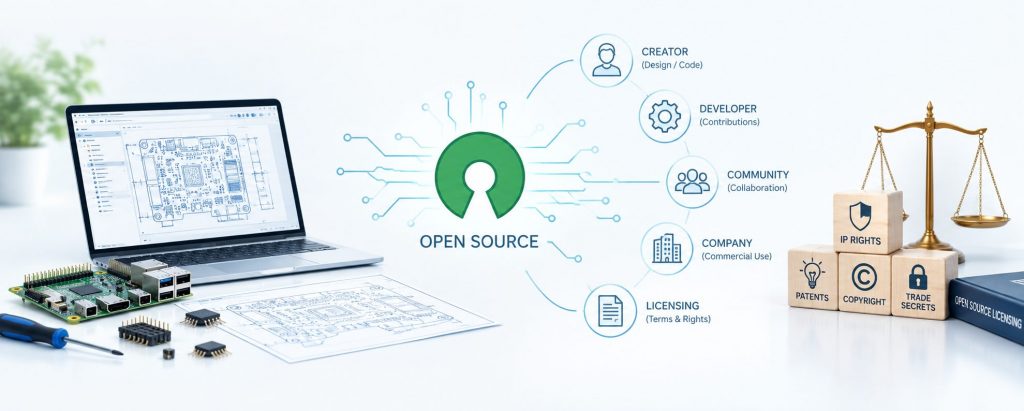
Introduction : Open-source hardware (OSH) projects let communities design, build, and share physical devices in the open. However, while in case of open-source software, copyright plays the major part from the legal perspective, the ownership in hardware becomes divided among several laws such as copyright in the case of the design file, design right in relation to the look of the product, patent in relation to the way it functions and even trade secret in relation to manufacturing process. This fragmented ownership has been overlooked by governing legislations such as the Copyright Act, 1957, the Design Act, 2000 and the Patents Act, 1970.
As a result, there are ambiguities about ownership, work rights, modification requirements and distribution in Indian maker communities, hardware start-ups and educational institutions operating in an OSH environment. To overcome the deficiencies, specific hardware licenses have been developed – such as CERN Open Hardware License (CERN – OHL), TAPR Open Hardware License and Solderpad License which combine copyright, design and patent provisions in one license. Nevertheless, these licenses do not always comply with statutory Indian laws especially when it comes to patent retaliation clauses and novelty requirements of the Designs Act. This article will clarify all these issues and provide practical recommendations for Indian maker communities and hardware start-ups.
Legal Provisions
Copyright in Design Files and Documentation Under the Copyright Act, 1957
The Copyright Act, 1957 provides protection to “original literary, dramatic, musical and artistic works” under Section – 13, which includes design files, schematics, PCB designs and technical documentation as literary or artistic works. Under Section – 14, “the author of a literary, dramatic, musical or artistic work has the following exclusive rights,” i.e., to reproduce, publish, perform and adapt the work. In the case of the OSH project, design files are original literary (in terms of source code and schematics) and artistic (in terms of visual representations) works covered under the protection of copyright automatically upon creation without registering the same. However, as per Section – 51 of the Copyright Act, 1957, “the doing of any act in relation to a literary, dramatic, musical or artistic work after the expiration of the period of copyright therein shall not be an infringement of copyright in the work.” Further, Section – 64 allows the use of any patented invention or copyrighted work for public purposes.
Design Rights: Ornamental vs. Functional Under the Designs Act, 2000
The Designs Act, 2000 defines “design” in Section 2(d) as “features of shape, configuration, pattern, ornament or composition of lines or colours applied to any article, whether in two dimensional or three dimensional or in both forms, by any industrial process or means, whether manual, mechanical or chemical, separate or combined, which in the finished article appeal to and are judged solely by the eye; but does not include any mode or principle of construction or anything which is merely functional in character.” This results in an important bifurcation in that the design features can be registered and protected while functional features do not fall within the purview of the Act. Section 5 of the Act says that the design should be new or original whereas Section 6 says that the design should not have been published in India or anywhere else before the date of application. Important here is Section 15 of the Act where it is said that any design registered under the Act shall not be deemed to be infringed if features of shape and configuration required by the function to be performed by the article are used. In case of OSH projects, the layout of the circuit boards, component placements and structures that are necessitated for engineering cannot be design-right protected.
Patent Eligibility and Anti-Evergreening Under the Patents Act, 1970
Section 48 of the Patents Act, 1970 grants investors exclusive rights to make, use, and sell patented inventions, subject to statutory exclusions in Section – 3. Section 3(d) excludes from patentability “the mere discovery of a new form of a known substance which does not result in enhancement of the known efficacy of that substance, or the mere discovery of any new property or new use for a known substance or of the mere use of a known process, machine or apparatus unless such known process results in a new product or employs at least one new reactant.” Strictly constructed by Indian courts, this section does not allow “evergreening” and demands technical progress. Section – 47 and 48 relate to infringement of patents, whereas Section 107A and 107B (added to the Patents Act, 1970 via Patents (Amendment) Act, 2002) cover compulsory licensing. In the case of OSH projects, patents may be granted on new processes, components, or methods of manufacturing if such developments meet the definition provided by Section 3(d) despite the fact that the criteria set forth here are very stringent.
International Frameworks
The Berne Convention (1886) and the TRIPS Agreement (1994) both premise copyright protection on human creativity and are silent on the licensing of functional hardware design. This gap has been filled by hardware specific licenses, primarily the CERN Open Hardware License 2, the older TAPR Open Hardware License, and the Solderpad License, each of which defines rights to “Make” physical products and convey them.
Legal Analysis
A Patent retaliation clause in hardware licenses effectively asks a licensee to give up part of their statutory right to sue under Section 48 in exchange for using the license. The doctrine of “patent hold-up”, wherein a licensor threatens to terminate patent rights to coerce settlement, is recognized internationally as anti-competitive and contrary to fair dealing principles. However, Indian courts have not yet directly addressed the enforceability of patent retaliation clauses in hardware licenses. The Supreme Court in Monsanto Technology LLC v Nuziveedu Seeds Ltd., (2019) 3 SCC 381, which examined the interplay between patent rights and statutory exclusions under the Seeds Act, suggests that courts will scrutinize contractual restrictions on statutory IP rights. A retaliation clause might be enforceable as a voluntary contractual undertaking by the makers as the licensee accepts the risk of termination by accepting the license, but a court might also view it as an unreasonable restraint on the licensee’s right to defend against infringement allegations or to challenge patent validity.
According to The Designs Act, 2000, the design needs to be “new or original” and it should not have been “published in India or elsewhere before the date of application” (Section 6). In OSH projects, design files become public from the start and thus this makes the process contradictory and therefore fails to meet the requirement under Section 6 of The Designs Act.
Secondly, there is no clear explanation in The Designs Act with respect to derivative designs or modifications. Suppose, if the community contributors make any modification in the OSH design and try to register the design then according to the act, the modification should be a “new or original” design. There is no clarity given in The Designs Act with regard to the derivative design which is based on the open-source design in order to fulfill the novelty requirement. Thus, it places an obligation on the part of the licensees modifying the designs to ascertain whether the modified designs can pass the novelty test or not.
Since copyright only protects the design documentation and not the functional article, the open-source hardware license has to provide for an explicit right to manufacture. The Copyright Act, 1957 does not expressly provide for “moral rights” as recognized by international conventions such as Berne Convention. However, Section 57 of the Copyright Act gives authors the right to claim authorship and to disapprove any distortion, mutilation or modification of the work which is prejudicial to his or her honor or reputation. Hardware licenses such as CERN-OHL and Solerpad require the licensee to maintain attribution notices and to mention any modifications made to the work, thereby implementing the moral right through a contract. In the Indian context, the same is enforceable under general contract law, although independent of Section 57 since the latter applies only to copyright infringement. A licensee who removes the attribution notices or represents the modified works as original may breach the terms of the hardware license without actually infringing on the copyright under Section 57.
Relevant Case Laws
Novartis AG v Union of India, (2013) 6 SCC 1
The Supreme Court applied scrutiny to Section 3(d) of the Patents Act, holding that “evergreening”, obtaining patents for mere crystalline form changes or new uses of known substances without genuine efficacy enhancement, violates the statutory exclusion. It was clarified by the Court that the protection of patents can only be granted to technical advancements, not for any minor changes and modifications. In terms of OSH projects, this case establishes that protection for hardware advancements through patents will only be allowed if the advancements reflect real technical advancements compared to what has already been made.
Bajaj Auto Ltd. V. TVS Motor Co., (2009) 9 SCC 797
The Supreme Court distinguished between ornamental and functional design elements, holding that purely functional features of an article are not registrable under the Designs Act, 2000. In this case, the Court clearly stated that protection under design rights is possible only for those components that appeal to the eye and can be evaluated only from an aesthetic perspective. It means that components that serve as necessary structural or functional parts of the object and are required for its proper functioning cannot be protected under the design right. Such a precedent is especially important for OSH projects, such as.
Qualcomm Inc. v. Federal Trade Commission, 969 F.3d 974 (9th Cir. 2020) (U.S.)
The Ninth Circuit held that patent holders cannot use patent threats or licensing practice. The Ninth Circuit held that patent holders cannot use patent threats or licensing restrictions to course unfair terms or to prevent licenses from challenging patent validity. The Court recognized that patent retaliation clauses and similar provisions can constitute patent misuse and antitrust violations. While Indian courts are not bound by U.S. precedent, this reasoning aligns with Indian competition law principles and fair dealing doctrine, leaving a scope for the Indian courts to similarly scrutinize patent retaliation clauses in hardware licenses.
Practical Implications
For Indian hardware startups, the fluidity and multi-layered nature of IP in the hardware sector poses an enormous transactional risk. The start-ups need to investigate which license applies to their design and what are the different licenses required for each layer of the project such as schematics, firmware, enclosure, documentation, etc., and whether there is a patent retaliation clause or not. The start-ups also need to make sure that they register the design before public disclosure of the same to avoid the designs losing their novelty under the Designs Act, 2000.
To start with, the protection for designs under design right does not apply to the OSH designs as the disclosure to the public leads to the loss of novelty. The second issue lies in the form of patent retaliation clauses in the hardware licenses which leave the licensee with a choice either to risk losing the patent protection if he sues someone or forego the license as well as the patent grant. The third problem could be that of cascading license obligations which might not be binding on the recipient under the Indian laws.
In order to solve the abovementioned problems, there must be a certain form of governance in Indian maker communities which the author thinks should include the following: (1) the existence of mechanisms for attribution and modification tracking based on Section 57 of the Copyright Act and hardware license attribution rules; (2) a certain patent strategy that distinguishes those inventions which are patentable in accordance with Section 3(d) from those that have to be copyrighted or kept as a trade secret; (3) contract rules regarding derivative works concerning the licensing of modifications with the hardware license; and (4) governance in the community related to design, modification, and attribution.
Conclusion
Open-source hardware is not governed only by copyright laws. One needs to govern copyright laws in relation to files, design laws in relation to appearances, and patents in relation to functionality, all at once in a particular project. In India, there exists an incomplete set of laws for governing open-source hardware through the Copyright Act, the Designs Act, and the Patents Act, leaving gas in terms of retaliation clauses, novelty timing and downstream obligations.
Until Indian courts tests these questions directly, Indian maker communities and hardware startups should treat license choice and governance documentation as their main protection it is advised that the Indian maker community and hardware startups rely on choosing the right license and document their license choice as their principal method of protection.
Author:- Devyani Kulsange, in case of any queries please contact/write back to us at support@ipandlegalfilings.com or IP & Legal Filing.
Endnotes
- The Copyright Act, 1957, No. 14 of 1957 (India), § 13.
- The Copyright Act, 1957, § 14.
- The Copyright Act, 1957, § 51.
- The Copyright Act, 1957, §.
- The Designs Act, 2000, No. 16 of 2000 (India), § 2(d).
- The Designs Act, 2000, § 5.
- The Designs Act, 2000, § 6.
- The Designs Act, 2000, § 15.
- The Patents Act, 1970, No. 39 of 1970 (India), § 3(d).
- The Patents Act, 1970, § 48.
- The Patents Act, 1970, §§ 107A–107B.
- Berne Convention for the Protection of Literary and Artistic Works, Sept. 9, 1886, 1161 U.N.T.S. 30 (as amended).
- Agreement on Trade-Related Aspects of Intellectual Property Rights, Apr. 15, 1994, Marrakesh Agreement Establishing the World Trade Organization, Annex 1C, 1869 U.N.T.S. 299 (TRIPS Agreement), Arts. 9–14 (copyright), 25–26 (designs), 27–34 (patents).
- Monsanto Technology LLC v. Nuziveedu Seeds Ltd., (2019) 3 SCC 381.
- Novartis AG v. Union of India, (2013) 6 SCC 1 (India)