AI-Generated Product Designs and Industrial Design Registration: Rethinking Authorship, Novelty, and Ownership in the Age of Generative Design
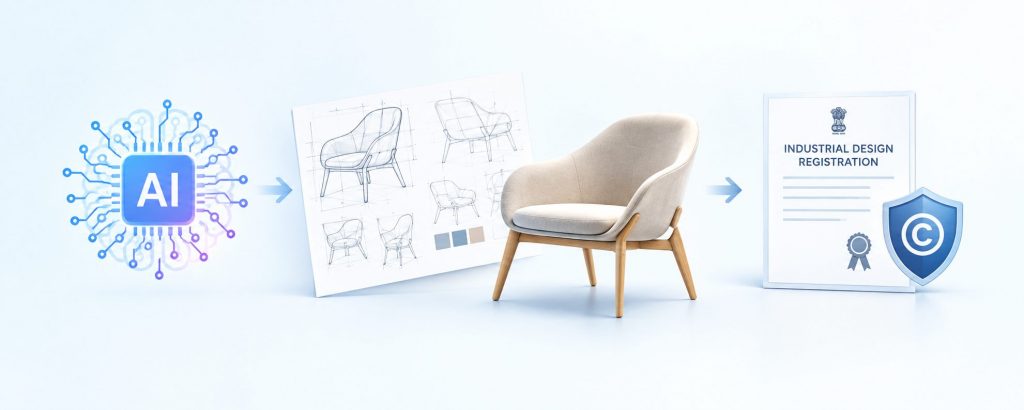
Introduction : Design tools that use generative methods, such as the AI assisted CAD add ons, parametric engines, and image generators, can produce many product form options in a few minutes. With one prompt, you can get dozens, sometimes hundreds, of different shapes, layouts, or surface looks. Furniture forms, casings for consumer electronics, packaging layouts, and even interface visuals can be made, adjusted, and checked faster than before. What used to take teams weeks of sketching, review, and revisions are now done in a short cycle. This change is already affecting how products are being made in the furniture, electronics, and packaging fields. It also shows gaps in the Indian rules for industrial design registration.
A key problem in this is attribution. If a person writes the prompt and chooses what to keep, yet the exact look is produced by the AI system, who should be treated as the author. Who should be seen as the proprietor with the right to apply for registration under the Designs Act, 2000. As studios and makers fold these tools into early design work, the answer changes outcomes in a direct way. It can decide whether new product forms can be registered, whether they can be used in enforcement against copying, and whether they can be sold without major legal risk.This piece looks at the legal rules in India that deal with who can claim proprietorship and what counts as a design that can be registered. It also covers the threats that AI assisted creation creates for both novelty and disclosure. It then turns to how contracts can split or assign ownership when people use generative platform terms. Lastly, it explains why design protection in this area has a smaller and more limited role than the protections offered by copyright and patents.
Legal Provisions
The Designs Act, 2000 (India) : Section 2(d) of the Designs Act, 2000 says a “design” means the look of an article, like as its shape, configuration, pattern, or the way lines or colours are arranged. It also says the look must be made by an industrial process and judged only by what the eye sees.Section 2(g) adds a rule for “original.” A design is original when it comes from the author of that design. It also covers cases where a familiar design is used on a new article for the first time .Section 2(j) explains who a “proprietor” is. It is the person for whom another person makes the design in return for payment. It is also the person who gets the design through an assignment. On its face, this wording does not treat a design as something made on its own by a machine. It reads like a design is commissioned or created by a human.
Section 4 explains the cases where a registration has to be refuse and One case is when the design is not new or is not original. It is also refused if the design was made public anywhere, in India or outside India, before the filing date and Another reason is when the design is too close to other known designs. If the design is scandalous or obscene, that is a ground for refusal too. Section 5 requires an application to be filed by “any person claiming to be the proprietor” of a new or original design. Section 21 sets out a limited exception to this. Even if there was an earlier exhibition, registration can still be allowed. Still, the Controller must be given formal notice. The application also has to be filed within six months after the exhibition.
Relationship with the Copyright Act, 1957 : Section 15(2) of the Copyright Act, 1957 says that copyright in a design that can be registered under the Designs Act ends after an article with that design has been made by an industrial process more than fifty times. This sets a clear limit between the rules for designs and the rules for mass manufacturing. Section 2(d)(vi) of the Copyright Act also deals with computer-made work. It puts authorship with the person who makes the work. But the Designs Act does not include a similar rule. Because of that, ownership of a design made with help from AI is left to how Sections 2(j) and 5 are read. There is no extra guidance in the Designs Act the way there is in the copyright law for computer-made works.
International Framework: The WIPO Hague System : The Hague Agreement on the International Registration of Industrial Designs is run by the World Intellectual Property Organization. It lets someone file one international application and ask for protection in several contracting states, such as India. Under the Common Regulations in the Hague system, the applicant must be named as either a natural person or a legal person. This rule was written long ago, before generative AI tools were available. The rule also does not spell out what to do when the exact look of a design is made by a machine on its own. Because there is no clear help at the international level, the same problem shows up at home. It also makes the issue under the Designs Act even harder to handle.
Legal Analysis
The Proprietorship Vacuum for AI-Assisted Designs : The Designs Act does not spell out a rule like Section 2(d)(vi) in the Copyright Act. Because of that, it is not clear who should count as the “proprietor” under Section 2(j). It could be the person who wrote the prompt. It could be the developer of the generative AI system. Or it could be the party that paid for the design. No Indian decision has yet answered this point head on. Still, there is helpful guidance from patent cases that deal with the same basic issue. Those cases focus on whether an AI system can be treated like an inventor. In the United Kingdom, the Court of Appeal in Thaler v Comptroller-General of Patents, Trade Marks and Designs said the Patents Act 1977 assumes an inventor is a natural person. The UK Supreme Court later backed that view in December 2023. In the United States, the Federal Circuit in Thaler v Vidal took a similar approach. It reached the same result under the Patent Act. In Australia, the Full Federal Court in Commissioner of Patents v Thaler set aside an earlier decision by a single judge. It held that only an entity with legal personality can be named as an inventor.
Novelty Searches and Disclosure Risk : India applies a strict global test for newness under Section 4. A design should not be published or used anywhere in the world before the filing date. This rule also sets up two main risks for product design that is made with AI help . The First, generative tools train on very large pools of prior material. That can include furniture catalogs, past packaging records, and product photos. So there is a real chance the AI output is not actually new. It might end up looking a lot like something that already exists. Next, if an examiner later does a class by class review using the Locarno Classification, that earlier material can be used against the application. Second, the courts have explained how novelty is judged. In Bharat Glass Tube Ltd. v. Gopal Glass Works Ltd., the Supreme Court said that originality can still be found when a known design is used on a new article. But later High Court decisions have applied that idea in a narrow way. They have said that a simple trade tweak to an old design is not enough. They also say the earlier publication must be shown in a concrete form. It should depict the design as it was used on the same type of article.
Ownership Clauses in AI Platform Terms of Service : Not every contract for generative AI services is set up the same way. In some deals, you get rights to what the tool makes. That may depend on choosing a specific paid plan. Other contracts give broader rights to the provider. Some also restrict how you use outputs from a free tier, and the limits can hit business work. If you plan to file a design registration, review the agreement first. A business or studio should read the deal terms in plain terms and then confirm you can actually claim ownership. You also need to see whether the service keeps its own intellectual property rights in the background. One more concern is a conflict that leads back to the system’s training material. If you work with a designer or a freelancer, the contract should cover AI work. The hiring document should state what happens with AI-assisted results. A clear assignment clause can help keep the ownership chain from getting messy under Section 2(j). It may also lower the chances of later court fights over infringement.
Why Design Protection Differs from Copyright and Patent Protection : Copyright protects were original creative work once it is fixed in a tangible form. You do not need to file anything for it to begin. In India, the term is normally the author’s life plus sixty years. But Section 15(2) can also alter the outcome when a special situation shows up.
For example, if a design that is also eligible to be registered is actually used in industry over fifty times and the protection from copyright does not last. In real life, this rule often steers common mass produced product also shapes away from copyright and toward the design path. Patent law follows a different system. It is also aimed at inventions with a technical core. Such inventions must be new, involve an inventive step, and be usable in industry. A patent is also granted only after a real review or examination. The patent term is twenty years. Patent rights do not care whether a product looks nice or not. Design protection sits in between these two areas. It covers only the ornamental or aesthetic parts of an article. These features are judged only by what a person can see. The protection period is shorter, ten years, with an option to extend it by five more years. There is no check on technical merit.”
Relevant Case Laws
- Thaler v Comptroller-General of Patents, Designs and Trade Marks, [2021] EWCA Civ 1374, [2022] Bus LR 375, [2021] RPC 19: The Court of Appeal held that the Patents Act 1977 presupposes that an inventor must be a natural person, a position later affirmed by the UK Supreme Court in December 2023; the reasoning is persuasive by analogy to the ‘person’ requirement in Section 5 of the Designs Act, 2000.
- Thaler v. Vidal, 43 F.4th 1207, 2022 U.S. App. LEXIS 21712, 2022 WL 3130863 (Fed. Cir. August 5, 2022): The Federal Circuit held that the US Patent Act unambiguously requires an inventor to be a natural person, reinforcing the international consensus against recognising an AI system as an author or inventor in its own right.
- COMMISSIONER OF PATENTS v THALER [2022] FCAFC 62, BC202202852 : The Full Federal Court unanimously overturned an earlier single-judge ruling and held that only an entity with legal personality can be named as an inventor, aligning Australia’s approach with the UK and the US.
- EASTERN BOOK COMPANY & OTHERS VERSUS D B MODAK & ANOTHER LNINDU 2007 SC 1: The Supreme Court held that copyright, and allied originality standards more broadly, require a ‘modicum of creativity’ beyond mechanical effort, a principle applicable by analogy when assessing the sufficiency of human contribution behind an AI-assisted design.
- Bharat Glass Tube Ltd. Versus Gopal Glass Works Ltd. – 2008 ICSC 1043 2008 ICSC 1043; LNIND 2008 SC 1043; 2008 INSC 565; [2008] 5 MLJ 939; (2008) 10 SCC 657; 2008 (8) SCALE 4; 2008 7 SCR 397; AIR 2008 SC 2520; The Supreme Court held that originality under Section 2(g) of the Designs Act can subsist in the application of a known design to a new article, while affirming that genuine novelty remains subject to close scrutiny against prior publication in tangible form.
Practical Implications
If you run a business or a design studio, you should write down the human work that goes into AI-aided design. Keep notes on each prompt tweak, how you chose one result over other options, and what you changed after the output. The goal is to support your ownership argument under Section 2(j). You should also check the service terms for the AI tools you rely onWatch out for settings that can show results before you mean to, like a public gallery option. If you need to satisfy India’s novelty rule, do not delay the filing date. For law firms and IP teams working inside a company, a layered plan can be useful. Use design registration to protect the look, shape, and overall ornamental feel of a product. Only ask for patent rights when there is a clear new functional improvement in the same product. For flat drawings, keep to copyright, including simple renderings and small branding elements, as long as they are not being used to claim an industrial design by themselves. Also keep in mind the call you must make under Section 15(2) when goods are made in high numbers, since it affects whether copyright or design rights apply.
Conclusion
Generative AI can cut product design ideation time from weeks to minutes. Still, the Designs Act, 2000 was not written for tools like this. The Copyright Act has a small window for computer made works. The Designs Act uses a different rule. It asks for an application by “any person claiming to be the proprietor”. Because of how courts have handled the DABUS style patent cases, this likely means the applicant must name a human or a firm as the proprietor. That proprietor should have had real creative control over the final design. At the same time, India follows a strict novelty rule. This creates extra problems for designs made with AI. Those risks can come from the data used to train generative models. They can also come from how many AI tools share results by default, through public disclosure settings.
Author:- Aryan Gandhi, in case of any queries please contact/write back to us at support@ipandlegalfilings.com or IP & Legal Filing.
Endnotes / References
- Designs Act, 2000, s. 2(d), s. 2(g), s. 2(j) (India).
- Designs Act, 2000, ss. 4, 5, 21 (India).
- Copyright Act, 1957, ss. 2(d)(vi), 15(2) (India).
- Hague Agreement Concerning the International Registration of Industrial Designs, Common Regulations.
- Thaler v Comptroller-General of Patents, Trade Marks and Designs [2021] EWCA Civ 1374 (United Kingdom).
- R (on the application of Thaler) v Comptroller-General of Patents, Designs and Trade Marks [2023] UKSC 49 (United Kingdom).
- Thaler v Vidal, 43 F.4th 1207 (Fed. Cir. 2022) (United States).
- Commissioner of Patents v Thaler [2022] FCAFC 62 (Australia).
- Eastern Book Company & Ors. v. D.B. Modak & Anr., (2008) 1 SCC 1 (India).
- Bharat Glass Tube Ltd. v. Gopal Glass Works Ltd., (2008) 10 SCC 657 (India).
- Gopal Glass Works Ltd. v. Assistant Controller of Patents & Designs, 2006 (3) CHN 188 (Cal.).
- World Intellectual Property Organization, Hague System for the International Registration of Industrial Designs — Guide for Users.
- Ryan Abbott, The Reasonable Robot: Artificial Intelligence and the Law (Cambridge University Press, 2020).
- Office of the Controller General of Patents, Designs and Trade Marks, Manual of Designs Practice and Procedure (India).