DPIIT’s Working Paper on Generative AI and Copyright
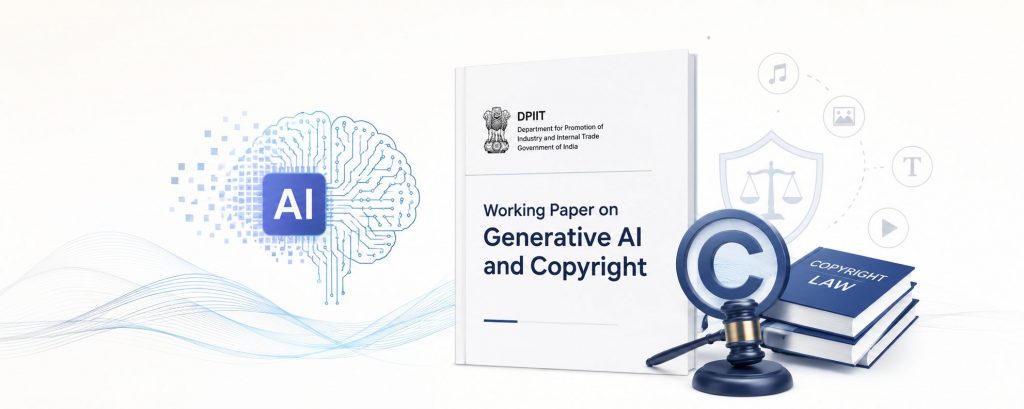
Introduction : In December 2025, the Department for Promotion of Industry and Internal Trade (DPIIT) released its Working Paper on Generative AI and Copyright, initiating a structured policy conversation on how India should regulate the use of copyrighted works in training generative AI models. The paper examines global approaches and puts forward recommendations that lean toward a mandatory blanket licensing framework accompanied by a statutory right to remuneration for copyright holders. This development is of central importance to the licensing ecosystem because it directly addresses one of the most contested questions in contemporary intellectual property law: under what conditions, and on what terms, may vast quantities of copyrighted material be used to train foundation models that power generative AI systems?
India’s approach is particularly significant because it seeks to balance the interests of a rapidly growing domestic AI industry with the need to protect and compensate Indian creators, publishers, and other rights holders whose works form part of the global data commons used for training. The proposals also interact with the Digital Personal Data Protection Act, 2023 (DPDP Act), creating a complex interface between data protection and copyright licensing obligations. This article examines the licensing implications of India’s emerging framework and situates it within the broader global landscape, drawing comparisons with developments in the European Union and the United States.
The DPIIT Working Paper’s Core Licensing Proposals
The DPIIT Working Paper analyses several international models, including the EU’s text-and-data-mining exceptions and transparency obligations, the US fair use doctrine, and various licensing-based approaches, before recommending a path tailored to Indian conditions. A central element of the recommended framework is a mandatory blanket licensing regime under which AI developers would be required to obtain licences (or pay into a central remuneration system) for the use of copyrighted works in training their models. This would be accompanied by a statutory right to remuneration for copyright holders, with collection and distribution potentially handled by a designated central agency or extended collective licensing mechanism.
Importantly, the paper appears to favour a system that limits the ability of individual rights holders to opt out entirely, while still providing for remuneration. This represents a significant departure from purely voluntary licensing models and from the more exception-heavy approaches seen in some jurisdictions. From a licensing perspective, such a regime would create a more predictable (if compulsory) market for training data rights in India, reducing transaction costs associated with individual negotiations while ensuring that creators receive compensation. It would also shift the default position from one in which developers might rely on fair dealing or other exceptions toward one in which licensing (or payment into a remuneration fund) becomes the primary compliance pathway.
Interaction with the DPDP Act and Personal Data in Training Datasets
Any framework for licensing training data in India must also navigate the Digital Personal Data Protection Act, 2023. The DPDP Act governs the processing of personal data and imposes obligations on data fiduciaries, including requirements related to consent, purpose limitation, and cross-border transfers. Training datasets frequently contain personal data, whether embedded in text, images, or other content scraped from the web. The interaction between copyright licensing obligations and DPDP Act compliance creates additional layers of complexity for AI developers operating in or targeting the Indian market.
From a licensing standpoint, this dual regulatory overlay means that agreements for the use of datasets in AI training must address both copyright clearance (or compliance with any blanket licensing/remuneration scheme) and data protection requirements. Developers may need to implement technical and organisational measures to minimise the inclusion of personal data, obtain appropriate consents or rely on legitimate use grounds under the DPDP Act, and ensure that any cross-border transfers of training data comply with applicable restrictions. These overlapping obligations are likely to increase compliance costs and influence the structure of data licensing agreements, with greater emphasis on warranties, indemnities, and audit rights relating to both copyright and data protection compliance.
Implications for Licensing Markets and Contractual Practice
If India moves toward a mandatory blanket licensing or central remuneration model as suggested in the DPIIT Working Paper, the licensing landscape for training data will change in several important ways. First, there would likely be greater demand for collective or extended collective licensing solutions capable of administering rights on behalf of large numbers of Indian copyright holders across different categories of works. Second, individual licensing agreements for high-value or specially curated datasets would continue to exist alongside any blanket regime, potentially commanding premium terms. Third, the existence of a statutory remuneration right could facilitate more standardised pricing and distribution mechanisms, reducing some of the uncertainty that currently characterises negotiations between AI companies and rights holders.
At the same time, the introduction of a mandatory element raises questions about the scope of the licence or remuneration obligation, the treatment of works whose authors have expressly reserved their rights, and the mechanisms for opting out (if any). Contractual practice will need to adapt to whatever final framework emerges, with careful attention to the allocation of risk between licensors and licensees regarding compliance with both copyright and data protection requirements. International AI companies will also need to consider how any Indian regime interacts with their global licensing strategies and with obligations under other jurisdictions’ laws.
Comparative Perspectives: EU, US, and India
India’s emerging approach, as signalled by the DPIIT Working Paper, occupies an interesting middle ground between the EU and US models. The European Union has combined text-and-data-mining exceptions (with opt-out possibilities) under the DSM Directive with transparency and copyright compliance obligations under the AI Act, while also exploring data access and licensing frameworks. The United States continues to rely primarily on fair use doctrine (with ongoing litigation and policy debate) while seeing legislative proposals such as the CLEAR Act that would introduce mandatory disclosure mechanisms. India’s consideration of a mandatory blanket licensing regime with statutory remuneration represents a more interventionist, collective-management-oriented model that seeks to guarantee compensation for rights holders while providing developers with a clearer compliance pathway.
This distinctive path reflects India’s policy priorities: supporting the growth of a domestic AI ecosystem while ensuring that Indian creators and publishers are not left uncompensated when their works contribute to the value of global AI systems. It also aligns with broader Indian policy thinking on data sovereignty and the need for mechanisms that channel value back to Indian rights holders. Whether this model proves workable in practice, and how it interacts with India’s international trade obligations and the needs of its AI industry, will be closely watched by other jurisdictions considering similar reforms.
Conclusion
India’s DPIIT Working Paper on Generative AI and Copyright marks an important step in the country’s efforts to develop a coherent policy framework for the licensing of copyrighted works as training data for AI systems. By leaning toward a mandatory blanket licensing approach accompanied by statutory remuneration, India is charting a path that prioritises creator compensation and regulatory clarity while seeking to accommodate the needs of AI developers. The framework’s interaction with the DPDP Act adds further complexity, requiring integrated compliance strategies that address both copyright and personal data protection obligations.
As India moves from working paper to potential legislation or regulatory action, the details of implementation, including the design of any central remuneration mechanism, the scope of any opt-out rights, and the enforcement architecture, will determine the practical impact on licensing markets. For rights holders, AI companies, and policymakers in other jurisdictions, India’s experiment offers valuable insights into the possibilities and challenges of constructing licensing regimes that seek to balance innovation, creativity, and equitable compensation in the age of generative AI. The coming years will reveal whether this distinctive Indian model succeeds in creating a functional, fair, and internationally compatible market for training data rights.
Author:- Amrita Pradhan, in case of any queries please contact/write back to us at support@ipandlegalfilings.com or IP & Legal Filing.
References
- Department for Promotion of Industry and Internal Trade (DPIIT), Working Paper on Generative AI and Copyright, Part 1: One Nation One License One Payment – Balancing AI Innovation and Copyright (December 2025) https://www.dpiit.gov.in/static/uploads/2025/12/ff266bbeed10c48e3479c941484f3525.pdf
- PIB, Ministry of Commerce and Industry, Government of India, ‘DPIIT Publishes First Part of Working Paper on AI-Copyright Interface’ (9 December 2025) https://www.pib.gov.in/PressReleaseIframePage.aspx?PRID=2200741&lang=2®=48
- Digital Personal Data Protection Act 2023, Section(s) 4, 6–8, 16.
- Ministry of Electronics and Information Technology, Government of India, Digital Personal Data Protection Rules 2025 (14 November 2025).
- Copyright Act, 1957, Section 52.
- Directive (EU) 2019/790, Article(s) 3–4.
- Regulation (EU) 2024/1689, Recital 105.
- US Copyright Office, ‘Artificial Intelligence Study’ (2025) https://www.copyright.gov/policy/artificial-intelligence/
- US Copyright Office, Copyright and Artificial Intelligence, Part 3: Generative AI Training (May 2025).
- Andy Warhol Foundation for the Visual Arts Inc v. Goldsmith, 598 US 508 (2023).
- Google LLC v. Oracle America Inc, 593 US 1 (2021).