Licensing Music for Retail Stores, Events and Brand Videos
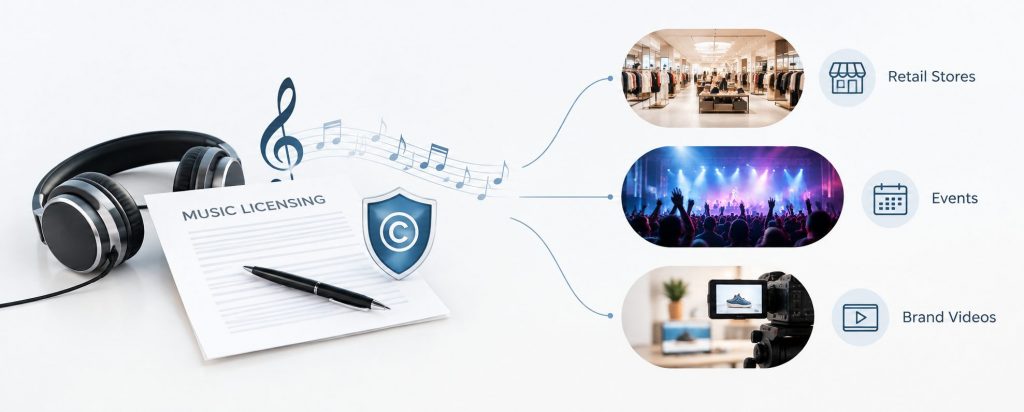
Introduction : Music has become the best and cheapest source of entertainment and a central part of commercial communication. Merchants/shopkeepers play music to set the vibe of their store, a brand lays a song beneath a promotional reel, and an organiser opens a launch with a popular track. The same music may reappear in many places and in many ways.
These uses look alike, but the copyright law treats them very differently. The question arising from these uses is whether they have obtained permission or not; even if they are using it legally, do they have a licence for that specific use? A commercially released song carries several layers of copyright, and permission for one layer does not extend to the others. This blog explains those layers, applies them to stores, events, videos, livestreams, and user-generated content, and ends by helping businesses avoid inadvertent exposure.
Legal Provisions
Layered rights in a song
Section 13 of the Copyright Act, 1957 recognises copyright in original musical works, cinematograph films and sound recordings, and section 13(4) clarifies that copyright in a film or sound recording does not affect the separate copyright in any work embodied in it. A song has at least two layers; therefore, it contains layered ownership, such as the lyrics and the musical work owned by the composer, lyricist or publisher, and the sound recording, usually owned by the producer or label.
Section 14 gives the list of exclusive rights. In relation to the musical work, they include reproduction, issuing copies, performance in public, communication to the public, making a sound recording or cinematograph film of the work, and adaptation; sound recordings carry their own set, including communication to the public. Section 2(ff) defines communication to the public broadly, as making a work available for being seen or heard. Briefly, the licence becomes a legal requirement the moment a track is made accessible to the world; it safeguards the artist’s work from being used commercially without their permission.
Section 51 treats the unauthorised exercise of these rights as infringement and reaches a person who permits any place to be used for the communication of a work to the public for profit.
B. Industry terms and statutory rights
Some of the important terms like public performance, synchronisation, mechanical and master rights are industry vocabulary. They describe uses that engage section 14. Public performance means playing music in a public or commercial setting, engaging the performance and communication rights in both the composition and the recording. Synchronisation means combining music with visual content, such as a brand video or advertisement. Mechanical rights concern reproducing the composition in copies for distribution, and Master Rights concern using a specific existing sound recording, such as the original recorded version of a song, in a video or advertisement.
C. Who grants the licence
Section 30 requires a licence to be in writing and signed by the owner, and section 33 channels collective licensing through registered copyright societies. In practice, Indian Performing Right Society (IPRS) administers performance rights in musical and literary works, while Indian Phonographic Performance Limited. (PPL) administers public performance rights in sound recordings.
Legal Analysis (The Four Rights Mapped)
Background Music (Store and Event)
A retailer may think that he is playing the music, but no one has come to listen to its playlist, so they do not require any licence. But section 2(ff) defines “communication to the public” as making the work available to the public, so background music still engages copyright. Consumer streaming subscriptions are licensed for personal use, not for commercial purposes.
Licences are also scenario-specific; PPL’s published position is that an annual background-music licence does not cover an event, which needs a separate event licence. A recording licence likewise carries no rights in the underlying music and lyrics, which requires IPRS licences. A store that plays ambient music daily and hosts a launch may therefore need several permissions.
At conferences, exhibitions and product launches, the organiser must check whether permission has been obtained to play music at the event. Section 51(a)(ii) reaches a person who permits a place to be used for communicating a work to the public for profit, so venue and organiser can both be exposed. Therefore, the organiser, hotel, event management agency and performers should clearly decide in their agreement who will obtain the necessary music licences and pay the fees. This helps avoid confusion and reduces the risk of copyright infringement.
Videos, reels and advertisements
The position changes when visuals or images combine with the music. Trending audio libraries on short-video platforms are commonly licensed for personal or non-commercial creation, and business accounts are frequently excluded. A commercial video or promotional reels set to a popular song needs synchronisation permission from the owner of the composition, and if the brand uses the original studio track, master permission from the label. Editing, shortening or looping the music may also engage adaptation rights or the author’s special rights under section 57.
Livestreamed events
Livestreaming creates two uses: the performance at the venue and transmitting it online to viewers watching remotely. The online transmission may amount to communication to the public under Section 2(ff). An organiser must check whether the existing music licence covers both uses or whether additional permissions are required; therefore, the event agreement should state whether the music licence covers live performance, livestreaming, recording, replay, and later promotional use.
User-generated and influencer content
A customer may post a video with copyrighted music and tag a brand. However, a video may contain copyrighted music for which the customer does not have permission to authorise further use. While online platforms may rely on the intermediary protection under Section 79 of the Information Technology Act, 2000, a business that selects and reposts a customer’s video on its own account may face a different legal position. The risk also extends to influencers: a creator’s personal-account licence may not travel into a paid brand collaboration, so a business should obtain the creator’s written consent and verify that the music is licensed for the intended use, including commercial promotion.
Relevant Case Laws
- The Foundation of Layered Rights: In Indian Performing Right Society Ltd v Eastern Indian Motion Pictures Association, the Supreme Court adopted the layered-rights model and held that a composer’s copyright in a musical work is not extinguished when it is incorporated into a film.
- The Social Media Trap & The Nemo Dat Principle: In Zee Entertainment v. Nykaa, the court held that Meta’s personal-use licence could not extend commercial rights to brands, and Nykaa faced a ₹2 crore claim even after removing the Reels, as the court applied the nemo dat quod non habet (you cannot give what you do not possess) principle to platform music libraries.
- The Registration Battle and the June 2026 Resolution: In Azure Hospitality v. PPL, the division bench of the Delhi High Court held that PPL could not license without registration, so they do not have any authority to charge them, as the registration was denied in 2012. PPL appealed to the SC, and the apex issued a temporary stay regarding specific payment rules strictly between the parties involved, but it did not reverse the High Court’s stance on registration. PPL was re-registered on 11 June 2026, so businesses cannot take this defence anymore that the “PPL is not registered and that this case ruling becomes irrelevant, as businesses cannot take the defence that the PPL registration is invalid.
Practical Implications
For retailers, before seeking new permits, it is recommended to determine what kind of sound already exists in your facilities, like in your events, shops, and content, and not depend only on the libraries provided by the platform; always search for other royalty-free alternatives and sync licences. For those who organise events, the coverage of a license must be established in contracts with other parties involved, and warranties and indemnities must be included in contracts as well. For marketing departments, it is necessary to create a new file for every video with complete information about composition, recording, territory, terms, and media. It is important to know that the term exposure includes injunctions, losses, and possible criminal lawsuits. As a result, it is much better to be careful at the very beginning.
Conclusion
Commercial music licensing doesn’t just involve determining whether a company has paid for the use of a piece of music. Various copyright questions arise depending on the use of the same artistic product, whether in a store, in performance, in video, during the live broadcast, or as part of a customer’s post. The different aspects of exploitation are described by industry terms and protected by Section 14 of the Act, even though they do not yet have a separate status of their own. When trying to avoid problems later, the music intended for any projected commercial use should be cleared beforehand. A background music license may not cover the advertising; obtaining permission to upload a video does not guarantee the authorization to use the music within it; a physical event license does not mean that the music can be used in the process of live streaming or for online purposes later.
Author:- Janvi Gaurav, in case of any queries please contact/write back to us at support@ipandlegalfilings.com or IP & Legal Filing.