ASEAN’s SCOPE IPR Work Plan 3 (2026-2027) – Regional IP Enforcement
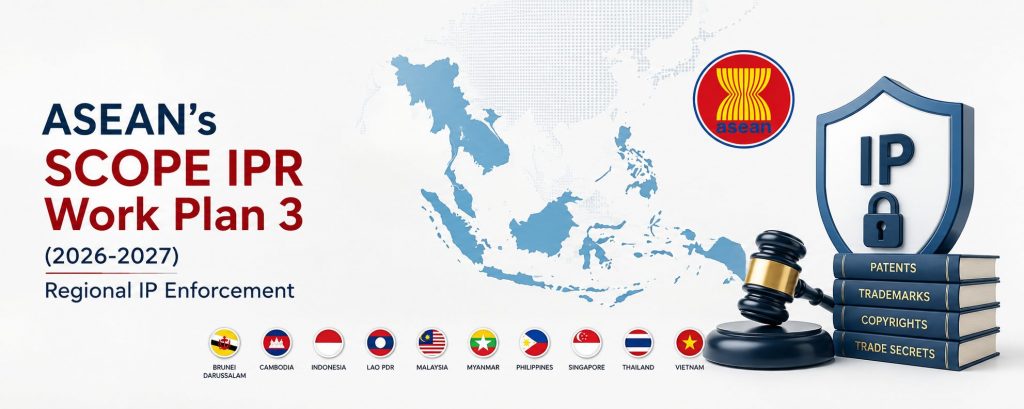
Introduction : In May 2026, the ASEAN Working Group on Intellectual Property Cooperation formally launched Work Plan 3 under the SCOPE IPR project, establishing a concrete operational roadmap to run through April 2027. This initiative represents a significant step in translating the broader strategic vision of the ASEAN Intellectual Property Rights Action Plan 2026-2030 into tangible, time-bound joint activities. By committing Member States to nineteen specific cross-border enforcement measures, the Work Plan seeks to address long-standing fragmentation in how ASEAN jurisdictions handle customs interventions, trade secret protection, and geographical indication enforcement at their borders.
The launch comes at a moment when ASEAN’s economic integration agenda places increasing emphasis on intangible assets, digital trade, and supply-chain resilience. While previous regional IP action plans have articulated high-level goals, implementation has often remained uneven across the ten Member States, whose legal traditions, institutional capacities, and levels of IP development differ markedly. Work Plan 3 attempts to narrow this gap by focusing on three practical enforcement pillars where cross-border coordination yields immediate commercial benefits: synchronised customs procedures, more consistent trade secret regimes, and harmonised approaches to geographical indications. In doing so, it builds directly on the institutional foundation of the AWGIPC while leveraging EU-supported technical cooperation under the SCOPE IPR framework.
The SCOPE IPR Framework and the Design of Work Plan 3
SCOPE IPR is an EU-funded cooperation project designed to strengthen the protection and enforcement of intellectual property rights across ASEAN in alignment with international standards, including those reflected in EU practice. Work Plan 3 was developed in close consultation with the AWGIPC and reflects priorities identified in the newly adopted ASEAN IPR Action Plan 2026-2030. Unlike purely aspirational documents, AWP3 translates strategic objectives into nineteen concrete joint activities with defined timelines, responsible agencies, and deliverables. These activities are clustered around the three thematic pillars of customs border measures, trade secret protection, and geographical indication enforcement.
The decision to concentrate on these areas is pragmatic. Customs authorities serve as the first line of defence against infringing goods in transit or entering domestic markets. Divergent procedures and information-sharing practices among ASEAN Member States create opportunities for forum shopping and reduce the effectiveness of border enforcement. Similarly, trade secrets, increasingly critical to technology transfer, manufacturing know-how, and data-driven business models, have historically received uneven legal treatment across the region. Geographical indications, meanwhile, represent an important tool for protecting traditional knowledge and local products, yet recognition and enforcement mechanisms remain fragmented. By targeting these three domains with coordinated activities, Work Plan 3 aims to deliver measurable improvements in enforcement coherence within a relatively short eighteen-month implementation window.
The Nineteen Joint Activities and Their Enforcement Focus
Although the full operational details of each of the nineteen activities are elaborated in project documentation shared among AWGIPC members and implementing partners, their overarching design is clear from the project framework. On the customs front, activities include the development of common risk-profiling tools, standardised information-exchange protocols for suspected infringing shipments, and joint training programmes for border officials across multiple Member States. These measures seek to reduce the time and uncertainty currently associated with multi-jurisdictional border actions and to create a more seamless enforcement experience for rights holders operating regionally.
In the trade secrets domain, the Work Plan envisages comparative legal studies, the drafting of model confidentiality clauses and protective orders, and capacity-building workshops aimed at judges, prosecutors, and regulatory officials. The goal is to move toward greater substantive and procedural alignment in how trade secret misappropriation is defined, proven, and remedied, an area where differences in civil procedure, evidentiary rules, and available injunctive relief have historically complicated cross-border litigation and licensing negotiations.
For geographical indications, activities centre on harmonising registration and opposition procedures at border points, developing common guidelines for the recognition of foreign GIs, and establishing practical mechanisms for coordinated enforcement against misuse in intra-ASEAN trade. Given the growing commercial importance of GIs for agricultural products, foodstuffs, and handicrafts originating in multiple ASEAN countries, these measures respond directly to demands from producers and exporters for more predictable protection when goods cross internal borders.
Implications for Regional IP
Work Plan 3 carries implications that extend well beyond technical enforcement improvements. For businesses operating across ASEAN, more consistent customs procedures and information sharing can materially reduce the cost and risk of protecting IP-intensive supply chains. Rights holders who have previously hesitated to pursue border measures in multiple jurisdictions because of procedural divergence may now find coordinated action more feasible. This is particularly relevant for sectors such as pharmaceuticals, electronics, consumer goods, and agricultural exports, where counterfeit or infringing products frequently move through several ASEAN ports before reaching final markets.
The trade secret and GI components similarly address pain points that affect both foreign investors and domestic innovators. Clearer and more convergent rules on trade secret protection can facilitate technology transfer agreements and joint ventures by reducing uncertainty about the legal consequences of unauthorised disclosure. For producers of GI-protected products, improved cross-border recognition and enforcement mechanisms can enhance the commercial value of their designations and support premium pricing strategies in regional markets. In this way, Work Plan 3 contributes to the broader ASEAN objective of moving up global value chains through stronger intangible asset protection.
At the systemic level, the Work Plan reinforces the institutional role of the AWGIPC as the central coordinating body for IP cooperation. By delivering a focused, time-bound set of activities with clear deliverables, it provides a model for how future regional IP initiatives might be structured — moving from high-level declarations toward operational programmes with measurable outputs. The EU-supported SCOPE IPR framework supplies technical expertise, funding, and comparative experience that many individual Member States could not easily mobilise on their own, thereby accelerating the pace of practical harmonisation in selected priority areas.
Implementation Challenges and the Limitations
Despite its carefully designed scope, Work Plan 3 faces the familiar challenges of ASEAN regional cooperation. Member States differ substantially in institutional capacity, legal tradition, and the priority accorded to IP enforcement within national budgets and political agendas. While Singapore, Malaysia, and Thailand possess relatively sophisticated IP offices and customs administrations, several other Member States continue to face resource constraints and competing development priorities. The success of joint activities will therefore depend on sustained political will, effective knowledge transfer, and the willingness of better-resourced jurisdictions to support capacity-building in less developed ones.
Moreover, the nineteen activities, while ambitious, remain limited in depth and duration. Eighteen months is a short timeframe in which to achieve meaningful convergence on complex issues such as trade secret litigation procedures or GI border enforcement. Much will depend on the quality of the model instruments and guidelines produced, the extent to which they are actually adopted or adapted at the national level, and the follow-through mechanisms that AWGIPC establishes beyond April 2027. Without continued momentum and integration into the longer-term ASEAN IPR Action Plan 2026–2030 implementation structures, there is a risk that the outputs of Work Plan 3 remain under-utilised.
Finally, the language of “legally binding” commitments in a regional work plan must be understood in the ASEAN context. ASEAN instruments typically operate through consensus and voluntary implementation rather than supranational enforcement. While Member States have politically committed to the activities under AWP3, actual compliance will rest on domestic legislative and administrative follow-up. Monitoring and peer-review mechanisms within AWGIPC will be important to maintain accountability and to identify areas where additional support or adjustment is required.
Conclusion
The launch of SCOPE IPR Work Plan 3 in May 2026 marks a pragmatic and focused phase in ASEAN’s ongoing effort to strengthen intellectual property cooperation. By concentrating on nineteen concrete joint activities in the areas of customs border measures, trade secret protection, and geographical indication enforcement, the Work Plan translates high-level strategic objectives into operational deliverables with clear timelines and institutional ownership. It addresses real commercial pain points for businesses operating across the region and reinforces the role of the AWGIPC as the central coordinating platform for IP policy and enforcement collaboration.
The ultimate impact of AWP3 will be measured not by the number of workshops held or guidelines drafted, but by the extent to which these outputs translate into more predictable, efficient, and effective enforcement on the ground. Success will require sustained engagement from all Member States, continued technical support from partners such as the EU, and robust follow-through mechanisms that link the Work Plan’s outputs to the longer-term implementation of the ASEAN IPR Action Plan 2026–2030. If these conditions are met, Work Plan 3 can serve as a meaningful building block toward a more integrated and business-friendly IP environment across Southeast Asia, one that supports innovation, trade, and investment while respecting the diversity of ASEAN’s legal and developmental landscape.
Author:- Amrita Pradhan, in case of any queries please contact/write back to us at support@ipandlegalfilings.com or IP & Legal Filing.
References
- European Union Intellectual Property Office (EUIPO), ‘EUIPO-led SCOPE IPR Project Steering Committee Endorses Annual Work Plan 3’ (13 April 2026) https://internationalipcooperation.eu/en/scopeipr/news/euipo-led-scope-ipr-project-steering-committee-endorses-annual-work-plan-3
- EU Funded IP Projects, ‘Activities: SCOPE IPR Work Plan 3 (2026–2027)’ https://internationalipcooperation.eu/en/scopeipr/activities
- ASEAN, ASEAN Intellectual Property Rights Action Plan 2026–2030 (10 December 2025) https://www.aseanip.org/docs/default-source/asean-ip-publications/public-version_aiprap-2026-2030_10dec2025.pdf
- ASEAN, ASEAN Economic Community Strategic Plan 2026–2030 (2025) 33 https://asean.org/wp-content/uploads/2025/06/AEC-Strategic-Plan-2026-2030.pdf
- World Intellectual Property Organization, WIPO Guide to Trade Secrets and Innovation (2024) pt III https://www.wipo.int/web-publications/wipo-guide-to-trade-secrets-and-innovation/en/part-iii-basics-of-trade-secret-protection.html
- World Intellectual Property Organization, ‘Summary of the Geneva Act of the Lisbon Agreement’ https://www.wipo.int/en/web/treaties/registration/lisbon/summary_lisbon-geneva
- EU Funded IP Projects, ‘Regional IP Enforcement Summit’ https://internationalipcooperation.eu/en/scopeipr/activities/regional-ip-enforcement-summit
- EU Funded IP Projects, ‘ASEAN Forum on Geographical Indications’ https://internationalipcooperation.eu/en/scopeipr/activities/asean-forum-geographical-indications