Biological Material and CRISPR-Cas9 Secondary Licensing in Agriculture
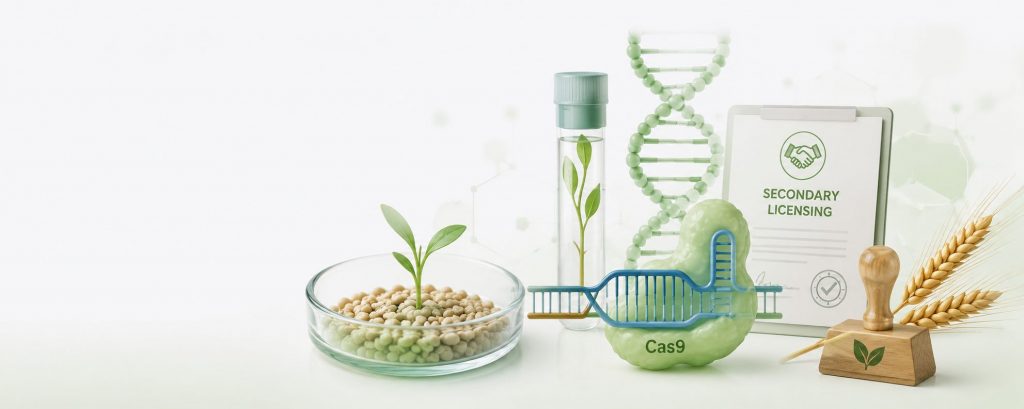
Introduction : CRISPR-Cas9 has changed the economics of agricultural innovation. Gene editing can be used to develop crops with improved disease resistance, altered nutritional characteristics, greater climate tolerance, or more efficient growth. Unlike conventional breeding, which may require repeated crossing and selection over several generations, gene-editing tools can be used to make targeted changes in a plant genome.
The legal consequences are less straightforward. A commercial gene-edited seed may involve several layers of rights: patents over the editing tool, patents over particular guide sequences or molecular methods, plant variety protection over the resulting variety, regulatory rights relating to biological material, and contractual restrictions imposed through licensing agreements. A company seeking to commercialise the seed may therefore need to obtain several permissions, even where the final genetic change is relatively small.
The tension becomes particularly visible when comparing the United States and India. The United States generally relies on patent rights and contractual licensing to control patented agricultural technologies. India, by contrast, has created a sui generis plant variety protection system through the Protection of Plant Varieties and Farmers’ Rights Act 2001 (PPV&FR Act), which grants breeders rights but expressly preserves important farmer freedoms. The resulting conflict is not simply between two licensing models. It reflects different assumptions about the relationship between innovation, ownership, food security and customary agricultural practice.
The Layered Nature of CRISPR Rights
CRISPR licensing begins with the distinction between the tool and the biological product. A patent may cover a CRISPR-Cas9 system, a method of introducing it into plant cells, a guide RNA arrangement, a delivery technique, or a particular genetic modification. A separate right may protect the plant variety produced through that process.
This distinction matters because ownership of a gene-edited plant does not necessarily grant freedom to use the editing technology. Conversely, a licence to use CRISPR-Cas9 does not automatically authorise commercialisation of a particular plant variety. The rights can belong to different entities and may have different terms, territorial limits and enforcement mechanisms.
A commercial seed may also contain several technical contributions. The gene-editing method may be licensed from one organisation, the trait from another, and the variety from a breeder or agricultural company. Secondary licensing arises when the original licensee seeks to authorise another party, such as a seed producer, distributor, local breeder or farmer cooperative, to use the technology. The contract must then determine whether sublicensing is permitted, whether royalties are payable on seed sales or acreage, and whether the downstream licensee may save and reuse the seed.
The legal analysis becomes more complicated where the edited plant itself is not patentable or where patent protection is limited. The commercial value may still be protected through plant variety rights, trade secrets, contracts, biological material controls and regulatory approvals. A company cannot assume that the absence of one form of protection eliminates all forms of control.
The United States Model
The United States provides a comparatively strong environment for patent-based control of agricultural biotechnology. The United States Patent and Trademark Office (USPTO) examines patent applications under the general requirements of patentable subject matter, novelty, non-obviousness, enablement and written description. Patent protection may extend to engineered biological systems, methods of producing modified organisms, genetic constructs and particular uses, subject to the limits imposed by patent law.
US law does not treat every plant or gene-edited organism in the same way. The Supreme Court’s decision in Diamond v. Chakrabarty established that a human-made, genetically engineered microorganism could fall within patentable subject matter, while decisions such as Association for Molecular Pathology v. Myriad Genetics limited the patentability of naturally occurring genetic material in an isolated form. These cases illustrate the central principle that human intervention and technical modification are important to patent eligibility.
For agricultural businesses, the more immediate issue is enforceability. A patent holder may license a trait or technology subject to contractual limits on reproduction, seed saving, transfer, research, geographic use and commercialisation. Some agricultural biotechnology arrangements have historically used technology-use agreements that prohibit farmers from saving harvested seed for replanting. Such terms allow the owner to control downstream multiplication even when the seed is physically possessed by the farmer.
The US system may therefore permit a high degree of vertical control. A patent holder may license a seed producer, who may sublicense distributors or growers, while retaining control through patent infringement claims and contract remedies. The legality of a particular restriction depends on the patent claims, the licence language, exhaustion principles, antitrust law and applicable plant variety protection rules.
Patent exhaustion creates an important boundary. In Bowman v. Monsanto, the Supreme Court held that patent exhaustion did not permit a farmer to reproduce patented soybean seeds by planting and harvesting them, because the planting process created new copies of the patented invention. The decision is highly relevant to gene-edited crops. It shows why physical sale of a seed does not necessarily terminate the patent holder’s control over subsequent generations of biological reproduction.
For secondary licensing, this means that the licensee must define the permitted acts carefully. A licence to use CRISPR technology in research may not authorise field trials, seed multiplication or sale. A licence to commercialise one crop variety may not extend to other varieties, traits or territories. If the agreement is silent, disputes may arise over whether reproduction is an ordinary incident of seed ownership or an unauthorised creation of additional patented articles.
India’s PPV&FR Framework
India follows a different institutional design. The PPV&FR Act was enacted to protect plant varieties, the rights of farmers and plant breeders, and to encourage the development of new varieties. It creates a system under which breeders can obtain exclusive rights over registered varieties while farmers receive legally recognised rights based on their historical contribution to conserving and improving plant genetic resources.
Section 39(1)(iv) is central to the conflict. It provides that a farmer is entitled to save, use, sow, resow, exchange, share or sell farm produce, including seed of a variety protected under the Act, in the same manner as before the Act came into force, subject to the limitation that the farmer may not sell branded seed of a protected variety.
The provision is broader than a narrow research or personal-use exception. It recognises farming practice as a legally protected activity. The farmer may retain seed from a crop, plant it again, exchange it with other farmers and sell farm produce that includes seed, provided the transaction is not the sale of branded protected seed. The PPV&FR Authority explains that the right to save seed concerns seed retained as farm produce, and that farmer-saved seed obtained from a farmer is not to be sold using the protected variety’s denomination or branding.
The Act also recognises farmers’ contribution through mechanisms such as registration of farmers’ varieties, compensation rights and the Gene Fund. The Authority’s structure reflects a policy decision that plant innovation is not created only in laboratories. Farmers may conserve, select and improve genetic resources over time, and the legal system should acknowledge that contribution.
This framework creates a significant limitation on contractual licensing strategies. A company may seek to impose a term requiring farmers to purchase fresh seed every season, but a contractual condition cannot simply erase a statutory right. The actual result will depend on whether the claimed technology falls within the PPV&FR framework, whether a separate patent is enforceable, whether the farmer is dealing with protected farm produce or branded seed, and whether the contract concerns acts outside the statutory right.
Where the Systems Collide
The central legal conflict arises when the same seed is covered by both patent rights and plant variety protection. Suppose a CRISPR-edited crop is protected by a patent covering the genetic modification and is also registered as a plant variety under the PPV&FR Act. The breeder may argue that planting saved seed creates a new patented product and therefore requires a licence. The farmer may respond that Section 39 preserves the right to save and resow seed from the crop.
This is not resolved merely by identifying which right was registered first. The authorities must determine the scope of each right and how the statutes interact. Patent law may regulate the use of a claimed invention, while the PPV&FR Act may preserve farmer activities connected with protected varieties. If the patent is drafted around the editing method, the patentee may face difficulties proving that ordinary seed saving infringes the relevant claim. If the claim covers the resulting biological material or a trait expressed in the seed, the farmer’s exposure may be greater.
The distinction between branded seed and farm produce is also crucial. India’s statutory protection is not an unrestricted commercialisation right. A farmer cannot use the protected denomination to market branded seed as if it were the breeder’s authorised product. This limitation protects the breeder’s market identity while preserving customary seed practices.
The second issue concerns secondary licensees. If an Indian seed company obtains a licence from a foreign technology owner, it cannot assume that it may pass all contractual restrictions down to farmers. The licensee must separate restrictions that protect valid patent interests from restrictions that conflict with mandatory farmer protections. A contract requiring a farmer to buy new seed every year may be commercially common in a patent-centred model, but its enforceability in India must be tested against Section 39 and the nature of the registered variety.
The third issue concerns biological material and containment. Gene-edited material may be transferred through breeding, seed exchange or accidental cross-pollination. A licensing system that treats every reproduction as a controlled commercial act may be difficult to administer in agricultural environments. The law must distinguish intentional commercial multiplication from ordinary biological processes and farmer use. Without that distinction, enforcement may become disproportionate and undermine legitimate agricultural practice.
Policy and Commercial Implications
India’s model seeks to avoid a complete transfer of control over agricultural reproduction to private rights holders. This is understandable in a country where seed exchange and farm-saved seed are central to agricultural resilience and affordability. A strict patent-only system could increase recurring costs for farmers and narrow the ability of local communities to maintain adapted seed stocks.
At the same time, gene editing requires investment. Research institutions and companies need a credible opportunity to recover development costs. If licensing rights become too uncertain, private investment may decline or technologies may be offered only through restrictive partnerships. The challenge is therefore not to eliminate licensing, but to align it with the statutory boundaries of farmer autonomy.
The strongest approach is a differentiated one. Commercial seed production, branded distribution, export, large-scale multiplication and industrial breeding can attract licensing obligations. Ordinary farmer saving, resowing and exchange should remain protected within the limits established by the PPV&FR Act. This structure preserves a market for innovation while preventing the licensing system from treating every agricultural act as an infringement.
Conclusion
CRISPR-Cas9 agriculture exposes the limits of treating patent law and plant variety protection as separate fields. The same seed may embody a patented editing technology, a protected plant variety, farmer-conserved genetic material and a contractual licensing network. Each layer serves a legitimate purpose, but their interaction determines whether the final system is workable.
The United States model gives patent holders strong control over reproduction and downstream commercialisation, as illustrated by Bowman v. Monsanto. India’s PPV&FR framework takes a more plural approach by protecting breeders while preserving farmers’ rights to save, sow, exchange, share and sell farm produce, subject to the prohibition on selling branded seed of a protected variety.
For secondary licensing, the central lesson is that a foreign technology licence cannot simply be transplanted into India. It must be adapted to Indian statutory rights, especially Section 39. Effective agricultural licensing will therefore depend on precise claim analysis, transparent contractual drafting, differentiated royalty models and respect for farmer autonomy. The future of gene-edited agriculture will not be determined solely by whether CRISPR technology is patentable. It will be determined by whether the licensing system can reward innovation without severing the relationship between farmers and the seed they cultivate.
Author:- Amrita Pradhan, in case of any queries please contact/write back to us at support@ipandlegalfilings.com or IP & Legal Filing.
References
- Diamond v. Chakrabarty, 447 U.S. 303 (1980).
- Association for Molecular Pathology v. Myriad Genetics Inc, 569 U.S. 576 (2013).
- Bowman v. Monsanto Co, 569 U.S. 278 (2013).
- Protection of Plant Varieties and Farmers’ Rights Act, 2001, Section 39(1)(iv).
- Protection of Plant Varieties and Farmers’ Rights Authority, ‘Frequently Asked Questions on the PPV&FR Act 2001’ https://plantauthority.gov.in/sites/default/files/finalnewfaq23.02.2021.pdf accessed 18 June 2026.
- Protection of Plant Varieties and Farmers’ Rights Act 2001, Section(s) 14, 15 and 26.
- Protection of Plant Varieties and Farmers’ Rights Act 2001, Section(s) 28 and 30.
- Protection of Plant Varieties and Farmers’ Rights Act 2001, Sections 39(1)(iii).
- Protection of Plant Varieties and Farmers’ Rights Protection Rules, 2003.
- United States Patent and Trademark Office, Patenting Biotechnology Inventions.
- World Intellectual Property Organization, Intellectual Property and Genetic Resources, Traditional Knowledge and Traditional Cultural Expressions.
- Food and Agriculture Organization of the United Nations, The State of the World’s Plant Genetic Resources for Food and Agriculture (FAO 2010).