How Novelty and Originality Shape Textile Design Registration in India
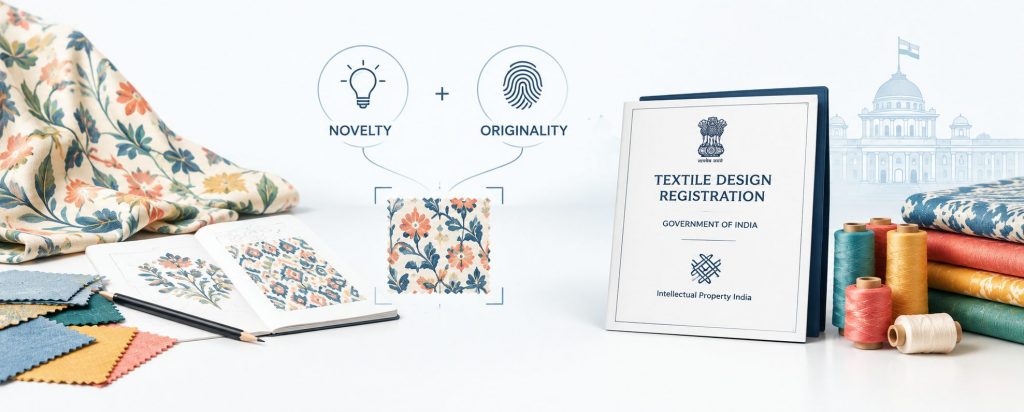
Introduction : Textile pattern registration is an unusually practical test of Indian design law. A fabric print, embroidery layout or repeated surface motif is commercially valuable precisely because consumers see it, yet its legal status can change as it moves from an original drawing to a manufactured textile and then to a fashion collection. Recent examination data and judicial decisions show that the real difficulty is not whether textile patterns fall within design law, but whether applicants preserve novelty, define the protected visual feature accurately and file before commercial disclosure.
Textile subject matter is registrable, but that is only the starting point
Class 05 of the Designs Rules expressly covers textile piecegoods and artificial and natural sheet material, including lace, embroidery, ribbons, braids and textile fabrics. This removes a common misconception – a surface pattern is not outside design law because it is applied to cloth. But classification does not answer novelty. Sections 2 and 4 still require a registrable design to satisfy the statutory conditions, including originality, prior-publication rules and sufficient distinction from known designs.
Between 1 April and 25 November 2025, Class 05 recorded 2,123 filings, 1,976 registrations, 57 abandonments and 42 refusals. Across all design classes in 2024-25, 38,009 applications were examined, with 604 refusals and 970 abandonments. These statistics establish that refusals occur, but they do not establish that the textile refusals were all based on novelty or originality. The reason for caution is structural. Section 28 prevents refused applications and the drawings, photographs or other representations left with them from being opened to public inspection or published by the Controller.
Bharat Glass – search the visual landscape, not just your own files
In Bharat Glass Tube Ltd v. Gopal Glass Works Ltd, the Supreme Court dealt with a registered pattern applied to glass sheets and the challenge based on prior publication. The Court stressed the significance of the design as it appears on the finished article and examined whether the material relied upon truly disclosed the relevant design before the applicant’s claim. For textile applicants, the lesson is direct: a novelty search cannot stop with patent-style databases or the designer’s own archives. Earlier fabric catalogues, trade-fair material, lookbooks, archived webpages, e-commerce listings and existing garments may all be relevant evidence of disclosure.
Section 4 is particularly unforgiving on timing. A design is barred where it was disclosed to the public anywhere in India or abroad before the filing or priority date, and registration is also unavailable where the design is not significantly distinguishable from known designs or their combinations. The safest workflow is therefore sequential, freeze the final visual version, document its creation, search the relevant market and file before a launch or public preview. Evidence of independent creation supports ownership; it does not by itself cure prior publication.
Aqualite – protect the feature that the certificate actually identifies
Aqualite Industries Pvt Ltd v. Relaxo Footwears Ltd. illustrates the importance of the registration certificate itself. The court treated the protected design as the features certified as novel, rather than the entire product. In that case, the relevant registration identified shape, configuration and surface pattern; colour similarity outside those certified features did not automatically become part of the registered design. For textile applicants, the implication is significant. The registration should make clear whether the intended protection lies in the repeat arrangement, ornamentation, motif configuration or another defined visual feature.
This also affects the quality of representations. A textile applicant should not rely on a generic statement such as “pattern for fabric” where the commercial identity lies in a particular repeat or arrangement. The representation should communicate the visual characteristics on which novelty is claimed. The Office’s examination guidance recognises novelty and originality as central examination questions and also records special rules concerning confidential first orders and certain exhibition disclosures. Filing strategy therefore has to be designed around the visual evidence that will eventually define the scope of protection.
Dura-Line – surface pattern is not a route to technical protection
The Delhi High Court’s decision in Dura-Line India Pvt Ltd v. Jain Irrigation Systems Ltd. adds the opposite caution. A registered surface pattern may be protected, but technical or constructional characteristics cannot be converted into design rights merely because they are visible on a product. The court rejected an approach that blurred visual design with functional and structural claims and assessed the alleged infringement by visual comparison. For textiles, the distinction matters where a particular weave, perforation, texture or production technique produces the appearance. The legally relevant claim should remain the visual result rather than the machinery or process that generates it.
The statutory boundary is clear: section 2(d) protects features that, in the finished article, appeal to and are judged solely by the eye. It excludes modes or principles of construction and matters that are in substance mere mechanical devices. An application is therefore stronger when it explains, through its representations, why the claimed feature is visually identifiable independently of the technical method used to manufacture the textile.
Microfibres and Ritika – why registration cannot be postponed indefinitely
The textile-specific difficulty becomes sharper when design law is viewed alongside copyright. In Microfibres Inc v. Girdhar & Co, the Delhi High Court considered upholstery fabric patterns and distinguished the original artistic work from the design derived from it for industrial application. The court treated textile patterns intended for industrial use as falling within the design framework. This is a crucial practical point: the fact that a pattern begins life as a drawing does not make its industrial application legally identical to that drawing.
Ritika Pvt Ltd v. Biba Apparels Pvt Ltd brought the issue into garment production. The plaintiff relied on copyright in drawings and garment designs, but the court applied section 15(2) of the Copyright Act in the context of industrial reproduction. Where a work is capable of design protection and crosses the statutory reproduction threshold without design registration, copyright cannot be used as a substitute for the missing design registration. For fashion businesses, the practical lesson is to identify at the development stage which assets are meant to be repeatedly applied to articles and to protect those assets through the correct regime before scale turns the registration decision into a legal vulnerability.
Cryogas – separate the rights asset before choosing the registration route
The Supreme Court’s 2025 decision in Cryogas Equipment Pvt Ltd v. Inox India Ltd revisited the copyright-design boundary and stressed the need to determine whether the relevant work actually falls within the design framework before applying the consequences of section 15(2) of the Copyright Act. The decision is not about textiles, but its method is useful for them because a single fashion business may hold an original sketch, a repeat textile pattern, a garment shape and confidential production information at the same time. Those are not automatically the same legal asset.
The practical response is to separate rights by function. The customer-facing repeat print or surface ornamentation may be a design. The underlying sketch may raise copyright issues. A novel production method may require a different form of protection. Treating all three as one “fashion design” makes it easier to file in the wrong class, describe the wrong feature or discover too late that public disclosure has already occurred.
Conclusion
The recent filing environment makes disciplined prosecution increasingly important. WIPO reported a 43.2% rise in India’s design filing activity in 2024, the strongest growth among the top 20 design offices in that dataset. That growth sits alongside a substantial stock of active Indian design registrations. In a high-volume sector such as fashion, where designs can have short commercial lives, the value of a registration may depend as much on speed and precision as on the artistic effort behind the pattern.
In January 2026, DPIIT published a concept note proposing amendments to the Designs Act for stakeholder comments. Until any amendment becomes law, however, applicants must work within the existing statute and rules. The practical position is therefore clear even without relying on unverified refusal stories: textile patterns are recognised design subject matter, but protection is secured through careful novelty management, accurate representations, correct classification and timely filing. A “rejection trend” should be treated as a warning to audit filing practice, not as a reason to assume that every textile pattern is difficult to register.
Author:- Amrita Pradhan, in case of any queries please contact/write back to us at support@ipandlegalfilings.com or IP & Legal Filing.
References
- Parliament of India, Lok Sabha, Unstarred Question annexure on design applications and examination outcomes, 2 December 2025, including Class 05 data for 1 April-25 November 2025, https://eparlib.sansad.in/bitstream/123456789/3015227/1/lsd_18_VI_02-12-2025.pdf
- Bharat Glass Tube Ltd v. Gopal Glass Works Ltd (2008) 10 SCC 657 (Supreme Court of India).
- Aqualite Industries Pvt Ltd v. Relaxo Footwears Ltd, FAO(OS)(IPD) 1/2022, judgment dated 18 November 2025 (Delhi High Court).
- Intellectual Property India, Manual of Designs Practice and Procedure, ch. 4 on examination, novelty and originality https://ipindia.gov.in/writereaddata/Portal/IPOGuidelinesManuals/1_30_1_manual-designs-practice-and-procedure.pdf
- Dura-Line India Pvt Ltd v Jain Irrigation Systems Ltd, CS(COMM) 245/2017 & CC(COMM) 54/2017, judgment dated 19 May 2025 (Delhi High Court).
- Microfibres Inc v. Girdhar & Co, 2009 SCC OnLine Del 1647 (Delhi High Court).
- Ritika Pvt Ltd v. Biba Apparels Pvt Ltd, 2016 SCC OnLine Del 1979 (Delhi High Court).
- Cryogas Equipment Pvt Ltd v. Inox India Ltd, 2025 INSC 483 (Supreme Court of India).
- Department for Promotion of Industry and Internal Trade, ‘Concept Note outlining the proposed amendments to the Designs Act, 2000’ (Notification, 23 January 2026), https://www.dpiit.gov.in/static/uploads/2026/01/791a71ebde47d93b67560f7394be2fec.pdf
- World Intellectual Property Organization, World Intellectual Property Indicators 2025 (2025), Designs highlights https://www.wipo.int/web-publications/world-intellectual-property-indicators-2025-highlights/en/designs-highlights.html