Confidentiality Failures That Destroy Patent Value: Lessons for In-House IP Teams
Introduction : In innovation the first line of defence of businesses that rely on patents is confidentiality. Sometimes the technically perfect invention is known to someone before the patent is filed and thus cannot be patented. Patents are different from the trade secret because they must disclose the information to the public but only after the patent application has been filed. Any disclosure prior to that time may eliminate the novelty and thus bar the patentability in jurisdiction that follows the doctrine of absolute novelty.
Today’s ecosystems demand the organisation to engage with suppliers, contractors, software developers, research institutions, marketing agencies and customers. Every interaction leads to the release of confidential information. Therefore, the role of confidentiality management is no longer just means of legal compliances but a part of an IP strategy. In house IP teams are crucial to the protection of valuable patent properties during commercial activities.
Legal Framework
Under Patent Act novelty is an important condition for patentability. The exceptions to anticipation in Sections 29-34 are limited and should not be considered as ‘safety valves’ for inadequate confidentiality management. Section 64 allows revocation if statutory requirements, such as novelty, are not met. Under Article 54 of the European Patent Convention, absolute novelty is required and under 35 U.S.C. §102, there are limited grace periods. The business that does activities abroad should therefore have a universal ‘file first, disclose later’ approach.
Reason for failure of Confidentiality
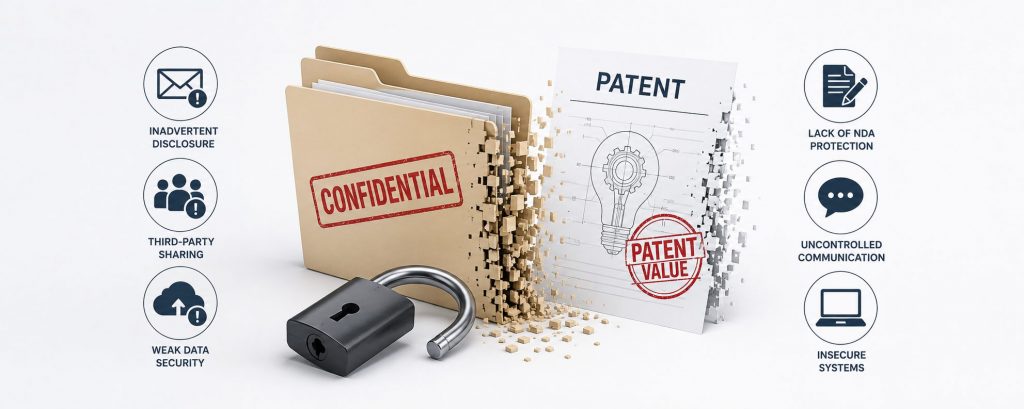
Common causes of confidentiality breaches include marketing efforts prior to patent disclosure, technical demonstrations at trade shows, vendor sharing without proper confidentiality agreements, academic publications, information on social media, employee disclosure via personal devices and in cloud storage. One of the most common reasons for unnecessary disclosures is lack of effective cross-functional communication between R&D, legal and marketing teams.
Legal Analysis
There are legal implications beyond the novelty of the disclosure. Courts repeatedly have held that inventions developed before filing and presented to the public can usually not be recovered by subsequent patent applications.
In Monsanto Co. v. Coramandal Indag Products (P) Ltd, (1986) 1 SCC 642, the Supreme Court had pointed out that novelty would be lost if the invention is available to the public beforehand or prior publication. The ruling illustrates the need for companies to be careful and mindful of technical publications and product disclosures.
This was especially the case in Egbert v. Lippmann, 104 U.S. 333 (1881), where the United States Supreme Court ruled that patent rights were invalidated by “limited use” of the invention by the public even though there was no public knowledge of the invention. The case emphasizes that disclosure to a few or trusted people doesn’t make it confidential.
In a similar way, Helsinn Healthcare S.A. v. Teva Pharmaceuticals USA Inc., 586 U.S. (2019), confirmed that some commercial transactions that occur prior to filing can be subject to the statutory on-sale bar despite confidentiality agreements. This is significant for licensing negotiations, investor talks and supply-chain agreements, as commercialization prior to filing can put future patent protection at risk.
All these authorities agree that there is not only an intention to keep it confidential, but also the fact that it has become ‘legally available to the public’ or ‘commercially exploited’ before being filed.
Managing NDA’s and Internal Controls
Each disclosure should be accompanied by a carefully drafted NDA that explicitly imposes obligations in respect of the definition of confidential information, permitted use, ownership of improvements, obligations to return or destroy, survival provisions and dispute resolution. Organisations should have inside need-to-know access, document categorisation, encryption, audit trails, role-based permissions and approvals for technical documentation.
Vendor Access, Trade Shows and Marketing Approvals
Only the minimum information should be provided to third-party vendors to enable them to perform their work. Manufacturing drawings, source code and prototypes should be shared in stages and once contractual protections have been put in place. Ideally, patent applications should be filed before trade shows, conferences or product launches. Marketing teams should seek prior written approval from the IP department before publishing any brochures, videos, websites or social media posts that may contain any ideas for invention.
Practical safeguards and for In house IP Teams
- Introduce structured invention disclosure programmes.
- Form cross-functional IP review committees.
- Provide employees with confidentiality training.
- Conduct vendor confidentiality checks.
- Enhance the induction and departure of staff.
- Secure digital collaboration platforms are maintained.
- Carry out periodic IP compliance reviews.
- Implement the company-wide ‘File First, Disclose Later’ policy.
Commercial Impact
Loss of patent protection can impact enterprise valuation, impair investor confidence, remove licensing opportunities and allow competitors to commercialise the same technology. The financial impact is frequently much greater than the cost of good confidentiality programmes.
Conclusion
In many cases, confidentiality mistakes ruin the value to the patient before the litigation process even starts. The importance of having strong NDAs, strict internal controls, restricted access with vendors, and ongoing employee awareness are crucial to maintaining novelty.
Confidentiality from the earliest stages of innovation management can position businesses much better to achieve enforceable patent rights and maximise the commercial value of their research and development.
Author:- Harinitha T P, in case of any queries please contact/write back to us at support@ipandlegalfilings.com or IP & Legal Filing.
References
- Patents Act, 1970 (India), ss. 29–34 & 64.
- European Patent Convention, art. 54.
- 35 U.S.C. §102.
- Monsanto Co. v. Coramandal Indag Products (P) Ltd., (1986) 1 SCC 642.
- Egbert v. Lippmann, 104 U.S. 333 (1881).
- Helsinn Healthcare S.A. v. Teva Pharmaceuticals USA Inc., 586 U.S. ___ (2019).
- WIPO Patent Drafting Manual.