The Dupe Dilemma: When Copying is not Infringement.
Introduction
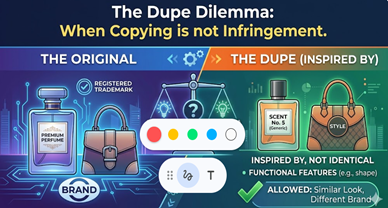
“Dupes” have become insanely common in today’s consumer- ran market. Consumers are constantly exposed to cheaper alternatives, no matter whether it’s fashion, beauty, or even lifestyle products. These alternatives closely resemble high-end or luxury goods and are often openly marketed as substitutes, sometimes even advertised as “dupes” on social media platforms. However, despite this visible copying, original brands rarely take legal action against such products. An important question arises considering the same: if copying is so obvious, why is it not always considered infringement?
The structure of Intellectual Property (IP) Law, provides an answer to the above. It is to be noted that contrary to popular belief, the law does not prohibit copying in all ways and forms. Instead, it protects only particular elements of a product, such as trademarks, registered designs, or original artistic expressions. As such, Ideas, general styles, trends, and functional aspects are usually not protected.[1]
Trademark Law and the Test of Confusion
One of the key tests for infringement under the Trademark Law is the likelihood of confusion. This concludes to meaning that a product will only be considered infringing if consumers are most likely to believe or perceive that it comes from the same source as the original brand. In other words, the law focuses on protecting the identity of the brand, not the product itself. As a result of the above, most dupes avoid using the same brand name, logo, or packaging.[2]
The importance of consumer confusion has been highlighted in several judicial precedents. For Example, in Cadila Health Care Lrd. V. Cadila Pharmaceuticals Ltd., The Hon’ble Supreme Court of India emphasized that the test of deceptive similarity must consider the perspective of an average consumer with not the most perfect recollection ability. This means that unless it is confirmed that a dupe creates confusion about the source of the product, it is unlikely to amount to trademark infringement.[3]
Ideas Vs Expression: The Limits of Protection
Another important restriction of Intellectual Property Law is that it does not work to protect ideas. This principle was clearly established by the Hon’ble Supreme Court in R.G. Anand V. Deluxe Films, where it was held that copyright law protects only the expression of an idea and not the idea itself. This concept applies broadly across IP law.[4]
This leads to the conclusion that brands, no matter how famous, cannot claim exclusive rights over general aesthetics such as product style, colour themes, or overall “look and feel”. As long as the expression differs, competitors are free to draw inspiration.
Design Law and Functional Limitations
Limited protection is provided by Design Law as well. The Designs Act, 2000 protects features related to shape, configuration, pattern, or ornamentation, but only if they are new and original and have been registered. Many designs are either not registered by their brands or they rely on elements that are too common to qualify for protection.[5]
It has also been clarified by Hon’ble courts in various judicial precedents that Design Law cannot protect functional elements. In Bharat Glass Tube Ltd. V. Gopal Glass Works Ltd., the Supreme Court discussed the important of novelty and originality in design protection. Similarly, in Kellogg Co. V. National Biscuit Co., the Court held that a single entity cannot monopolize functional features. This means that a particular design cannot be exclusively owned by one brand if the design is necessary for the use of the product.[6]
Dupes Vs Counterfeits
Another key difference that explains the existence of dupes is the difference between counterfeits and dupes. Original brand’s name, logo, or trademarks are used illegally in counterfeit products, making them clearly unlawful. Dupes, on the other hand, do not misrepresent their origin. They imitate the appearance of a product but are sold under a different brand name. Due to this reason, they often fall outside the scope of trademark infringement.[7]
Practical and Strategic Reasons for why Brands do not Act
Except legal limitations, there are also practical reasons why brands choose not to take action against dupes. Intellectual property litigation, like traditional litigation, can be extremely expensive and time consuming, especially when dealing with multiple small sellers operating across different jurisdictions. The cost of enforcement may outweigh the potential benefits in many cases.[8]
There is also a strategic piece involved. Taking legal action against dupes can sometimes lead to increased attention for the products involved. This phenomenon is often referred to as the “Streisand Effect,” and occurs when attempts to subdue information end up amplifying it instead. Calling out a dupe in the age of social media, can make it go viral instead.
Interestingly, it is argued by some scholars that imitation can actually benefit the original brand. In The Knockoff Economy, Kal Raustiala and Christopher Springman suggest that copying can drive innovation and increase market demand. It should acknowledge that dupes can enhance visibility and desirability of the original product[9].
Trademark Function and Passing Off
From wider perspective, trademark law is not created to protect product aesthetics but to protect brand identity. It can be said that trademarks function primarily as indicators of source rather than protection for product design.[10]
The issue of passing off also plays a role in this discussion. In the case Reckitt & Colman Products Ltd. V. Borden Inc., the Hon’ble Court established that misrepresentation leading to consumer confusion is essential. There must be deception regarding origin and imitation alone is not sufficient. [11]
More recent cases, for instance, Christian Louboutin SAS V. Nakul Bajaj, have also emphasized the importance of distinguishing between legitimate and infringing use of trademarks. Similarly, Croc Inc. USA V. Liberty Shoes Ltd. and Carlsberg Breweries A/S V. Som Distilleries examine the extent of design protection. These cases show that IP protection has clear limits.[12]
Conclusion
The staying power of dupes is not a failure of the legal system but rather a reflection of how its created. Intellectual property law looks to balance the rights of creators with the necessity to promote competition and innovation. The markets remain dynamic and accessible when some level of imitation is allowed.
The “dupe dilemma” ultimately emphasizes an important legal reality that not all copying amounts to infringement. As long as a product does not misuse protected components or mislead consumers about its place of origin, it is very likely to fall within the boundaries of lawful competition.
From the view of policy, this balance is crucial. Over protection could stifle creativity and restrict market accessibility while under protection could harm innovation. The current framework tries to come to a middle ground, one that allows inspiration to grow while protecting distinct identity.
In the end, intellectual property law does not seek to eliminate copying altogether but rather, it defines its limits. And within those limits, duplication is not just unavoidable, it is lawful.
Author:- Kavya Sharma, in case of any queries please contact/write back to us atsupport@ipandlegalfilings.com or IP & Legal Filing.
[1] World Intellectual Property Organization (WIPO), Understanding Industrial Property- https://www.wipo.int/edocs/pubdocs/en/wipo_pub_895_2016.pdf
[2] Section 29, Trade Marks Act, 1999
[3] Cadila Health Care Ltd. v. Cadila Pharmaceuticals Ltd., (2001) 5 SCC 73
[4] R.G. Anand v. Deluxe Films, (1978) 4 SCC 118
[5] Section 2(d), Designs Act, 2000
[6] Bharat Glass Tube Ltd. v. Gopal Glass Works Ltd., (2008) 10 SCC 657, Kellogg Co. v. National Biscuit Co., 305 U.S. 111 (1938)
[7] OECD/EUIPO, Trade in Counterfeit and Pirated Goods- https://www.oecd.org/content/dam/oecd/en/publications/reports/2016/04/trade-in-counterfeit-and-pirated-goods_g1g65d0c/9789264252653-en.pdf
[8] WIPO, Enforcement of Intellectual Property Rights- https://www.wipo.int/en/web/ip-enforcement
[9] Kal Raustiala & Christopher Sprigman, The Knockoff Economy- https://jipel.law.nyu.edu/wp-content/uploads/2015/04/The-Knockoff-Economy-Excerpt-Raustiala-Sprigman.pdf
[10] Barton Beebe, The Semiotic Analysis of Trademark Law, 51 UCLA L. Rev. 621 (2004)- https://www.uclalawreview.org/wp-content/uploads/2019/09/27_51UCLALRev6212003-2004.pdf
[11] Reckitt & Colman Products Ltd. v. Borden Inc., [1990] 1 WLR 491
[12] Christian Louboutin SAS v. Nakul Bajaj, 2018 SCC OnLine Del 12215, Crocs Inc. USA v. Liberty Shoes Ltd., CS (COMM) No. 772/2016, Carlsberg Breweries A/S v. Som Distilleries, CS (COMM) 690 of 2018