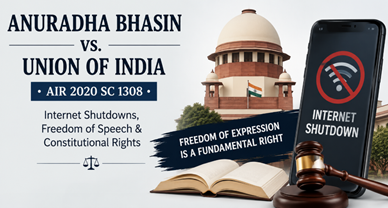
Anuradha Bhasin vs. Union of India AIR 2020 SC 1308
Introduction and Background
Although cherished in our heart as a “Paradise on Earth”, the history of this beautiful land is attached with the violence with militancy. While the mountains of Himalayas spell tranquility, yet blood is shed every day. In this land of inherent contradictions these petitions add to the list, wherein two sides have shown two different pictures which are diametrically opposite and factually irreconcilable. In this context, this court’s job is compounded by the magnitude of the task before it. Liberty and security have always been loggerheads. The question before us, simply put, is what do we need more, liberty or security? Although the choice is seemingly challenging, we need to clear ourselves from the platitude of rhetoric and provide a meaningful answer so that every citizen has adequate security and sufficient liberty. The pendulum of preference compromises the other.
It cannot be said that the Internet is the most widespread and accessible channel of information exchange in the modern world. The importance of the internet cannot be understated as it keeps us connected from dawn to dusk and enables our most basic activities.
Vinton G. Cerf, one of the Internet’s pioneers remarked that “though the Internet is very important, however, it cannot be elevated to the status of Human Right.” With great respect to his opinion, the Hon’ble Supreme Court in the case of Anuradha Bhasin said that “the prevalence and extent of internet proliferation cannot be undermined in one’s life.”
In this case, the telecom restrictions imposed in the state of Jammu and Kashmir were challenged by the Supreme Court, which upheld the fundamental right to access the Internet and also upheld the principle of proportionality.
The judgment in the case of Anuradha Bhasin v. Union of India impacted Constitutional Law in India to a large extent. This judgment became prominent due to its curious and notable subject matter. Its decision was given by the Hon. Supreme Court of India.
Facts of the case:
- Jammu and Kashmir is an Indian territory that borders Pakistan, and the two countries have been in dispute for decades. Under Article 370 of the Constitution of India, these territories were given special status and had their own constitution, and Indian citizens from other states were not allowed to buy land or real estate there.
- The issue starts with the security advisory issued by the Civil Secretariat, Home Department, Government of Jammu and Kashmir stating to cut short their stay and make their safe arrangements to go back. Subsequently, educational institutions and offices were also shut down until further orders. On August 4, 2019 internet services, mobile connectivity and landline were shut down until further orders.
- On August 5, 2019, the Constitutional Order No. 272 was passed by the President of India applying all provisions of the Constitution of India to Jammu and Kashmir and stripped it from special status enjoyed since 1954. On the same day, due to prevailing circumstances, the District Magistrate passed the order restricting the movement and public gathering, apprehending breach of peace and tranquility under Section 144.
- Due to this, journalist movements were restricted and this was challenged under Article 19 of the Constitution which guarantees freedom of speech and expression and freedom to carry any trade or occupation. In this context, in the Supreme Court, legality of internet shutdown and movement restrictions are challenged under Article 32 of the Constitution
Petitioner Argument
- The first petition was filed by Ms. Anuradha bhasin the Executive Editor of the Kashmir Times Srinagar Edition, contended that internet is crucial for modern press, without which print media has come to a “grinding halt”.
- This had prevented her from publishing the paper since 6 August. She said the government has not provided any reason for needing to approve the order, as required by the suspension rules. She further argued that the orders were issued based on fears of a threat to public order also argued that some trades are completely dependent on internet. This Right to trade through internet also fosters consumerism and provides wide availability to choose different goods and services.
- That the Freedom of Trade and Commerce via the medium of internet is protected under Article 19 (1) (g) of Indian Constitution, which is subject to certain restrictions provided under Article 19 (6) of Indian Constitution.
- That the restrictions imposed in the state under section 144 were neither reasonable nor proportional with the aim of the public policy. It was asserted that “public order” is different from “law and order”. The restrictions were imposed as argued by the respondents was due to a threat to law and order.
Respondent’s Argument
Following arguments were made by Mr. K.K. Venugopal, the learned Attorney General for Union of India and Mr. Tushar Mehta, the Solicitor General of the State of Jammu and Kashmir:
- That restrictions on internet in the State of Jammu and Kashmir were essential in order to combat terrorism.
- That the standard of free speech and expression cannot be applied to the internet in the view of the fact that internet is boundless as it opens up for a two-way communication through the engagement on social media and the dangers of the dark web is also present.
- That particular websites could not be targeted, but instead, the internet as a whole was supposed to be shut down in the state of Jammu and Kashmir.
- That the claims made by plaintiff on the stringency of the restrictions on internet were grossly exaggerated.
Issues
- Whether the Government can claim exemption from producing all of the restriction orders?
- Whether freedom of speech and expression and freedom to practice any profession, or to carry on any occupation, trade or business over the Internet is a part of the fundamental rights protected by Article 19(1)(a) and Article 19(1)(g) of the Constitution?
- Whether the Government’s action of prohibiting internet access is valid?
- Whether the imposition of movement restrictions under Section 144 of the Code of Criminal Procedure was valid?
- Whether the freedom of the press of the Petitioner in W.P. © No. 1031 of 2019 was violated due to the restrictions?
Rule of Law
- Temporary Suspension of Telecom Services (Public Emergency or Public Safety) Rules, 2017- Section: R. 2(1), R. 2(2)
- Telegraph Act,1885; – Section: 5(2)
- Information Technology Act, 2000; – Section: 69-A
- Information Technology (Procedures and Safeguards for Blocking for Access of Information by Public) Rules, 2009
- The Telegraph Act, 1885
- Criminal Procedure Code, 1973. – Section: 144
- Constitution of India: Article 19(1)(a) and Article 19(1)(g)
Application of law by the Supreme Court
ISSUE 1 Whether the Government can claim exemption from producing all of the restriction orders?
The court ruled that the state must file a restraining order. He began by outlining the difficulties he faced in determining the legality of the restrictions when the authorities refused to issue an order imposing those restrictions. Citing the precedent of Ram Jethmalani v. Union of India10the court explained that states have an obligation to disclose information to preserve the right to remedies under Article 32 of the Constitution of India. Further, Article 19 of the Constitution of India has been interpreted to include the right to information as an intrinsic part of the right to freedom of speech and expression.
The Court added, “a democracy, which is sworn to transparency and accountability, necessarily mandates the production of orders as it is the right of an individual to know.” These fundamental rights obliged the State to act responsibly in protecting them and prohibited the State from taking away these rights casually. The Court reiterated that no law should be passed in secret because of an anticipated danger to democracy that such acts may entail.
To make its point, the Court cited James Madison, “a popular government, without popular information, or the means of acquiring it, is but a prologue to a farce or a tragedy; or perhaps both Knowledge will forever govern the ignorance and a people who mean to be their own governors must arm themselves with the power which knowledge gives.” The State was thus obliged to take proactive steps to make public any law restricting fundamental rights unless there was a countervailing public interest reason for secrecy. However, even in such cases, the Court would be the body to weigh the State’s privileges against the right to information and decide what portions of the order could be hidden or redacted. In the present case, the State initially claimed privilege, but then dropped the claim and released some of the orders, explaining that all could not be released because of unspecified difficulties. For the Court, such justification was not a valid ground. Thus, the state had no choice but to take active measures to enact laws restricting fundamental rights, as long as the public interest did not override private life.
ISSUE 2 Whether freedom of speech and expression and freedom to practice any profession, or to carry on any occupation, trade or business over the Internet is a part of the fundamental rights protected by Article 19(1)(a) and Article 19(1)(g) of the Constitution?
The Supreme Court has held that freedom of speech and freedom of expression on the Internet is an integral part of Article 19(1)(a). They highlighted their earlier decision in Indian Express v. Union of India1where freedom of expression is a fundamental right under Article 19(1)(a). Subsequently, in the case of Odyssey Communications Pvt. Ltd. V. Lokvidayan Sanghatana12, it was held that the right of citizens to exhibit films is now protected under Article 19(1)(a).
Since the Internet is one of the main means of disseminating information, freedom of speech and the expression of opinions via the Internet are fundamental rights under art. The Government may impose reasonable restrictions only in accordance with Article 19(2). Reasonable limitations are limited to interests such as sovereignty, integrity, security, foreign friendship, public order, decency or morality or contempt of court, defamation or incitement to criminal offences, but complete limitations are also included, but only where appropriate. Knock down The court ruled that: Freedom of speech under Article 19(1)(a) and the right to engage in trade or business using the Internet under Article 19(1)(g) are constitutionally protected. This statement means that any restrictions on Internet access must be reasonable and within the limits of art. Articles 19(2) and 19(6) of the Constitution. The court notes that not only peace and tranquility are guaranteed at the same time, but freedom of speech and expression are also not subject to any pressure.
ISSUE 3 Whether the Government’s action of prohibiting internet access is valid?
Having laid out the principles of proportionality and reasonable restrictions, the Court turned to assessing the restriction imposed on freedom of speech online. It outright rejected the State’s justification for a total ban on the internet because it lacked the technology to selectively block internet services as accepting such logic would have given the State green light to completely ban internet access every time. However, the Court conceded that there was “ample merit in the contention of the Government that the internet could be used to propagate terrorism thereby challenging the sovereignty and integrity of India” and thus it had to determine the extent to which the restriction burdened free speech.
The Court highlighted that It had to consider both procedural and substantive elements to determine the Constitutional legality of the internet shutdown. The procedural mechanism has two components. First, there is the contractual component between Internet Service Providers and the Government. Second, there is the statutory component as enshrined under the Information Technology Act, 2000, the Code of Criminal Procedure, 1973 and the Telegraph Act. In its analysis, the Court focused largely on the latter as it directly applied to the case at hand.
Furthermore, Section 5(2) of the Telegraph Act permitted suspension orders only in a situation of public emergency or in the interest of public safety. The Court thus found that to issue a suspension order, the Government first had to determine that a public, and not any kind of other, emergency existed. “Although the phrase “public emergency” has not been defined under the Telegraph Act, it has been clarified that the meaning of the phrase can be inferred from its usage in conjunction with the phrase “in the interest of public safety” following it.”
ISSUE 4 Whether the imposition of movement restrictions under section 144 of the code of criminal procedure13 was valid?
The Court held that the power cannot vanquish legitimate expression of opinion or grievance or exercise of any democratic rights. This section can only be imposed in case of an emergency and not for the prevention of instruction or injury to any lawfully employed. Therefore, mere disturbance in the law and order of the state may not necessarily lead to a breach of public order. Only the magistrate and the state have the right to decide whether there is a likelihood of threat to public peace. No person should be deprived of his liberty unless it is dangerous and therefore repetition of the imposition of such orders would be a clear abuse of power.
The court held that the state had to publish the order placing restrictions before the court. It had cited difficulty in determining the legality of the restriction imposed when the state refused to produce the order before the court. The state must provide all relevant information necessary which is needed. As per the interpretation of Article 19, freedom of speech and expression includes right to information. The state has no right to pass such law based on mere apprehension of danger. Hence, this cannot be a valid ground or reason to refuse to produce the order.
ISSUE 5 Whether the freedom of the press of the Petitioner in W.P. © No. 1031 of 2019 was violated due to the restrictions?
The Court rejected the Petitioners’ arguments that the restrictions on movement and communication imposed in Jammu and Kashmir directly curtailed freedom of the press and journalists’ ability to perform their professional duties. The Court began by highlighting the importance of freedom of the press. It recalled that as early as in 1914, the freedom of the press had been recognized in India.
In Channing Arnold v. The Emperor, the Privy Council stated that: “the freedom of the journalist is an ordinary part of the freedom of the subject and to whatever length, the subject in general may go, so also may the journalist, but apart from the statute law his privilege is no other and no higher. The range of his assertions, his criticisms or his comments Is as wide as, and no wider than that of any other subject.” It was thus not doubted that the freedom of the press is a valuable and sacred right protected by the Indian Constitution.
The Court Interpreted the Petitioners to claim that the imposed restrictions did not necessarily have a direct but rather an indirect as well as a chilling effect on their freedom of expression. However, the Court found that the Petitioners failed to offer evidence that the restrictions restricted the publishing of newspapers in Jammu and Kashmir or to challenge the State’s argument that newspapers were published and distributed during the communication and movement lockdown. “In view of these facts, and considering that the aforesaid Petitioner has now resumed publication, we do not deem it fit to indulge more in the issue other than to state that responsible Governments are required to respect the freedom of the press at all times. Journalists are to be accommodated in reporting and there is no justification for allowing a sword of Damocles to hang over the press indefinitely.”
Conclusion
On closer examination of this case, we can conclude that the court recognized the fundamental right to the Internet, even though the right to the Internet was not explicitly declared as a separate fundamental right. “It was held that the internet is a medium through which other fundamental rights are exercised and that the freedom of speech and expression through the medium of the internet is an integral part of Article 19(1) (a) and accordingly, any restriction on the same must be in accordance with Article 19(2) of the Constitution.
In the context of internet blackouts, the three-pronged test of Article 19(2) requires that any restrictions on freedom of expression be constitutional, lawful and reasonable. As a result, the constitutionality of internet shutdowns must be judged on the same basis as the limits of free speech.
The judgment mandates that suspension orders granted under the Suspension Rules be reviewed regularly to ensure that they do not become permanent. With time, we’ll be able to see how this safeguard works in practice.
This case may also be a ray of hope in the darkness, as the Court hereby concludes that freedom of speech and opinion on the Internet is a fundamental right and will be considered by the Court in subsequent cases. The world is a global village and not being able to use the internet gives people a variety of new opportunities and information, so they use the internet as a basic right. It is clear that they will be separated. Internet blocking disrupts the speedy functioning of various needs that hamper national growth. So it can be said that over time the doctrines used in this case become outdated and can be more effectively applied to do justice.
Author:- Kanishka Nayak, in case of any queries please contact/write back to us at support@ipandlegalfilings.com or IP & Legal Filing.
References:
- Anuradha bhasin v. Union of India, AIR 2020. Retrieved from May 27, 2023, from https://legalserviceindia.com/legal/article-7866- anuradha-bhasin-v-s-union-of-india-air-2020.html
- Criminal Procedural Code, 1973
- P. © No. 1031 of 2019
- https://legalbonanza.com/leading-cases-judgements/anuradha-bhasin-v-union-of-india-case study/cid5283727.htm#:~:text=The%20petition%20was%20filed%20by,the%20newspaper%20since%20August%206.
- https://legalbonanza.com/leading-cases-judgements/anuradha-bhasin-v-union-of-india-case study/cid5283727.htm#:~:text=The%20petition%20was%20filed% 20by,the%20newspaper%20since%20August%206.
- Criminal Procedural Code, 1973
- (1914) 16 Bom LR 544
- 1986 AIR 515, 1985 SCR (2) 287
- 1988 AIR 1642, 1988 SCR Supl. (1) 486
- (2011) 8 SCR 725, (2011) 8 SCC 1