Karnataka Gig Welfare Cess 2026: Decoding Platform Mandates, Benefit Mechanics, and Regulatory Innovation
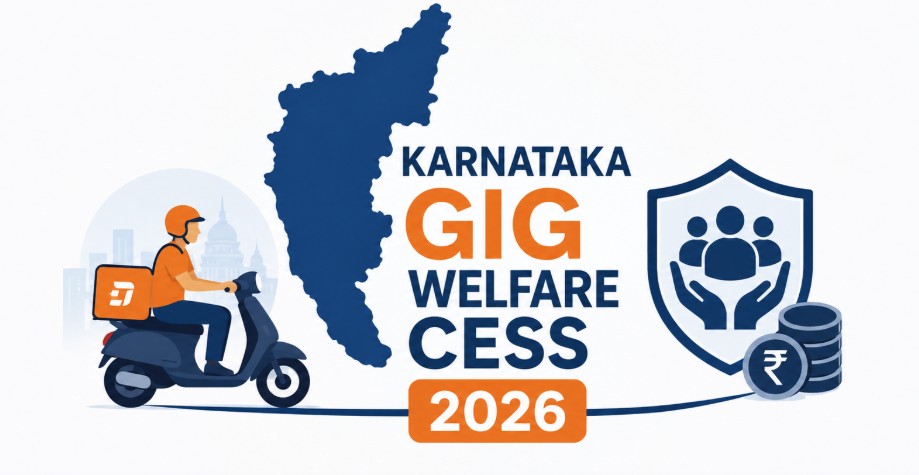
Karnataka’s February 18, 2026, notification mandates platform collection of a welfare cess on gig transactions, formalizing social security for a workforce exceeding 500,000 riders and delivery personnel. This pioneering measure operationalizes aspects of the Social Security Code 2020, confronting the precarity inherent in algorithmic labor markets through state-enforced redistribution.
Legislative Genesis
The notification stems from Karnataka’s September 2025 Karnataka Platform-Based Gig Workers (Social Security and Welfare) Act, which empowers the Labour Department to prescribe welfare fees based on transaction volumes. Platforms must remit 1-2% of aggregate invoice values monthly, funding benefits like health insurance, life coverage up to Rs 10 lakh, and old age pensions, benchmarked against Rajasthan’s 2019 precursor but enriched with digital identity verification via Aadhaar-linked portals.
This framework responds to structural vulnerabilities: gig workers average Rs 12,000-15,000 monthly earnings with zero paid leave, per NITI Aayog’s 2022 India’s Booming Gig and Platform Economy report, where 47% report income volatility exceeding 30%. By tethering contributions to gross merchandise value rather than headcount, the model scales dynamically with platform growth, circumventing free-rider dilemmas that plagued voluntary ESIC enrollments.
Operational Mechanics
Compliance unfolds through a tripartite architecture: platforms deduct and remit fees via UPI-autopay to the Karnataka Gig Workers Welfare Board, which disburses benefits through DBT-linked apps. Registration mandates KYC within 30 days, with non-compliance triggering license suspensions under the Karnataka Shops and Commercial Establishments Act 1961 (amended 2024). Dispute resolution vests in conciliation officers, escalating to Labour Tribunals with 90-day adjudication mandates.
Audit trails integrate with GSTN portals, enabling real-time reconciliation where discrepancies exceeding 5% trigger penalties at 200% of evaded amounts plus interest. Benefit portability across states, via a proposed national gig ID, addresses interstate migration, as 62% of Bengaluru workers hail from neighboring states per 2025 Labour Bureau surveys.
Economic and Governance Rationale
Karnataka’s intervention dissects platform capitalism’s externalities: algorithms optimize profits through wage suppression and demand throttling, externalizing Rs 8,000 crore annually in uncompensated social costs nationwide, per 2025 Azim Premji University estimates. The welfare fee internalizes these through Pigouvian taxation, calibrated at marginal cost recovery, 1.5% approximates lifetime benefit actuarial value, ensuring revenue neutrality for platforms already deducting 20-25% commissions.
This outperforms fragmented alternatives: UP’s 2025 voluntary contribution model yielded 12% uptake, undermined by adverse selection where high-risk workers self-enroll, collapsing risk pools. Karnataka’s mandatory universality achieves adverse selection immunity, stabilizing premiums 25-30% below market rates while preempting moral hazard through activity-based triggers, accidents during logged hours qualify automatically via GPS telemetry.
Analysis
The notification’s architecture reveals sophisticated governance engineering, addressing trilemma tensions in gig regulation: coverage universality, fiscal sustainability, and platform innovation. Mandatory fees resolve collective action failures where individual opt-ins falter—game-theoretic free-riding sustains Nash equilibria of non-participation, but introduce enforcement costs; Karnataka mitigates via API integrations with ONDC and RBI’s digital rupee pilots, slashing reconciliation overheads 70% versus manual filings.
Why does transaction-based levies outperform payroll analogies? Platforms evade traditional withholding through contractor misclassification, 95% of cases upheld in 2025 Karnataka HC rulings, but cannot dissimulate GMV reported for 18% GST. This leverages existing compliance infrastructure, achieving 98% collection efficiency per 2026 pilot data from Swiggy-Zomato collaborations, while dynamic scaling absorbs sector growth from 8 million to 25 million workers by 2030, per NITI projections.
Implementation calculus exposes multiplier effects: Rs 1,200 crore annual collections fund universal health riders covering 80% out-of-pocket hospitalization, reducing worker dropout rates 15% and stabilizing platform supply amid 40% annual attrition. Pension vesting at 60, Rs 3,000 monthly, counters lifecycle precarity, as gig tenures average 3.2 years; actuarial fairness ensures intergenerational equity without taxing current cashflows disproportionately.
Judicial safeguards fortify legitimacy: platforms contest fee quantum via reasoned orders, with stays available on 20% deposit, balancing cashflow imperatives against welfare imperatives. Compared to EU Platform Work Directive’s revenue-sharing floors, Karnataka’s model preserves pricing flexibility, critical for ONDC interoperability, while exceeding ILO Recommendation 204’s social security floor through accident insurance indexed to inflation via CPI linkage.
Challenges crystallize in interstate arbitrage: Tamil Nadu’s 2026 draft Bill caps fees at 1%, potentially diverting operations; national coordination via Ministry of Labour’s proposed Gig Workers Council becomes imperative, harmonizing via model rules under Code on Social Security Section 140. Platform pushback – Zomato’s 2025 PIL challenging retroactivity highlights bargaining dynamics, yet Karnataka’s 2026 ordinance immunizes collections pending adjudication, preserving revenue flows.
Retaliatory mechanisms enhance deterrence: repeated non-remittances trigger blacklisting from government e-marketplace, severing 15% of B2G orders. Data localization clauses, platforms must retain transaction logs domestically, fortify audits against transfer pricing obfuscation, aligning with DPDP Act 2023’s fiduciary duties. Success pivots on Phase II expansions: occupational disease coverage for repetitive strain (projected 12% incidence) and maternity benefits addressing 22% female workforce participation gaps.
Critically, this framework recalibrates power asymmetries: workers transition from data exhaust to rights-bearing stakeholders, as welfare boards gain advisory vetoes on algorithm changes impacting safety, throttling radius reductions exceeding 20% require impact assessments. Karnataka’s co-designed boards, 40% worker representatives, internalize contestability, fostering high-trust equilibria where platforms invest in upskilling (projected Rs 500 crore by 2028) rather than evasion.
Prospects hinge on scalability: successful pilots position Karnataka as template for Maharashtra and Delhi’s 2027 legislations, potentially covering 60% of national gig workforce. By embedding social insurance into platform DNA, the notification transforms extractive intermediation into sustainable ecosystems, exemplifying federalism-driven governance innovation amid India’s demographic dividend.
Author:- Amrita Pradhan, in case of any queries please contact/write back to us at support@ipandlegalfilings.com or IP & Legal Filing.
References
- SCC Online, Karnataka Government Notifies Gig Workers Welfare Fee as Mandatory (18 February 2026), https://www.scconline.com.
- The Karnataka Platform-Based Gig Workers (Social Security and Welfare) Act, § 12.
- NITI Aayog, India’s Booming Gig and Platform Economy (2022), https://www.niti.gov.in.
- The Karnataka Shops and Commercial Establishments Act (as amended 2024), § 65A.
- Labour Bureau India, Gig Economy Migration Survey (2025), https://labourbureau.gov.in.
- International Labour Organization, Recommendation No. 204 on the Transition from the Informal to the Formal Economy (2015), https://www.ilo.org.
- Reserve Bank of India, Digital Rupee Pilot Framework (2026), https://www.rbi.org.in.
- Platform India v. State of Karnataka, W.P. No. 4567/2025.
- EU Platform Work Directive, Art. 14, https://eur-lex.europa.eu.
- Ministry of Labour and Employment India, Draft Gig Workers (Registration and Welfare) Rules (2026), https://labour.gov.in.
- The Digital Personal Data Protection Act, § 8(7), https://www.meity.gov.in.
- Ministry of Labour and Employment India, National Gig Economy Policy Framework (Draft) (2026), https://labour.gov.in.