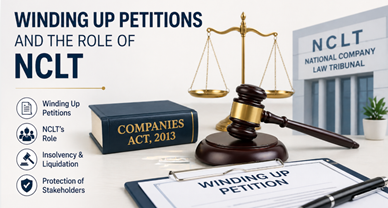
Winding Up Petitions and the Role of NCLT
Introduction
Earlier, the winding up of the companies was governed under the Companies Act 1956 or 2013, but after the change in 2016 with the emergence of the new law i.e Insolvency and Bankruptcy code, 2016 ( herein thereby referred as IBC), the winding up of the companies are done under this new law. It is supported by the Companies (Winding Up) Rules 2020. A change from focus on winding up the company, selling the assets of the company in order to fulfill the obligation of creditors and rightfully paying their dues to now focusing upon the saving of the company and still being rightfully able to pay the dues of the creditors.
With the emergence of IBC, 2016, now the companies have a second chance for survival, this marks a significant shift in the winding procedure of the company. The new procedure allows for all the companies which are not at a stage where the winding up procedure is at an irreversible stage, they can now have their matters transferred to the National Company Law Tribunal hereinafter referred to as NCLT) under the IBC, 2016.
Understanding Legal Provisions Concerning Transfer to NCLT
Section 7 of Insolvency and Bankruptcy code, 2016
A financial Creditor has the ability to file an application for initiating corporate insolvency resolution process before NCLT against his debtor even after there are proceedings pending before the High Court for the same under the Companies Act.
Section 238 of Insolvency and Bankruptcy code, 2016
Overriding Effect of IBC, 2016 over Companies Act, 1956 or 2013- In a scenario where there is a conflict between the IBC, 2016 and Companies Act, 1956 or 2013, the IBC Code, 2016 will always prevail and have an overriding effect over the Companies Act, 1956 or 2013.
Section 434 of Companies Act, 2013
The sub section 1(c) of Section 434 of Companies Act, 2013 states that all proceedings pending before a High Court for winding up must be transferred with immediate effect to the NCLT to look into and decide. But the Companies (Second Amendment) Act, 2017 and Notification dated 7 December 2016 elucidated that only the proceedings which are not at a stage which is so advanced as to not reverse the process of winding up are to be transferred to the NCLT and the court shall exercise its discretion on whether to transfer the petition or not.
Rule 5 of Companies (Transfer of Pending Proceedings) Rules , 2016
This rule extends on the clarification provided by the Section 434 (1) c of Companies Act, 2013 and states that the petition of winding up of companies pending before the High Court and the same has not been yet served to the respondent for consideration shall be transferred to the NCLT and where the application has been transferred to the respondent for consideration, the court shall use its good judgement to consider the transfer to NCLT.
A chance at Revival: Transfer to NCLT
The recent judgement of the Himanchal Pradesh High Court in the Case of Elecon Engineering Company Limited v. M/s Inox Wind Limited & Anr. held in Para 13 that
“By reason of IBC there could be a possibility of initiation of proceedings under Sections 7 and 8 of IBC in relation to a company against whom a winding up petition is pending. A reading of the provisions of IBC with the Companies Act, 2013 undoubtedly would have primacy over the Companies Act, in case, there is a conflict as the ultimate object of IBC is to resuscitate the corporate debtors who are in the red. This approach is also in some cases necessary to transfer the winding up proceeding to NCLT to prevent parallel proceeding”
While giving the judgement in the case of Elecon Engineering Company Limited v. M/s Inox Wind Limited & Anr. , the Himachal Pradesh High Court placed reliance on the landmark Supreme Court Judgement in the case of Action Ispat & Power (P) Ltd. v. Shyam Metallics & Energy Ltd., held in the Para 25 that
“It is only where the winding-up proceedings have reached a stage where it would be irreversible, making it impossible to set the clock back that the Company Court must proceed with the winding up, instead of transferring the proceedings to NCLT to now be decided in accordance with the provisions of the Code. Whether this stage is reached would depend upon the facts and circumstances of each case.”
Dissecting the above judgements and assessing the legal obligation of the Courts to now transfer the proceedings to the NCLT in case of an application by either the company itself or any of the company’s creditors when the stage of the proceeding is as such that it is not irreversible. What is meant by the term “proceedings have reached an irreversible stage” is that a point in the case where the winding up of the company has been done already to such an extent that it is impossible to not wind up the company anymore which exhausts the very purpose of transferring the petition to the NCLT in order to save and revive the company.
Implications for companies facing liquidation
This pro revival approach comes as a silver lining for the companies. This enables a pathway for both the creditors as well as the companies to both mutually benefit from the revival of the company. The winding up of a company is a lengthy and tiring procedure which results in the inevitable shutting down of a company but the IBC, 2016 provides an alternative by reviving the company as well as helping the company to clear the dues of their creditors at the same time. A paradigm shift from liquidation first to resolution first is the contemporary approach for winding up petitions in India.
The NCLT provides for multiple solutions for the Companies facing liquidation which include restructuring of the entity, change of management, new investments into the company etc. This way the interest of the shareholders are protected along with that, it provides a chance to the company a new chance at life with the much needed changes in order for its viability. A faster, firmer and time bound decision of the NCLT as compared to the time consuming, too concerned about procedural aspect decision of the High Court due to increasing number of cases in Courts is what makes the NCLT stand out and why creditors and companies both prefer to proceed and initiate proceedings under NCLT.
Challenges and Judicial Trend
With the restructuring of the companies, there comes a series of challenges for the changes to settle which temporarily delays the repayment of the due amount to the rightful creditors. Though for a short period of time, the creditors for sure suffer due to the temporary injunction which might be passed for exploring the different routes in order to prevent liquidation. Earlier, due to lack of sufficient guidelines regarding at what stage to transfer the winding up petition, the High Courts exercised their own discretion and there was no common standard laid down for the same but that has been changed by the clearly laid view point of Supreme Court in the landmark case of Action Ispat & Power (P) Ltd. v. Shyam Metallics & Energy Ltd.
Conclusion : Alignment With The Objectives Of Corporate Insolvency Resolution
The main essence of that IBC is to balance the rights of both the company and the creditors and ensure the resuscitation of the company. The transfer of winding up petitions to the NCLT serves the dominant objective of the Corporate Insolvency Resolution which is to preserve the company. This shift in modern India encourages the revival of the company rather than the fragmented approach of liquidation. To conclude, as long as the proceedings instituted in the High Court for winding up of the Companies are in the initial stages, then on application of either the Company or any of the creditor, the Court shall transfer the petition to NCLT. Resolution before liquidation is the new motto of the companies facing financial trouble and this provides them a fair chance to recover.
Author:– Ms. Garima Agarwal, in case of any queries please contact/write back to us at support@ipandlegalfilings.com or IP & Legal Filing.
References
- Insolvency and Bankruptcy code 2016.
- The Companies Act 2013.
- The Companies Act 1956.
- Companies (Transfer of Pending Proceedings) Rules 2016.
- Elecon Engineering Company Limited v M/s Inox Wind Limited & Anr 2025:HHC:11215.
- Action Ispat & Power (P) Ltd v Shyam Metallics & Energy Ltd (2021) 2 SCC 6