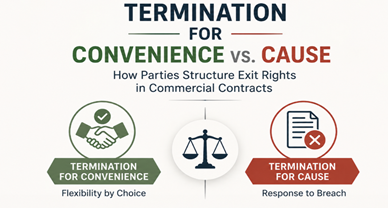
Termination for Convenience vs. Termination for Cause: How Parties Structure Exit Rights in Commercial Contracts
Introduction
When considering rights of an individual or entity in commercial rights, the right to exit from a contractual relationship is at par with the right to enter one. There are two principal mechanisms:
- Termination for cause
- Termination for convenience
While the former is concerned with breach or default of contract by one party, the latter allows termination without the need for any wrongdoing. This blog discusses these mechanisms under the Indian Contract Law, their strategic and commercial significance, and how they influence ongoing contractual relationships.
Interpreting the Clauses: Definitions and Distinctions
- Termination for Cause
Termination for cause occurs when a party exercises the right of termination based on a default by the other party in essential terms, insolvency, fraud, or other similar wrongdoing. It is a default-based termination and usually includes a cure period during which the defaulting party has an opportunity to cure its default.
For instance, a software services agreement could stipulate that a customer can terminate the agreement if the service provider fails to attain Service Level Agreements (SLAs) for three successive months.
- Termination for Convenience
Conversely, termination for convenience enables a party to withdraw from the agreement without fault or default on another’s part. The privilege is normally exercised in such a way as to provide protection against commercial uncertainty, shifting business priorities, or variations in cost.
Termination for convenience is neither a doctrine of Indian law and must be expressed in the contract. In the absence of such a clause, unilateral termination without cause would amount to wrongful termination damages.
Legal Position Under Indian Law
Indian contract law, governed primarily by the Indian Contract Act, 1872, does not enforce a general principle of unilaterally terminating a contract without cause unless otherwise contracted. This is because contractual obligations are meant to be performed as agreed, and the law presumes that both parties have entered into the agreement with a binding intention.
- Statutory Provisions
Section 37 of the Indian Contract Act obligates parties to perform their contractual obligations unless law excuses them from obligation.
Section 39 allows termination for non-performance of obligations in full at cause’s benefit.
Section 73 enunciates the form of compensation on breach involving wrongful termination.
- Judicial Interpretations
Indian courts have held in all cases uniformly that termination for convenience is legal only if specifically mentioned in the agreement. In Indian Oil Corporation Ltd. v. Amritsar Gas Service, the Supreme Court of India categorically held that even when termination for convenience is being invoked in terms of contract, there could be compensation payable for losses.
In Air India Ltd. v. GATI Ltd., the Delhi High Court held that where there is a repudiatory breach by one party, the other may terminate even if the contractual termination formalities were not strictly followed because the breach itself rendered the process redundant.
Commercial and Strategic Considerations
- For Cause Clauses – Risk Management and Accountability
Maintaining an effective “for cause” termination clause allows parties to manage risk by:
- Creating leverage in guaranteeing performance.
- Providing exit on time in case of poor quality, delay, or misconduct.
- The reason for granting reputational
These conditions are most crucial in long supply, outsourcing, or licensing arrangements, where string of default can devour business value.
Strategic drafting tip: The parties typically define what constitutes a “material breach” and specify cure periods so that there is no dispute on whether termination is warranted.
- For Convenience Clauses
For convenience clauses are more contentious. Although they give flexibility, they disrupt long-term planning by the counterparty.
Employers and corporates prefer such provisions in employment, vendor, and consultancy contracts to maintain exit options open. However, a well-drafted clause shall:
- Require notice (e.g., 30 or 60 days).
- Be objective.
- Provide for payment for work completed or transition fees.
Commercial practice, of course, is that usually vendors, contractors, or the smaller players resist such terms, requesting minimum term periods or pre-termination fees.
Drafting Best Practices
- Language and Clarity
There has to be certainty to minimize disputes. Provisions should mention:
- Basis of “cause” (e.g., insolvency, regulatory defaults).
- Cure periods and procedures.
- Notice periods.
- Compensation or fees on termination.
- Notice Requirements
Courts tend to examine if procedural conditions for termination, such as providing written notice within a specified time have been met. Non-compliance may make termination ineffective, even if substantively warranted.
- Compensation and Limitation of Liability
Termination for convenience clauses must clearly provide:
- Whether the party terminating will compensate for unbilled services.
- Any liquidated damages.
- Refund of advance payments or security deposits.
Indian Industry Examples
- Government Contracts
In government contracts and government procurement, the Government of India ordinarily reserves the right to terminate for convenience without liability in excess of payment for work performed.
This is a public interest reason to enable government departments to modify priorities without incurring long-term commitments.
- Employment Contracts
Termination at convenience of employment contracts will remain governed by the Industrial Disputes Act, 1947 and law of labour. In Air India v. Nergesh Meerza, arbitrary termination clauses have been held to be non-enforceable on grounds of being violative of Article 14 of the Constitution.
International Contracts and Indian Enforceability
Under cross-border contracts, Indian companies can be subjected to boilerplate termination at will under US style. Indian law, being more stringent on this aspect, might require:
- Governing law provisions.
- Local enforceability screening.
- Adequate arbitration or dispute resolution clauses.
Indian courts will only give effect to such provisions in the event that they don’t violate public policy or legislative rights.
Disputes and Trends in Litigation
Disputes over termination clauses tend to pivot around:
- Whether or not termination was validly triggered.
- Whether notice and protection of procedure was followed.
- Whether termination was
- Quantum of damages recoverable.
Indian courts are embracing commercial realism, enforcing contractually bargained rights while protecting parties against arbitrary conduct.
Conclusion
Termination clauses are more than legal boilerplate; they are also tactical tools dispersing risk and demarcating the existence life cycle of a commercial relationship. Indian courts will enforce for cause and for convenience termination provisions as long as they are sufficiently articulated, reasonably invoked, and consistent with contractual and statute demands.
Parties should consider power, business value, and compliance when they negotiate such provisions. A good termination clause will steer clear of exposure to law but still offer business flexibility.
Endnotes:
- The Indian Contract Act, No. 9 of 1872, (India).
- Indian Oil Corp. Ltd. v. Amritsar Gas Service, (1991) 1 SCC 533 (India).
- Allan Farnsworth, Contracts § 8.16 (4th ed. 2004).
- Ministry of Finance, Government of India, General Financial Rules, 2017, Rule 204(v).
- Air India v. Nergesh Meerza, (1981) 4 SCC 335 (India).
- See Bharat Aluminium Co. v. Kaiser Aluminium Technical Services, (2012) 9 SCC 552 (India).
- The Industrial Disputes Act, No. 14 of 1947, India Code.
- Justice A.S. Anand, Contract Law in India, LexisNexis Butterworths (2019).
- Air India Ltd. v. GATI Ltd., Delhi HC, 2015.