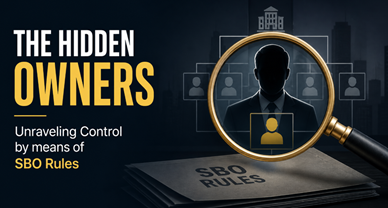
The hidden owners: Unraveling control by means of SBO rules
Introduction
Business in India is apparently well-integrated and clean. It has registers for directors and shareholders. Looking beyond the surface of these companies; there are owners of the businesses that are hidden.
They are identified as Significant Beneficial Owners (SBOs). Although an effort has been made by the Indian Companies Act, 2013 (specifically Section 90) to bring out these individuals, the question arises whether India is trying to bring out the true owners of these companies or is it merely trying to look through the misrepresentations of what these companies project to the world.
Main Blog
On Outside Paper: Explaining SBO
Section 90 of the Companies Act, 2013 highlights that on paper ownership may be different from actual control. It states that the absentee director is not necessarily the one calling the shots. The concept of SBO enlarges the definition to include anyone who owns, directly or indirectly, at least 10 % of the voting shares or voting power or exercises or is able to exercise significant influence or control.
This is significant. Because in the corporate world control is seldom located where it is documented.
Reason for SBO Rules: In search of the real power
Today’s business organizations are built-knowingly or unknowingly-over others to take ownership far away from the seat of management. Multi-tier subsidiaries, off-shore bodies, nominee shareholders and financiers put a wall around ownership.
The purpose of SBO norms is to fill this void:-
- To make control transparent
- To deter financial crimes-money laundering
- To promote good Governance
- To be responsible
But the problem is- A law can call for transparency, but it cannot force an honest personal conduct.
Legal Frame Work : Strong on Paper
Section 90, along with Companies (Significant Beneficial Owners) Rules, 2018, erect a laid down compliance architecture:
SBOs to submit declarations of their interests
Companies to identify and keep records
filings to be made to the Registrar of Companies
penalties for non-compliance
On paper, it appears comprehensive. In reality, it relies a great deal on self-disclosure- and this is where its strengths dissolve.
Judicial Glimpses:Lifting the Corporate Veil
Indian courts have held that: “It is now well settled law that a corporate structure could be misused for concealing the truth”. The Supreme Court in Life Insurance Corporation of India v. Escorts Ltd. held that though the corporate body has a distinct legal entity, the corporate veil shall be lifted where the true culpable actors are to be ascertained.
Even further in the case of Delhi Development Authority v. Skipper Construction Co. (P) Ltd., the Court pointed out that the corporate mask could not be used as a cloak to mask …a nexus or …some dereliction of duty.
The Registrar of Companies declared the Significant Beneficial Owners (‘SBOs’) of Samsung Display Noida Private Limited (‘SDNPL’) to be non-compliant with Section 90 of the Companies Act, 2013, which was missing a declaration of such SBOs. SDNPL argued that, as no individual shareholder held a majority stake, the Lees did not have any control of the business. The case demonstrates the fact that indirect ownership and control should be taken into account when declaring SBOs.
In the case of LinkedIn Technology Private Limited (Instituted under the Registrar of Companies RoC in NCT of Delhi &Haryana and High Court of Delhi) the broader and more liberal interpretation of provisions of Relevant Beneficial Ownership SBO would lead to RoCs being armed with powers to initiate enforcement proceedings against CEOs of Multinational holding companies operating in different parts of the world. This would require such provisions to be rigorously tested across complex holdingtraders, undercutting corporate separateness and attributing personal liability on foreign CEO executives for Indian subsidiary noncompliance.
This is a case in point: LinkedIn’s illicit SBO dosclosures- even in the face of clear control by Microsoft managers- nonetheless led to disclosure breach, with sanctions highlighting the importance of timely, accurate filings based on an improved standard of corporate governance leadership. These examples demonstrate the judiciary’s abiding wish to probe-an ownership scheme to disguise aberrant conduct-the law endures to see behind the façade. SBO rules represent an effort to encode this policy but may avoid future judicial intervention.
The really hard part: The bridge between the Law and Reality
And now we get into the uncomfortable part:
- Complex ownership structures
In contemporary corporate and ownership structures, isolating who controls SBOs is often feasible only after a substantial effort by experts. Picture impossible.
- Reliance on self-disclosure
Today we tend to assume that if an individual controls an SBO they will tell us-that is… optimistic.
- Enforcement Constraints
Almost no regulator has the personnel or resources to verify all of the disclosures individuals are required to complete.
- Interpretational ambiguity
“Considerable influence” and “Control” are not always unambiguous, resulting in possible strategic avoidance.
Critical Analysis: Transparency or Controlled Visibility?
Transparency provided by SB0 regulations is definitely a step forward but not a panacea. Currently, the existing framework seems to be more direct in letting through those who are eager to cooperate not guaranteed in conveying those who want to adhere to the requirements of ad hoc arrangements. There’s also an underlined bifurcation:
transparency entails balancing disclosure of material information business considerations require privacy somewhere between, the law mediates.
However, let us face the stark realities. When enforcement becomes lax and investigative resources are constrained, disclosures of material events and happenings by a listed company can turn into edited versions of facts instead of pure and plain facts themselves.
Conclusion
SBO’s mark a significant change in corporate law from the concept of ownership to that of control. It transmits an indication of transparency to flourish where non-transparency historically was the defining feature.
Yet, intentions are not sufficient.
For the rules to be more meaningful, India has to go beyond disclosure, and develop better quality of verification, enforcement and trans-national cooperation.
Until then, the “invisible owners” might not be all that invisible—but they won’t be all that exposable either.
Author:– Harshitha SV, in case of any queries please contact/write back to us at support@ipandlegalfilings.com or IP & Legal Filing.
References
1) Companies Act, 2013 – Section 90
2) Companies (Significant Beneficial Owners) Rules, 2018
3) Life Insurance Corporation of India v. Escorts Ltd, (1986) 1 SCC 264.
4) Delhi Development Authority v. Skipper Construction Co. (P) Ltd,(1996) 4 SCC 622.
5) Samsung Display Noida Limited, ROC, Uttar Pradesh.
6) Linkedin Technology Private limited, ROC, NCT of Delhi & Haryana.
7) Ministry of Corporate Affairs Circulars.