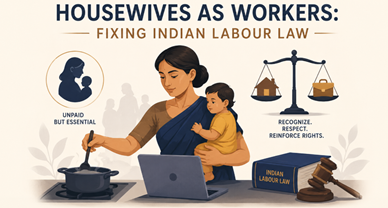
Housewives as Workers: Fixing Indian Labour Law
Introduction
A private chef, a cleaner, a tutor, a therapist, caring and nursing, ironing and laundry services, all of these jobs that cost a hefty amount, are being done by housewives for free. According to data from the National Statistical Office (NSO), about 160 million Indian women are engaged as housewives and spend 5 hours a day, or 299 minutes, on unpaid household work for household members.[i]It is hightime that homemaking is recognized as an official profession and an important economic activity that supports the Indian economy.A housewife is a woman whose primary occupation is managing the household affairs,including cooking,cleaning, and child-rearing, without any payment or remuneration, but once we recognize this unpaid labour as a valid job, we can also create legal recognition under the existing labour laws to provide this huge chunk of our population with safeguards against exploitation. In addition to their obvious contributions, housewives also enable their husbands to go out to work and earn money for the family and help build the future generation, that is, the children. This is a contribution by housewives not only to the present economy but also to the future economy. Households rely on this labour as an additional saving measure, especially in lower-income households. This burden limits women’s opportunities to engage in paid employment, while they continue to contribute to an invisible economy for no pay.
In this blog post, I shall analyse the existing laws governingunpaid labour by housewives in the labour sector and what they do not cover. I shall also bring to light international laws that formally recognize the profession of housewivesand provide them with benefits. Subsequently, I shall compare these frameworks with the prevailing situation in India and propose tailored policy measures for effective implementation here. Finally, this blog post will address implementation gaps and anticipate counterarguments.
Existing Indian Laws: Coverage and Critical Gaps
India’s labour framework has recognized diverse types of workers, including, in some instances, domestic workers, but has refused to recognize housewives. However, while we do not have the statutory teeth, the Indian Judiciary has, at multiple times, evaluated the cost of work done by housewives. Courts have quantified this labour value in various legal cases based on opportunity cost and skill, with the aim of providing financial compensation for labour. However, they only equate this professional work for compensation purposes in motor accident deaths or injury claims, where families can receive payouts for lost contributionsand do not pay them a salary for labour. The Courts basically calculate a notional income for unpaid work to award fair damages, as in Lata Wadhwa v. State of Bihar.[ii]It has also been the case that they have received maintenance and property rights from the earning spouse’s income as recognition of their contribution to the household, as done in Kannaian Naidu v. Kamsala Ammal[iii]; however, this is still an indirect payout that is received only under specific circumstances.
The Unorganized Workers Social Security Act, 2008[iv] (hereinafter,the UWSSA) covers almost all workers in the unorganized sector, such as bidi workers and construction workers, and provides them with life or health insurance, old-age pensions, etc., through welfare boards. However, housewives are not recognized as unorganized workers because they lack employer contracts. Despite performing an endless number of domestic tasks, a mere technical discrepancy can turn them from paid workers into unpaid labourers with no legally enforceable benefits.
In People’s Union for Democratic Rights v. Union of India[v], it was held that non-payment of minimum wages constitutes forced labour under Articles 23[vi] and 43[vii] of the Indian Constitution. However, under the Minimum Wages Act, 1948[viii], 18 categories of scheduled employments have been identified, including maids and gardeners, but housewiveshave still not been formally recognized under this law. They perform identical tasks to these workers, but because they lack an employer-employee relationship, they are excluded from earning even the minimum wage. Even the Code on Social Security,2020[ix], which recognizes gig and platform workers, does not formally recognize housewives or grantthem anybenefits.
Therefore, we can say that there is no specific Indian statute that directly recognizes the unpaid labour done by housewives as an official profession, acknowledging the need for a policy to protect these women from being exploited. However, courts have increasingly recognized the value of their work through judicial interpretations in family law contexts,bringing us one step closer to the end goal.
International Frameworks: Models of Formal Recognition
The UN’s Convention on the Elimination of All Forms of Discrimination Against Women (CEDAW)[x], which India has ratified, calls for the valuation of unpaid care under Article 11. In fact, the UN Sustainable Development Goal 5.4 targets the recognition and valuation of unpaid labour by housewives by 2030.
One of the main issues in the Indian System is that it does not recognize much of the work done by housewives as an economic activity. India has a pre-dated criterion for what constitutes an economic activity, and this burden ultimately falls on households. The table below shows a clear difference between the Indian and UN systems[xi].
In 2007, Venezuela’s government initiated a program for stay-at-home mothers and housewives in low-income brackets, aiming to recognize domestic labour as a valuable economic activity. In fact, Article-88 of the Venezuelan Constitution[xii] states that “the state shall recognize work at home as an economic activity that creates added value and produces social welfare and wealth.” Housewives were actually entitled to social security under this law, and this program was intended to provide housewives with a salary equivalent to 80% of the national minimum wage, a milestone for gender equality and the fight against unpaid labour everywhere.
These payments must not be seen as handouts but earned wages given for productive work.
Indian Policy Proposal – India Specific Action Plan
Labour Laws are the need of the hour for full-time housewives. While unconditional cash payments can create dependency, other forms of Social Protection Policies must be implemented nationwide by the Central Authorities. Once the Centre passes legislation formally recognizing homemaking as a professional occupation and making it uniformly applicable across India, we can take one step closer to bridging the gender income disparity in India.While the first step and primary focus should be on housewives in lower-income households, once the foundation has been laid, these policies should apply to all, including those in middle-class households.This can be done in many ways-
- Expanding Definitions-The UWSSA could be amended, and unorganized workers could be redefined to include housewives. E-Shram cards with self-declarations could be distributed to all housewives or, the Minimum Wages Act, 1948, could add housewives to its list of professions, with skill-based divisions between basic care for a nuclear family and advanced care for a joint family. The Code on Social Security, 2020, which ensures social security to all, must also ensure that once a housewife becomes a senior citizen, she can have a pension to fall back on, even if she is not actively contributing to the economy.Furthermore, it must provide accident coverage for any home injuries. This can be seen as a welfare scheme in accordance with the principles setout in Article 15 of the Indian Constitution[xiii].Furthermore, an important aspect of this policy is that benefits or wages, in whatever form, are transferred directly into the hands of the housewife to prevent any malpractice or misuse.
- Promoting market entry – These policies, while aimed at recognizing the important work done by housewives, shall also simultaneously promote market entry in various ways. For example, a registered housewife holding an E-Shram card shall earn credits under the Pradhan Mantri Kaushal Vikas Yojana (PMKVY), which shall enable market entry. This shall be done to ensure that women do not get trapped in traditional rolesand make it harder for them to gain marketable skills for outside work.
- Phased Rollout- Just like how all policies, including One Nation One Election, Uniform Civil Code, etc., will be implemented in a phased manner, these policies must also be implemented in the same way. This is because policies recognizing housewives’right to be paid for their unpaid labour can only be implemented perfectly if time is taken to understand the ground reality of how women and the Indian demographic as a whole would react to such a Policy. It could be piloted in 5 states first, then rolledout nationwide via the E-Shram Cards. The policy implementation shall be continuously monitored by NITI Aayog, and any disputes may be heard by the Labour Tribunal, with the option to appeal to higher courts if not resolved.
Addressing Implementation Gaps and Counterarguments
A criticism of implementing such a scheme would be that “paying housewives increases dependency/unemployment.”However, this is not free money. Itiswages that shouldbepaidfor valid labour. For example, for a long time, social media influencers were not considered a profession; now,India’s influencer marketing sector is projected to reach INR3,375 crore by 2026, with a CAGR of 18%.[xiv] Recognition creates jobs; it does not kill them. On a social note, it could prevent women from being treated as unpaid domestic workers.
Secondly, instead of cash handouts, payments can be provided through universal basic services such as healthcare, insurance coverage, and market-entry credits. They must be classified as self-employed domestic workers under the Code on Social Security, entitling them to pensions andInsurance, mirroring theapproach to ASHA workers.
If administrative and financial burdens are a concern when registering about 160 million housewives, a phased rollout policy has previously been suggested in this blog. Furthermore, these policies would serve as and incentive to boost female workforce participation and contribute to the country’s GDP, as the ultimate goal is to increase self-sufficiency and discourage women from relyingsolely on their families for financial assistance. Having a social support network from the government, in this author’s opinion, would allow women to pursue their ambitions and ultimately join the organised sector. Furthermore, through PMKVY,they shall have the opportunity to enter the real world and find work outside their homes.
Another implementation obstacle could be verification issues, which can be addressed by having housewives, provide self-declarations with family affidavits and have them audited by the labour tribunals to prevent misuse, as was done in the employees’ provident fund (EPF) fraud cases.
These measures ensure that a transformation of labour law regarding housewives’ unpaid labour can be achieved through enforceable reforms.
Conclusion
A homemaker does not sit idle; she performs labour that enables the earning spouse to function effectively. – Justice Swarana Kanta Sharma (Delhi High Court)
Reforming India’s labour code for housewives requires not just political will but also public recognition of the importance of the work that housewives do. It demands that political parties demonstrate genuine interest and commitment to investing in such a large social cause, as this is definitely not a profit-oriented policy but a social welfare policy, which should ultimately be the goal of any welfare state, such as India.
Furthermore, India, as a country that has ratified CEDAW and recognized the SDGs, must align itself with international law mandates. It must shed the outdated notions of what labour is, confining it to just factories and offices or employer-employee relations,and instead redefine economic activity to encompass unpaid care.
Courts have time and time again recognized this labour, provided valuation for it,and compensated women in different circumstances; it is time the statutes followed suit. Envision 160 million women empowered, GDP surging, families thriving, and gender gaps closing. Policymakers must take this moment to recognize that kitchens are the economy’s hearth; it is time to light it with justice.
Author:- Laya Charan, in case of any queries please contact/write back to us at support@ipandlegalfilings.com or IP & Legal Filing.
References
[i]https://www.thehindu.com/opinion/open-page/life-of-homemakers/article66636727.ece
[ii]Lata Wadhwa v. State of Bihar, (2001) 8 SCC 197, para.10
[iii]Kannaian Naidu v. Kamsala Ammal, 2023 SCC OnLine Mad 4077
[iv]The Unorganised Workers’ Social Security Act, No. 33 of 2008, India Code (2008).
[v]People’s Union for Democratic Rights v. Union of India, (1982) 3 SCC 235
[vi]India Const. art. 23
[vii]India Const. art. 43
[viii]Minimum Wages Act, No. 11 of 1948, India Code (1948) (India).
[ix]The Code on Social Security, 2020, No. 36 of 2020, INDIA CODE § 1 (2020).
[x]Convention on the Elimination of All Forms of Discrimination Against Women, Dec. 18, 1979, 1249 U.N.T.S. 13.
[xi]Source: Compiled from the System of National Accounts, 2008 (www.imf.org; https//unstats.un.org) based on 18th ICLS and NSS 68th Round 2011-12, Report No. 559: “Participation of Women in Specified Activities along with Domestic Duties”.
[xii]CONSTITUTION OF THE BOLIVARIAN REPUBLIC OF VENEZUELA art. 88 (Venez. 1999).
[xiii]INDIA CONST. art. 15, cl. 3.
[xiv]https://www.ey.com/en_in/insights/media-entertainment/how-influencer-marketing-is-impacting-brands-in-india