FRAND and Standard Essential Patents in India’s Smart Device Transition
Introduction : Standard Essential Patents (SEPs) were once associated primarily with mobile telecommunications. That association is no longer adequate. As India expands smart home appliances, connected vehicles, smart grids, industrial sensors and digitally integrated public infrastructure, technologies governed by technical standards are becoming embedded in sectors that traditionally operated outside the telecommunications industry.
This transition creates a new licensing challenge. A manufacturer of a smart meter, electric vehicle component, connected appliance or energy-management system may need access to technologies covered by SEPs even though it is not itself a telecommunications company. The resulting dispute is not simply about the amount of royalty payable. It concerns the relationship between private patent rights, industry-wide standards, market access and competition law.
The central question for the Competition Commission of India (CCI) is whether a SEP holder has used the market power created by standardisation to impose unfair or discriminatory licensing conditions. Section 4 of the Competition Act 2002 prohibits abuse of a dominant position, including the imposition of unfair or discriminatory conditions or prices. However, the application of this provision to SEP disputes has been legally contested, particularly after the Delhi High Court’s intervention in the Ericsson litigation.
India’s emerging smart-device economy makes this question more consequential. A licensing dispute involving a smartphone manufacturer affects a particular product market. A dispute involving smart-grid infrastructure may affect electricity distribution, public procurement, energy reliability and the deployment of low-carbon technologies. The competitive harm may therefore extend beyond the immediate parties.
The SEP and FRAND Relationship
An SEP is a patent that protects technology necessary to comply with a technical standard. If a product is designed to operate according to that standard, the manufacturer may have no commercially realistic alternative to implementing the patented technology. This creates a structural problem. Before the standard is adopted, several technologies may compete. After adoption, the selected technology becomes indispensable to all compliant products.
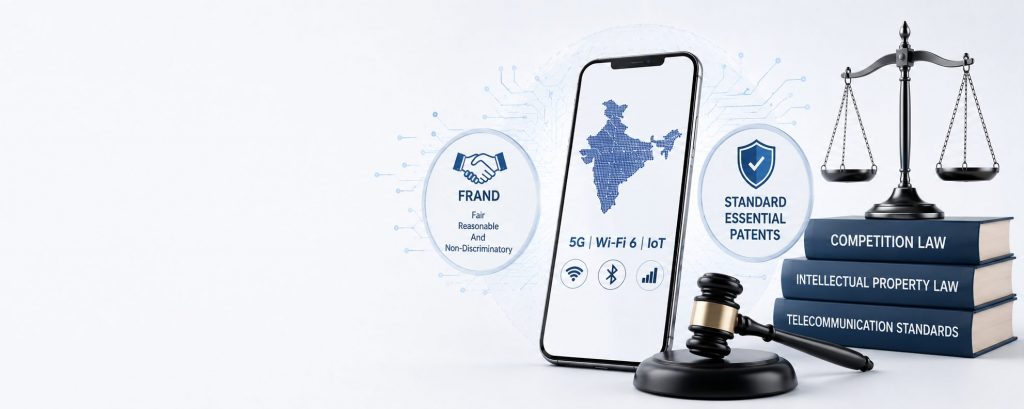
Standard-setting organisations address this problem by requiring participating patent holders to commit to licensing SEPs on FRAND terms. FRAND means fair, reasonable and non-discriminatory. The commitment is intended to preserve two interests at the same time. Innovators should receive compensation for contributing valuable technology, while implementers should be able to access the standard without being subjected to exploitative or discriminatory conditions.
The difficulty is that FRAND is not a single royalty formula. “Reasonable” may depend on the value of the patented contribution, the number of relevant SEPs, comparable licences, the stage of negotiation and the commercial role of the technology. “Non-discriminatory” does not necessarily mean identical terms for every licensee. Different terms may be justified by volume, territory, field of use, payment risk, cross-licensing or other objective differences.
The issue becomes sharper when a SEP holder calculates royalties based on the price of the finished product rather than the value of the component implementing the technology. In the Ericsson disputes, complainants argued that royalty demands based on the end-product price could overstate the contribution of the relevant technology and impose excessive costs on manufacturers. That concern becomes especially significant for smart devices containing multiple technologies supplied by different firms.
CCI’s Earlier Approach
The CCI’s early SEP cases arose from complaints against Ericsson by Indian handset manufacturers, including Micromax and Intex. The allegations included excessive and discriminatory royalties, forced execution of non-disclosure agreements, bundling of patents that were not required by the implementer, and demands calculated by reference to the price of the end product.
The CCI treated these allegations as capable of constituting abuse of dominance under Section 4. Its reasoning was that a SEP holder may possess significant market power because implementers cannot realistically avoid using the standard. If the patent holder then imposes exploitative conditions, the FRAND commitment may become a means of restricting competition rather than facilitating standardisation.
In 2016, the Delhi High Court upheld the CCI’s authority to investigate the allegations at the prima facie stage in the Ericsson litigation. The decision was significant because it recognised that the existence of patent rights does not automatically exclude competition-law scrutiny. Patent ownership gives the holder certain exclusionary rights, but those rights may be examined when their exercise affects market conditions and access to essential technology.
The CCI’s approach therefore focused on conduct and market effect. It did not necessarily assume that every high royalty was unlawful. Rather, it identified possible indicators of abuse, including unreasonable pricing, discriminatory treatment, restrictions on access to information and procedural terms that made effective negotiation difficult.
The Jurisdictional Tension
The relationship between the Patents Act 1970 and the Competition Act 2002 remains central to SEP disputes. SEP holders have argued that patent licensing, infringement, injunctions and royalty-related matters are governed by the specialised patent framework. On this view, the CCI should not use competition law to supervise licensing terms that arise from patent rights.
The opposing position is that patent law and competition law address different concerns. Patent law determines the scope and enforceability of exclusive rights. Competition law examines whether the use of those rights harms competition in a relevant market. A patent may be valid and enforceable, yet its licensing conduct may still raise competition concerns if the holder uses indispensable technology to impose exclusionary or exploitative conditions.
The Delhi High Court’s 2023 judgment in the Ericsson proceedings created substantial uncertainty by holding that allegations concerning the exercise of patent rights in licensing could fall within the exclusive domain of patent law in the circumstances before the court. The judgment treated the Patents Act as the special statute governing the relevant conduct. This created a restrictive environment for CCI intervention in SEP licensing disputes.
However, the legal debate did not eliminate the underlying economic problem. If competition law is unavailable, a manufacturer may have to challenge abusive licensing only through patent-law proceedings or contractual mechanisms. That can be expensive and procedurally slow, particularly for MSMEs that lack the bargaining power and financial resources of multinational SEP owners.
Smart Grids and Non-Telecom Implementers
Smart-grid infrastructure illustrates why the SEP debate must now extend beyond mobile phones. A smart grid may use communication standards for smart meters, grid sensors, demand-response systems, electric-vehicle charging, remote monitoring and distributed energy management. These devices may rely on standardised connectivity even though their principal function concerns electricity rather than communication services.
The implementers are likely to be diverse. They may include energy-technology companies, meter manufacturers, software providers, engineering firms and MSMEs supplying components to public or private utilities. Such businesses may not have experience negotiating global patent licences. They may also lack information about which patents are essential, whether the patents are valid, and whether the requested terms are comparable with licences granted to larger firms.
This creates an asymmetry of information and bargaining power. The SEP holder may possess detailed knowledge of its portfolio, prior licences and industry benchmarks. The MSME may know only that access to the standard is necessary to participate in a tender or supply chain. If the licensing demand arrives after the product has been designed and investments have been made, the implementer’s ability to refuse becomes even weaker.
The public dimension intensifies the problem. A smart-grid project may operate under government procurement deadlines, regulatory performance obligations and infrastructure planning cycles. If licensing uncertainty delays deployment, the effect may include higher project costs, delayed energy-efficiency benefits and reduced competition in the supply of grid equipment. The relevant harm is not confined to the royalty paid by one manufacturer.
How CCI May Assess Abuse of Dominance
The first step would be market definition. The CCI may ask whether the relevant market is the technology market for a particular standard, the licensing market for specific SEPs, or a broader product market involving smart-grid equipment. The answer matters because dominance depends on the alternatives available to the SEP holder’s counterparty.
A SEP holder may not be dominant in the market for all smart-grid products. It may nevertheless possess dominance in the licensing market for a particular patented technology if the standard makes substitution practically impossible. The CCI would need to examine the importance of the standard, the availability of technically viable alternatives, switching costs, interoperability requirements and the feasibility of redesigning the product.
The second step would involve examining the challenged conduct. Possible indicators include:
- Royalty demands that bear no reasonable relationship to the economic value of the patented contribution.
- Royalties calculated on the entire device or system price where the SEP performs only a limited technical function.
- Refusal to provide sufficient information to assess the patent portfolio or royalty basis.
- Discriminatory terms imposed on similarly placed licensees without objective justification.
- Bundling of essential and non-essential patents without meaningful choice.
- Coercive non-disclosure conditions that prevent the implementer from evaluating or challenging the demand.
- Threats of injunctions or exclusion from supply chains before the parties have engaged in a genuine FRAND negotiation.
The third step would require an assessment of competitive effect. The CCI would need to distinguish between a difficult but legitimate licensing negotiation and conduct that excludes rivals, raises their costs or prevents market entry. An MSME’s inability to obtain a favourable royalty alone may not establish abuse. The analysis should ask whether the terms materially impair competition, whether the conduct affects access to the standard, and whether the SEP holder has offered a credible path to licensing.
The fourth step would involve assessing objective justification. A SEP holder may explain price differences through volume, territory, credit risk, litigation exposure, cross-licensing, technical support or different fields of use. The CCI would need to examine whether those explanations are genuine and proportionate rather than post hoc reasons for discriminatory treatment.
Conclusion
India’s transition toward smart appliances, smart grids and electric vehicles is expanding the SEP problem into sectors where manufacturers and MSMEs may have limited experience with FRAND licensing. The issue is no longer confined to whether mobile-phone royalties are excessive. It concerns whether access to standardised technologies will remain open enough to support broad participation in India’s digital and energy transition.
The CCI’s assessment of abuse of dominance should begin with market power created by standardisation, then examine the transparency, proportionality and discriminatory effects of the licensing conduct. Patent ownership should not immunise conduct that harms competition, but competition law should also avoid becoming a mechanism for imposing an artificial royalty level or rewriting legitimate commercial agreements.
The most defensible approach is one that preserves rewards for innovation while preventing the strategic use of indispensable technology to exclude implementers. For smart-grid infrastructure, that balance will be especially important. India’s ability to deploy interoperable and affordable systems may depend not only on engineering and investment, but also on whether FRAND licensing remains credible for enterprises beyond the traditional telecommunications sector.
Author:- Amrita Pradhan, in case of any queries please contact/write back to us at support@ipandlegalfilings.com or IP & Legal Filing.
References
- Competition Act 2002, Section 4(2)(a)(i) and (ii).
- Competition Commission of India, Case No. 50 of 2013.
- Competition Commission of India, Case No. 76 of 2013.
- Telefonaktiebolaget LM Ericsson v Competition Commission of India, 2016 SCC OnLine Del 1951.
- Competition Commission of India v. Monsanto Holdings Pvt Ltd, Writ Petition (Civil) No. 1076 of 2017.
- World Intellectual Property Organization, ‘Standard Essential Patents
- European Commission, Guidelines on the Applicability of Article 101 of the Treaty on the Functioning of the European Union to Technology Transfer Agreements (2026).
- Nivedita Bhat, ‘Competition Law and Standard Essential Patent in India: A Few Critical Issues to Ponder’ in Competition Law in India.
- International Telecommunication Union, Smart Sustainable Cities and Communities: Standards and Policy Frameworks (ITU 2024).
- Ministry of Power, Government of India, Smart Grid Knowledge Portal and National Smart Grid Mission Materials https://www.nsgm.gov.in accessed 28 July 2026.