The Hidden Cost of DPDP Compliance for Startups
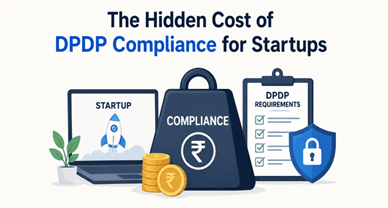
In the run of modern life, humans have given up control over their lives to technology. So much so that the Algorithms now predict our behaviour from the footprint we leave on the internet. While data privacy regulations enacted by legislation focus on protecting the general public, their complexity and requirements often leave small and young businesses, especially startups, at a disadvantage.
A startup grows from a limited set of resources, such as the number of team members, investment, and an urgent need to innovate quickly. Yet the Digital Personal Data Protection Act, 2023 (“DPDP Act”) imposes an additional burden on them.
The DPDP Act is rooted in the constitutional recognition of privacy in the landmark judgment of Justice K. S. Puttuswamy v. Union of India[1]. With this recognition, the legislation was drafted and enacted as India’s first comprehensive framework governing digital personal data. However, the transition from policy to implementation in society is proving difficult for emerging businesses.
Giant ventures have the potential to run through the compliance costs through assigned legal, cybersecurity, and governance teams. On the other end of the spectrum, startups often run with a minimal number of employees managing multiple roles simultaneously. Compliance with the DPDP Act diverts the focus of a startup’s resources away from innovation and growth towards regulatory survival. Thus, for them, the compliance which the DPDP Act requires is not merely a legal obligation; it is an additional business activity which asks for time, investment, and expertise. This creates what may be called the “hidden cost” of compliance.
Compliance is an evolving process
It is pertinent to note that compliance under the DPDP Act is a continuous and evolving process. Startups are expected to maintain consent management systems, grievance redressal mechanisms, secure data, review vendor relationships, and monitor the outgoing data flows. This requires a considerable investment, as the costs include not only legal consultation and cybersecurity but also operational restructuring. From the onset, start-ups attempt to achieve profitability; these repeated expenses have a significant impact on hiring decisions, product development deadlines, and market expansion plans.
Consent Architecture
The DPDP Act states that businesses should obtain free, specific, informed, unconditional, and unambiguous consent before processing personal data. Apparently, it appears loud and clear. However, in practice, startups have to build systems that are capable of recording consent, allowing withdrawal of consent, maintaining proof of consent, updating privacy notices, responding to user queries, and ensuring compliance from multiple platforms and vendors.
Nowadays, startups rely mostly on third-party services such as SaaS tools, cloud storage, and integrated APIs, and tracking the movement of personal data becomes an extremely difficult exercise. Many businesses are unaware of a complete understanding of where their data resides or how it travels internally. The hidden cost lies in restructuring these backend architectures, which requires engineering bandwidth that could otherwise be used for product innovation.
Building Internal Awareness
Despite being a technical issue, Data Protection is a cultural issue as well. If a single employee mishandles a client’s information, using insecure systems, or sharing data without authorisation, it can expose a startup to severe penalties. Thus, it is important to invest in regular employee training and awareness programmes.
For startups with high employee turnover or distributed remote teams, training itself becomes a recurring operational burden. Moreover, simplifying complex legal concepts for non-legal employees also requires substantial effort. Unlike multinational corporations with established governance systems, startups must create compliance cultures from scratch.
Third-party risks
Most startups rely on payment gateways, cloud providers, analytics tools, CRM platforms, and outsourced service providers. However, under the DPDP Act, a startup may remain accountable even where a third-party vendor mishandles data. This means that startups must negotiate stronger data processing agreements, monitor vendor compliance, assess the cybersecurity standards of third parties, and conduct periodic reviews of external systems.
It is pertinent to note that for smaller businesses that lack legal departments, negotiating such contracts with larger technology providers can be both expensive and impractical. Thus, the hidden cost is not only regulator compliance but also the increased complexity of business relationships.
Penalties
Perhaps the most intimidating aspect of the DPDP regime is the possibility of high financial penalties. The Act allows penalties extending up to ₹250 crore for certain violations. Even if regulators adopt a nuanced approach during the early years of enforcement, the fear of liability itself may alter startup behaviour. Founders may become excessively risk-averse in handling data-driven innovation.
The unresolved compliance risks also influence valuation decisions and due diligence assessments from the investors. Venture capital firms increasingly examine governance and data security practices before investing in technology businesses. Consequently, DPDP compliance is no longer just a legal concern, but it is becoming a funding and business continuity concern.
Sector-Specific Challenge
The hidden cost of compliance affects across industries. In FinTech startups, there is a high level of financial information which needs strong encryption systems, rigorous consent mechanisms, breach response protocols and continuous monitoring of financial data flows. In HealthTech companies, multiple medical records and patient histories are stored. The cost of maintaining confidentiality, secure storage and regulated sharing of health data is higher due to the sensitivity of the information involved.
Real-world implementation examples
The founder of Legalpay, Kundan Shahi, a legaltech startup, states that they have minimised data collection. They ask only for what is essential and are also embedding privacy into the product architecture. CTO of Antara Senior Care, Vipin Chawla, says that their company has done a full data mapping exercise, consent protocols and role-based access controls.
Can Compliance become a Competitive Advantage?
Despite the challenges, the DPDP Act should not be viewed solely as a regulatory burden. In the long run, startups that prioritise privacy may build stronger consumer trust and gain a competitive edge. Consumers are becoming increasingly conscious of how businesses collect and use personal data. Companies that demonstrate transparency, accountability and security may enjoy higher customer loyalty and stronger brand credibility.
It is pertinent to note that startups possess one advantage that giant corporations often lack, which is agility. Startups can integrate privacy-conscious infrastructure at an early stage. Leaner organisational structures may allow quicker implementation of compliance controls if approached strategically.
Author:- Aliza Mirza, in case of any queries please contact/write back to us at support@ipandlegalfilings.com or IP & Legal Filing.
References
- https://theamikusqriae.com/compliance-challenges-for-indian-startups-under-the-dpdp-act-2023/
- https://hypertrust.one/blog/dpdp-compliance-challenges-in-india/
- https://www.linkedin.com/posts/gautammehta_dpdp-dataprotection-startups-share-7402233096240365568-BdHk/
- https://www.thehindubusinessline.com/info-tech/costs-and-complexity-of-dpdp-compliance-likely-a-challenge-for-start-ups/article70290725.ece
- Digital Personal Data Protection Act, 2023
[1] K.S. Puttaswamy (Aadhaar-5J.) v. Union of India, (2019) 1 SCC 1