Non-Compete and Non-Solicit Clauses: Diverging Approaches in India, Vietnam, and Thailand
Introduction
In today’s global economy companies are putting in large investments into developing proprietary technologies, building out customer relationships, and into the training of very skilled employees. As competition grows so do we see employers put in place legal measures to protect their valuable business assets from the exploitation by former employees. Of which the most used by companies are non-compete and non-solicit clauses.
Non-compete agreements in general see to it that when an employee leaves the company that he or she cannot go over to a competing firm or start out a competing business. As for restrictive covenant clauses, we see that former employees left out of a job do not go to approach the company’s clients, customers, suppliers, or ex co-workers for what is in the interest of the competition. Though these provisions are very much a part of what we see in the world today in terms of employment agreements, their enforceability is a very different story in each jurisdiction.
The issue at hand is that of which we see a struggle between opposing forces. On one hand employers have a right to protect trade secrets, confidential info, and commercial goodwill. On the other hand, employees have a basic right to pursue any career they wish and earn a living without unfair constraints. What that balance looks like varies in each legal system which in turn produces different solutions to the issue of restrictive covenants.
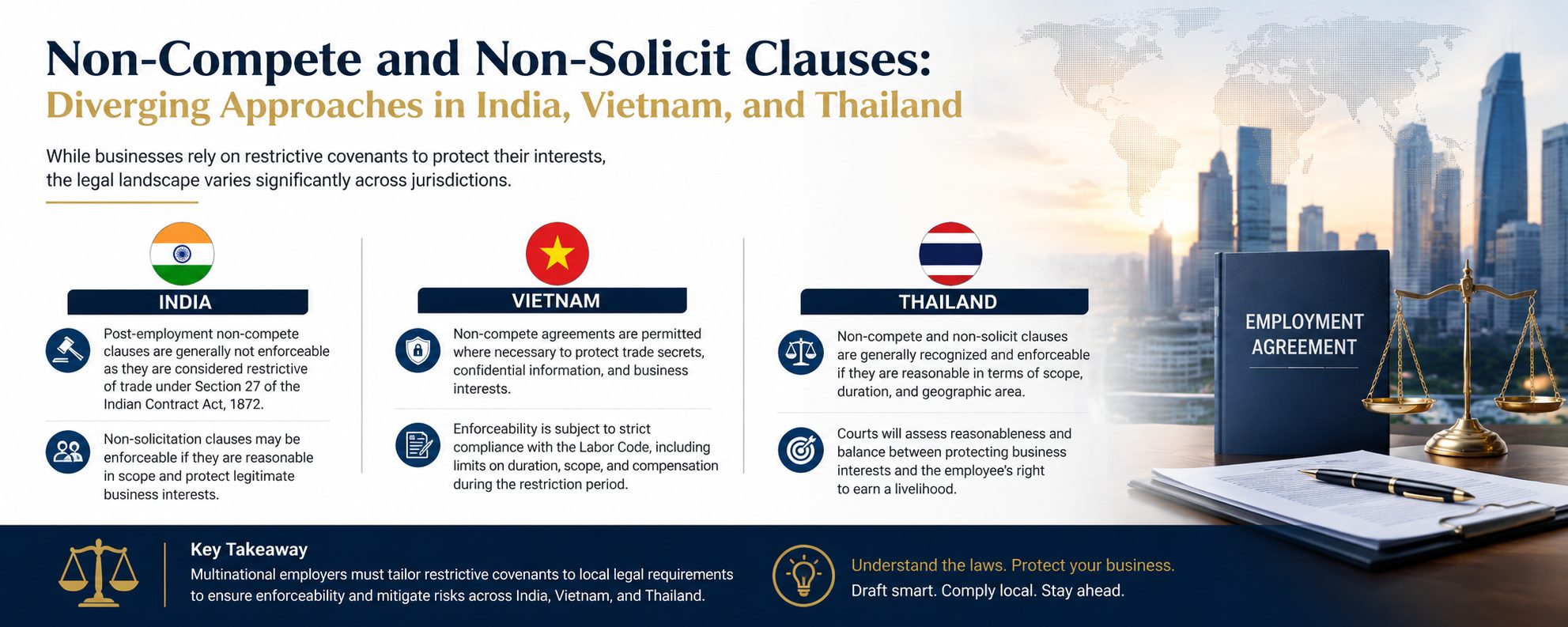
India, Vietnam, and Thailand present in large part what we see of these different approaches. In India post-employment non-compete restrictions are for the most part done away with, Vietnam has over time put in place a structure which does allow for such clauses in some cases. Thailand takes a middle path which is to allow the restrictive covenants but to very closely look at their reasonableness which they do. What we see in this is of great import for multi-national corporations, legal practitioners, and human resource professionals which are based in Asia. We look at how each of these countries handles non-compete and non-solicit clauses in detail which also includes the legal theories behind it, the judicial stand point and the practical results of that.
They Really Stop You from Working? Restrictive Covenants Explained
Today’s businesses live off information. We see in customer databases, pricing strategies, tech innovations, marketing plans and internal business processes years of investment and large financial outlay. As employees leave a company they may take with them what is valuable to the competition. To that end companies often include restrictive covenants in employment agreements. Of these the non-compete and non-solicit clauses are very much in the front. A non-compete clause is one which bars an ex-employee from getting into head to head competition with the former employer for a time after they leave. It is a measure to protect the company from what may come of the ex-employee’s access to confidential info and strategic know-how.
A non-solicit agreement has a more limited scope. Rather than a total ban on employment which is an issue in some circles, what we see is that former employees are stopped from poaching customers, suppliers, or co-workers for a competitive edge. Also it is noted that these agreements which do not put as great a hinder in professional freedom are put forward more by courts. What plays into the enforcibility of such agreements is how legal systems do to protect business interests against on the other hand individual economic freedom. That balance plays out very differently in India, Vietnam, and Thailand.
The Right to Work: How Indian Courts Protect Your Next Job?
India has taken up what is very much a restrictive stand regarding post-employment non-compete agreements. What forms the basis of this is Section 27 of the Indian Contract Act of 1872 which reports that agreements which operate to stop legal trade, profession or business are void. Also unlike many common law countries which look at restrictive covenants through the lens of reasonableness, Indian law in general has a very doubting view of post-employment restraints. What we see is that the Indian approach is very much policy based. The policy behind this approach is rooted in public interest. Indian courts time and again have brought to fore that each individual has a right to earn a living and to pursue professional options. What is put forward is that which prevents a person from work after the termination of employment is against this principle.
In the case of Niranjan Shankar Golikari v. Century Spinning Manufacturing Co. Ltd. the Supreme Court handed down what is to date one of the most important decisions in this field. In that which came before them the Court drew a distinction between restrictions which operate during the term of employment and those which extend beyond. While it was accepted that restrictions during the term of employment are valid as employees are held to have a duty of loyalty to their employers, post-employment restrictions did not receive the same level of support.
In Superintendence Company of India Pvt. Ltd. v. Krishan Murgai the Court put forward that which is a covenant not to work after leaving is unenforceable under Section 27. That judgement strengthened the idea that it is within the former employee’s right to obtain work in the same industry after he leaves; they have that which they have earned in terms of skills and experience.
India is in play here, employers are still not left out. Courts have put forward that they will protect trade secrets, confidential info, and intellectual property. Also it is very much the case that we see use of confidentiality agreements which do break out when non-compete clauses do not. Also it is true that in which former employees misuse exclusive info or get into illegal practices employers may take legal action.
Non-solicit clauses in this regard take a different stance. In India we see that courts are more willing to support provisions which tie former employees from going after the company’s clients or poaching staff. While these clauses do not bar employment totally they are put forth as a more proportional way to guard business interests. At the same time enforcement is very much a case by case issue. What we see is that courts look at whether the clause in question really does protect the business’ interests or if it is in fact a way to suppress competition. Thus in India for which this is an issue, employers must very carefully craft out these restrictive agreements and may not assume that large scale post-employment restrictions will be accepted by the court.
Labor Rights vs. Civil Obligations : Reconciling Restrictive Covenants Under Vietnamese Law
Vietnam reports a very different set of legal issues. As the country has opened up to the global economy and has drawn in more foreign investment, we see that the employment relationships have become more complex and business oriented. That which we note is that this change has played a role in the discussion around restrictive covenants. Also unlike in the case of India, Vietnam does not have a statute which voids out post-employment non-compete agreements. Instead of the legal structure there is more flexibility in what parties put in their contracts which in turn protect business interests in which trade secrets and confidential info play a key role.
Non-competition contracts with employees in key positions are also common for Vietnamese employers. Post-employment restrictions are often necessary for executives, engineers, researchers and employees who have access to strategic information. Such clauses usually try to work on an employee not joining other firms that may be in competition with the employer OR revealing/ helping out with material information after a certain period beyond termination.
Vietnamese law has paid much attention and concern to the protection of trade secrets, business secrets. As a result, courts and arbitral bodies are usually more inclined to recognize restrictive covenants that are directly tied to the protection of confidential information. The bar for enforcement is much raised by the presence of an actual proprietary interest.
However, Vietnamese authorities generally expect that those restrictions must stay within limits. Clauses too broad that will prevent a person from working in the profession they wish to work may be struck down. Judicial review may take into consideration elements like length, the geographic range of prohibited activities and the specific kind of bans imposed.
Non-solicit clauses have been popular in Vietnam as well. In many cases, businesses even want to cover themselves from competition poaching away their clients, customers or trained staff. Because these clauses have a more limited scope than non-competition provisions, they may face less scrutiny legally.
In this sense, Vietnam’s experience illustrates a more overarching attempt to weigh economic growth against commercial certainty. Vietnam stands between these two extremes as it gives a greater degree of contractual freedom while ensuring that barriers to employees free movement do not go too far and provides employers remedy compared to India where less restrictive justifications will still have to be given.
Tailored to Fit: Why Blanket Non-Competes Fail the Reasonableness Test in Thailand
Thailand is situated between India’s employee-centric approach and Vietnam’s employer-centric approach. Thai courts are likely to support restrictive covenants but will subject them to reasonableness tests.
Thai law is anchored on the principle of ‘proportionality’ and Thai courts are likely to acknowledge that employers have legitimate interests which are worthy of protection and may include confidential information, customers, and business goodwill. These interests, however, will have to be balanced with the employee’s right to earn a living.
Thus, when considering the enforcement of non-compete clauses, Thai courts typically take many factors into account. The length of the restriction is often a relevant consideration. Restrictions lasting for an unreasonable amount of time may be considered unreasonable. Geographic restrictions may align with the scope of the former employer’s business operations. If the former employer only conducted business in a particular region, a restriction on competitive activities on a nationwide basis may be difficult to justify.
Restrictions on the type of activities that former employees may engage in also may be subject to survey. Non-compete clauses that restrict employees from partaking in any activities in a particular industry may be more sensitive to challenge than clauses that restrict employees from carrying out specific competitive activities.
Thai courts may employ this flexible approach to determine the most appropriate outcome for the specific circumstances of the case at hand. Courts may determine that a restrictive covenant is not invalid if the restriction is warranted to protect the interests of the business.
Under Thai law, non-solicitation clauses are likely to be viewed as reasonable means of protecting employee relations and business operations, and as a result, are not likely to be prevented entirely. Non-compete clauses are more likely to be used in place of these clauses.
Thailand’s model attempts to protect the employee’s rights by ensuring that the courts are able to protect the employee’s rights while also preventing unreasonable restrictions.
Mapping the Stakes: What the Asian Non-Compete Divide Means for the Future of Work?
India, Vietnam, and Thailand’s employment relationships show how difficult it is to manage jobs globally. A prohibitive covenant valid in one country may be completely ineffective in another.
This challenges multinational corporations in multiple countries. The most common approach to address national differences in employment law is the incorporation of standardized contracts. This is, however, highly problematic.
For example, a broad, vague non-compete clause, developed according to Thai and Vietnamese standards, may lack enforceability in India because of Section 27 of the Indian Contract Act. On the other hand, a contract made for the Indian market may not be as restrictive, therefore, may not provide adequate protection to other countries that allow more balancing restrictions.
Indian professionals typically have a higher level of mobility between employers than Vietnamese and Thai professionals. Professionals in Vietnam and Thailand have much more limited mobility than professionals in India, given the greater legislative and contractual restrictions on their movement based on the kind of employment contract and level of access to classified information.
Winds of Change: How Asia is Quietly Rewriting the Rules on Non-Competes?
Asia’s treatment of non-compete and non-solicit clauses is still developing. Protection of intellectual property and trade secrets becomes more pressing with rapid technology, remote work, and cross border employees.
Contractual restrictions covenants are becoming more sophisticated and are frequently accompanied by provisions, which describe a narrower legitimate business interest, set of restrictions. Cases are more commonly considered whether they create any unnecessary burden on employees.
In India, there is academic and trade interest in whether approaches to Section 27 are reflective of the modern knowledge economy. Little to no judicial changes are expected.
Encroachment of foreign business in Vietnam will necessitate changes to laws governing employment and disputes. Further development in works in Thailand with a framework of reasonableness and proportionality.
Internationalization of business coupled with the increasing employee mobility is a recipe for tension between employee self-determination and business interests. This will be a dominating theme of modern employment law.
Conclusion
Non-compete and non-solicit clauses are at the crossroads of business rights and personal freedoms, and as such are some of the most litigated clauses in employment contracts. We can analyze India, Vietnam, and Thailand to understand how different legislations approach this area of employment law.
India is the most employee-friendly of the three and rarely enforces post-employment non-compete contracts. Vietnam allows for more flexible non-compete contracts if they are necessary to serve a legitimate business interest, such as protecting trade secrets from employees. Thailand allows for the enforcement of non-compete contracts if they are reasonable and not excessive.
For businesses with interests in these three countries, understanding this area of employment law is not an intellectual exercise, but essential in order to have enforceable employment contracts within these countries. As employment law in South East Asia evolves, the area of restrictive covenants will be an integral part of employment law and the business interests of companies operating in the region.
Author:- Kumar Harsh, in case of any queries please contact/write back to us at support@ipandlegalfilings.com or IP & Legal Filing.