International Trademark Registration through the Madrid Protocol
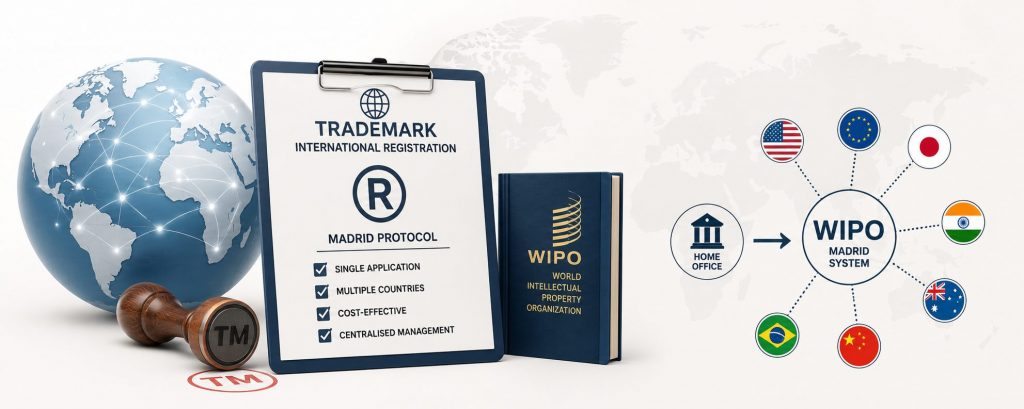
Introduction : Registration of the Trademark through the Madrid Protocol is a standardised system for registering the trademark at minimal fees in Swiss Francs (CHF). The WIPO is a global platform that facilitates countries from different backgrounds coming together to conduct worldwide searches to protect their brand reputations across multiple jurisdictions from misuse. Presently, 132 members are revising. Also, depending on the budget the portal has introduced a fee calculator system.
This article will focus on recent updates to the NICE classification and the benefits of international registration under the Madrid Protocol. Also, the requirements that need to be fulfilled at the national
level, so that the registration process can go on smoothly with the WIPO, with the nuances that need to be kept in mind while registering.
Importance of Madrid Protocol
The Madrid agreement was introduced for international registration in 1891 but it has its own limitations related to application registration, had language barriers and in short, lacked flexibility which affected trans-border applications. Then, in 1989, the Madrid Protocol came into force to facilitate the application of the different countries’ municipal laws. Its main objective is to promote mark registration with fewer norms in a wider network for the exponential growth of the business.
Under the Madrid System, both the Madrid Agreement and the Madrid Protocol are administered by the WIPO but the Madrid Protocol unified the system of registration process for parties having different kinds of barriers and made the whole process pocket-friendly. This system provided an ecosystem where a brand name coming from any country can easily have access to the market of any country with zero legislative hindrances and without limiting the hiring of innumerable attorneys for protecting their mark.
To take advantage of this system, the country needs to be a member of the Madrid System. But in situations where a country is not a member, under no circumstances can they access this system, unless they have fulfilled any of these criteria, i.e., holding citizenship of the member countries, owning an enterprise within the Madrid circle and having a legal place of permanent residence.
The Registration Procedure: The Complete Handbook
Once you are done with the whole planning process of starting a business internationally the next step is to protect your brand reputation and prevent any misuse of the business’s goodwill in the wider network. The following are the steps:
- First register on the eMadrid using a WIPO Account.
- Then on the webpage, an option will pop up for filing an application.
- Then prepare the application, and Submit the application to the office of origin which is the IP office for previously registered Trademarks. They do the preliminary check and compare it with the basic mark.
-
On passing the requirement by the IP Office they certify and forward the application to WIPO, stating the grant of protection of the mark. The time limit is 12 months which can extend up to 18 months.
-
On receiving the application, WIPO will check the required formalities for instance, the name and if it complies, the mark will be registered and it will be published in the WIPO Gazette of International Marks upon payment of the fees.
-
A certificate of international trademark registration will be sent and the member IP Office will be notified.
For fee calculation, the WIPO has introduced a Fee calculator to understand the breakdown of the fee structure depending on the class of the Trademark and the legislation of the member country. Although the basic fees are divided into two categories depending upon the colour scheme of the mark, with the help of the calculator one can easily get an estimated charge.
The Trademark Registration: India’s Regulation System
The initial step for proceeding towards International registration is to register the mark under Section 18 of the Trade Marks Act, 1999. Form TM-A is the standard set for registering the mark that includes NICE classification, Vienna codification and if no objection is found by the examiner or raised within 4-months, it gets published in the Trademark Journal with issuance of a Registration certificate valid for 10 years and subject to renewal. This is the foundation of India’s system of IP filings which protects the mark within India’s jurisdiction.
India acceded to the Madrid Protocol in 2013 by inserting Chapter IV-A thereupon after completion of the formalities of having a basic mark, the next move is to file an MM2 form. After completion of this step, the Office of Origin status is based on the applicant’s domicile/nationality/establishment in India, not automatic after MM2 filing. The office must verify the applicant’s connection to India first whose role is to do the preliminary check related to the applicant’s name, address, mark identification, etc., and forward the application to WIPO for the rest of the formalities.
Major Shift in the Nice Classification
On 1st January, 2026 major changes were introduced by the publication of its 13th edition to provide an efficient categorisation of goods and services by adding and shifting them under different heads of the 45 classes. However, this readjustment of the classes will not affect existing applications, it has a prospective effect which means that only new registrations have to make sure that the new classes match their existing basic mark registration by conducting a clearance search for both the old and new versions. Below is the list of shufflings that took place in the NICE classification that India follows:
- Sunglasses, corrective eyelenses and contact lenses moved to class 10 from class 9 except smart glasses
- lifeboats, fire engines and lifeboats moved to class 12 from class 9.
- electronically heated clothing like heated jackets, socks etc. and heating devices moved to class 25 from class 11.
-
Essential oils were divided as per their usage into different class groups like cosmetic or perfume use is moved to class 3, for food flavourings the class is 30, for medicinal purposes the class is 5 and for industrial use the class is 1.
- devices which are used for personal care like electric toothbrushes, etc. moved to class 21 from class 10.
-
AI has been assigned an explicit class i.e., class 42. AI is not a standalone Nice Class Many AI-related services are generally classified in Class 42, but AI products and services may also fall under other classes depending on their nature and function. This distinction is important for trademark prosecution accuracy.
- Now Airport VIP lounge services are listed under class 43.
- Legal assistance is now in class 45.
- Optician services are classified into three heads depending upon the services taken i.e., for retail services of optical goods is given under class 35, for repairing of glasses is given under class 37, and for healthcare-related services the class is 44.
- Class 41 has now added a smash room for entertainment purposes.
The setback of the new NICE classification, however, is that it affects the older registration which was registered as per the older NICE classification when no class was allotted to them before, for instance, AI-related services now have to go through the re-registration process of their Basic Mark under the new class and then move forward with the international registration process under the Madrid system. Also, if there are any existing goods and services class shifting they can simply file but only after doing proper due diligence for the WIPO application.
The Attorney’s Perspective
The registration of the trademark on the WIPO portfolio does not automatically mean that the trademark is now shielded from any kind of opposition. It just opens a door to different sets of bundled municipal laws where the mark is open to be opposed in different countries depending upon their respective time period. This opposition is too self-tracked and if missed this will cost the trademark protection in that particular region. However, if no opposition is raised within the given
time frame it is assumed that the trademark protection has been successfully granted and will be published in their respective local portals.
Another important point to be noted here is the accurate classification of the goods and services because the WIPO examiners are very strict in scrutinising the application. Every word of the goods and services has to be defined under specific heads of class to avoid receiving an irregularity notification. Also, the new 13th edition of NICE classification has to be studied carefully and if there is a reshuffle in the designated class of the goods and services the safer side will be to register it under both classes for WIPO.
Last but not least, international registration is dependent on local registration for 5 years. If the mark registration gets cancelled or opposition is raised the international registration will be hampered majorly. So, having a solid Basic Mark for international registration is a major relief from facing any future setbacks.
Conclusion
The Madrid Protocol is a rule book for registration of Trademarks internationally, It does not ensure protection of the mark but only a gateway to defend it from one Para phrasal into different jurisdiction to another.
Author:- Samridhi, in case of any queries please contact/write back to us at support@ipandlegalfilings.com or IP & Legal Filing.
References
- https://nclpub.wipo.int/enfr/?hl=en-GB
- https://taxguru.in/corporate-law/timelines-stages-trademark-registration.html#:~:text=This%20signifies%20those%20codes%20which,proceed%20to%20the%20next%20step
- https://www.wipo.int/en/web/madrid-system/how_to/file/basics
- https://www.intepat.com/blog/file-trademark-application-india-form-tm-a
- https://www.wipo.int/en/web/treaties/registration/madrid/summary_madrid_marks