Geographical Indications versus Trademarks in Southeast Asia: Where Brand Owners Get It Wrong
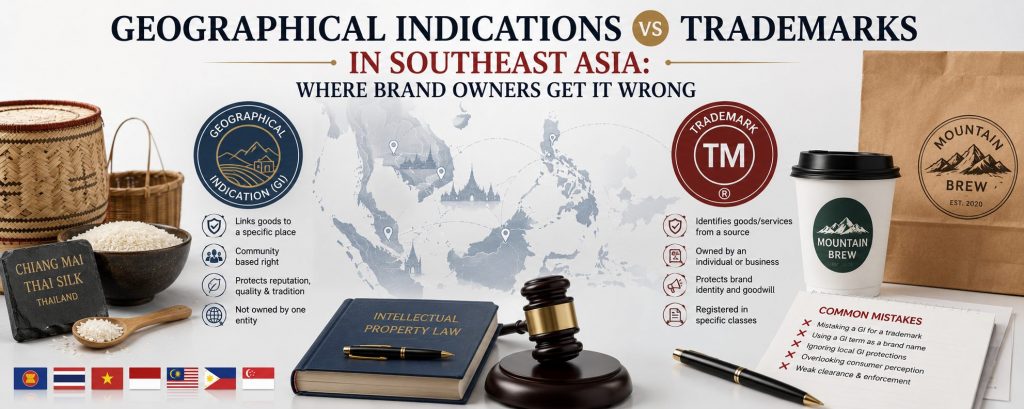
Introduction : Intellectual property rights form a vital part in relation to the functioning of globalisation in current times and the economic setting because they help in offering protection to the corporations and maintaining their identity, besides fostering healthy competition. Intellectual property rights comprise several categories, among which one of the most prominent areas where they overlap is the problem involving conflict between trademarks and geographical indications (GIs). This type of conflict is prevalent mainly in Southeast Asian countries. Trademarks and geographical indications can be termed as indicators, but their uses differ greatly, even though they have some applications in marketing.
However, as the development of economic conditions continues in Southeast Asia, there seems to have been an escalating pattern of conflicts between the trademark owners and the producers utilizing geographical indicators. The reason behind this has been the misinterpretation by most trademark owners that trademark law dictates how geographical terms should be named and therefore provides exclusive right to name them.
Difference between Trademarks and Geographical Indications
A trademark is a term that refers to distinct signs used to differentiate goods and services of one firm from those of other firms. Trademarks may include words, logo, slogan, symbol, or combination of these signs. One of the roles of the trademark is the ability to communicate the origin of the product and enable customers to distinguish the product from those of other companies.
Geographical indication, on the other hand, is not a personal trademark. It is rather a collective trademark which is owned by producers of goods manufactured in specific geographical regions in accordance with the set manufacturing standards. The value of the GI is determined by the link between it and its origin. Products such as the Phu Quoc fish sauce in Vietnam, Kampot pepper in Cambodia, and Bali coffee in Indonesia receive commercial value because of the geographical identification.
It is of utmost significance to know the difference between these two because in many Southeast Asian countries, agricultural and artisanal products have cultural, economic, and historical significance. At present, governments in Southeast Asian countries use GIs as instruments for protecting their heritage, supporting rural development, and maintaining the tradition of knowledge.
The Mistake of Assuming a Trademark Always Prevails
One of the most common mistakes trademark owners make is assuming that obtaining an earlier trademark registration guarantees complete protection against future GI claims. Most ASEAN countries, including Thailand, Vietnam, Indonesia, and Cambodia, follow a “first-to-file” trademark system. This encourages businesses to quickly register signs containing geographical names before competitors enter the market.
Foreign businesses frequently attempt to register names such as “Bali,” “Phu Quoc,” or “Champasak” as standalone trademarks, believing that filing first grants them exclusive ownership rights. However, this assumption ignores the special protection afforded to geographical indications under the Agreement on Trade-Related Aspects of Intellectual Property Rights (TRIPS) administered by the World Trade Organization.
Under GI protection systems, geographical names associated with regional products cannot be unfairly appropriated by private entities. If local producers later succeed in registering a GI for that region, conflicting trademarks may be invalidated, restricted, or canceled altogether. Trademark owners who invested heavily in branding, packaging, and advertising may suddenly find themselves unable to continue using their registered marks.
Monopolisation of the Whole Geographical Area
he next major error that has been committed by the trademark owner is his attempt to monopolize the whole geographical area by way of trademark registration. Most companies believe that once they register the name of the geographical location, they can bar others from referring to such location for commercial purposes. This is because no law on trademarks can grant monopoly of the geographical identity in such a way as to prevent legitimate manufacturers from referring to their products. In fact, the geographical indication pertains to all producers of that geographical region in compliance with the geographical indication law.
Therefore, assuming that the producers of the coffee beans in Bali have fulfilled all the qualifications of the geographical indication, they are entitled to refer to their product as that produced in Bali.
Distinctiveness, Generic Terms, and Secondary Meaning
Trademark holders also tend to confuse the treatment of geographical terms when registering marks. Trademark registries in Singapore and Malaysia tend to raise objections against marks that are mostly geographical and descriptive in character. Since geographical names cannot distinguish goods, the application should provide evidence that a term has achieved a “second meaning” or “acquired distinctiveness.” This involves showing that consumers identify a mark with the holder’s business rather than a geographical place or area. Trademark holders tend to think that mere commercial use alone would satisfy this requirement, failing to realise that a higher level of proof is needed. This results in their applications being either rejected or objected to, or even vulnerable to cancellation.
Trademark holders also fail to recognise that certain geographical and descriptive expressions are already too general to serve as trademarks. Consumers begin using a term to describe a category of goods rather than associating it with a single source or producer.
Differences in the Implementation of GI and Trademark Protection in Southeast Asia
Additionally, one should note the fact that each state of ASEAN applies a distinct approach when it comes to reconciling the two kinds of protection provided to the concerned objects. Although certain coordination takes place on the regional level, the practices of IP enforcement remain highly dissimilar from one another. On the one hand, states like Malaysia and Cambodia may permit the existence of the trademark and geographical indication if it is impossible to confuse customers.. The approach tries to reconcile the interests of the business world with those of the regional producers. In Indonesia, geographical indications prevail. In case of a conflict between the trademark and the GI registration, the former will not be granted an indefinite protection status. This could lead to serious problems for companies that are unaware of the stricter standards that apply in Indonesia.
GI Disputes within the Framework of Cross-Border Commerce
With the development of cross-border and online commerce, there has been an increase in GI disputes in countries belonging to Southeast Asia. Now, governments are aware of the value of geographical indications not only as intellectual property rights but also as cultural landmarks and hence enforce them strictly. In some of the ASEAN countries, it has now become imperative for customs authorities to work in close collaboration with the country’s intellectual property offices to ensure that no abuse is made of geographical indications in cross-border trade. In such a scenario, the owners of the trademarks will face opposition from the customs officials whose actions could result in the confiscation of goods at the border point. This new approach implies that GIs are not simply protected through private intellectual property laws but have also come to be seen as cultural assets. It follows from here that customs officials can treat the misuse of geographical names as involving cultural heritage.
How Brand Owners Can Avoid These Mistakes
Firstly, there must be a better way to treat the issue of intellectual property protection in regard to the territory in question. To begin with, the aspect of the sensitivity of geographical names has to be recognised from a legal standpoint. Secondly, a careful legal analysis of the trademark protection system in each individual country has to be made before applying for registration. There seem to exist considerable differences between ASEAN countries’ legal frameworks in regard to the described disputes. Some trademarks are likely to be registered immediately, while others cannot get approval.Lastly,it is preferable to use a certification or collective trademark rather than a usual brand for the reason that they allow the trademark owner to protect the product without creating a monopoly on the market.
Conclusion
The conflict between geographical indication and trademarks in Southeast Asia shows the progress made in intellectual property law in the region. With ASEAN countries growing more interested in the safeguarding of their heritage, agricultural products, and traditional knowledge, there is no assumption that brand-naming strategies that work elsewhere would provide trademark holders immunity from potential legal conflicts.
Brand-naming issues and trademark problems can be traced in companies whose approach to geographic names involves treating such terms as ordinary assets belonging solely to one company. The problems usually stem from attempts to monopolize a place name, disregarding geographical indications, or using describing words for trademarks with inadequate care.
Author:- Vedika, in case of any queries please contact/write back to us at support@ipandlegalfilings.com or IP & Legal Filing.
Endnotes
-
Paris Convention for the Protection of Industrial Property, 20 March 1883, as revised at Stockholm on 14 July 1967, arts. 6quinquies and 10bis.
-
Agreement on Trade-Related Aspects of Intellectual Property Rights (TRIPS Agreement), Marrakesh Agreement Establishing the World Trade Organization, Annex 1C, 15 April 1994, arts. 22–24.
-
World Intellectual Property Organization (WIPO), Geographical Indications: An Introduction, WIPO Publication No. 952E (2023), available at: https://www.wipo.int/edocs/pubdocs/en/geographical/952/wipo_pub_952.pdf (accessed 18 June 2026).
-
Association of Southeast Asian Nations (ASEAN), ASEAN Intellectual Property Rights Action Plan 2016–2025, available at: https://asean.org (accessed 18 June 2026).
-
World Trade Organization, Technical Information on Geographical Indications, available at: https://www.wto.org/english/tratop_e/trips_e/gi_e.htm (accessed 18 June 2026).
-
European Commission, Protection of Geographical Indications for Agricultural Products and Foodstuffs in ASEAN Countries, EU-ASEAN Intellectual Property Rights Cooperation Programme (IP Key Southeast Asia), 2024, available at: https://ipkey.eu/en/south-east-asia (accessed 18 June 2026).
-
Christopher Heath and Anselm Kamperman Sanders (eds.), Intellectual Property Law in Asia (Kluwer Law International, 2023) chs. 8–12 (discussing GI and trademark protection across ASEAN jurisdictions).
- Dev Gangjee, Relocating the Law of Geographical Indications (Cambridge University Press 2012) 145–178 (examining conflicts between trademarks and geographical indications and the protection of regional product names).