Paris Convention Explained: Origins, Principles, and Global Impact on IP Rights
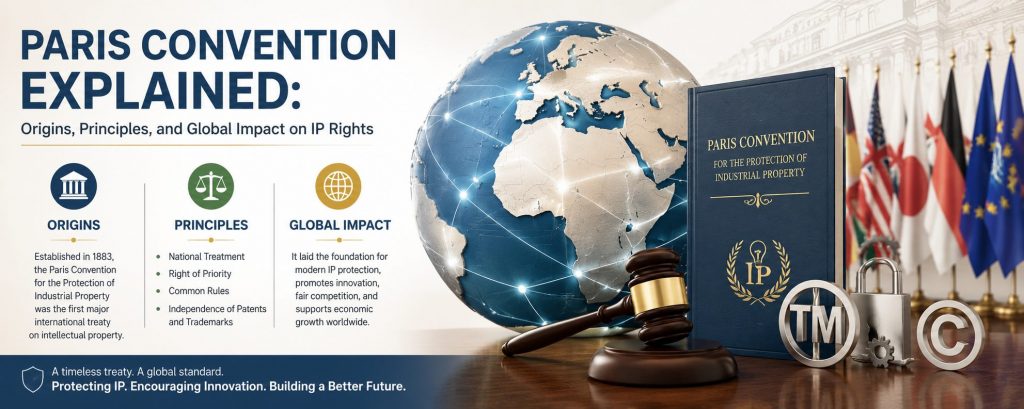
Introduction : Back in 18th century, there was a world where inventors lose all of their rights on their creations, the moment they cross a national border. There was no mechanism to globalize their innovative inventions. To address these concerns, “The Paris Convention for the Protection of Industrial Property”, was signed in Paris, France, on March 20, 1883, which is one of the first international treaties that laid a foundation for international protection of intellectual property rights. It established a Union for the protection of Industrial Intellectual Property such as patents, trademark, utility models, geographical indications, trade secrets, and the regression of unfair competition. It is administered by the ‘World Intellectual Property Organization’ (‘WIPO’), based in Geneva, Switzerland. This Article examines the origins of the Paris Convention, analyses its key principles such as right of priority, national treatment, and how it impacts in the development of modern international patent law.
Historical Development
The need for an international framework for industrial property arose in 19th century because during this time, there was rapid industrialization and people were facing difficulties in protecting their industrial property such as patents, trademark, beyond their national borders. They were struggling to seek protection in foreign countries due to the difference in law of foreign countries, lack of reciprocity and frequent piracy. There are three major incidents which paved the way for Paris Convention:
- The 1873 Vienna Boycott Threat:
Before the Vienna Exhibition of 1873, US inventors and manufacturers formally threatened a total boycott, in consequence of which the Austro-Hungarian Empire passed a temporary emergency law for protecting the foreign designs. Later, the organizers of the Exhibition hosted the Vienna Congress for Patent Reform in the same year to recognize the need for an international system;
- The 1878 Paris Universal Exposition:
Similarly, many industrialists were terrified of “literary and industrial piracy”, so the France hosted the Industrial Congress on Industrial Property to determine the basis of uniform, binding international law for Industrial property; and
- The 1880 and 1883 Paris Diplomatic Conferences:
After drafting the treaty in a diplomatic conference in Paris in 1880, the “Paris Convention for the Protection of Industrial Property” was signed in 1883 by 11 countries including France, Belgium and Switzerland.
The Convention is still in force and has been revised several times due to the commercial and technological development. Some of the major amendment occurred in Brussels (1900), Washington (1911), The Hague (1925), London (1934), Lisbon (1958), Stockholm (1967) and in 1979. As on 6 April 2022, the Convention has 179 contracting member countries, which makes it one of the most widely adopted treaties worldwide. India’s membership into the convention came into force on December 7, 1998.
Key Principles
The key principles of the Convention are given below:
- Right of Priority:
Article 4 of the Convention provides for the right of priority in the case of patents (and utility models where they exist), marks and industrial designs. According to this right, an applicant could apply for any of the other contracting states within a certain period of time of his regular first application, filed in any one of the contracting state. The application in other contracting states must be filed within 12 months for patents and utility models and 6 months for industrial designs and marks from the date of first regular application in the contracting state. These subsequent applications will be regarded as if they had been filed on the same day as the first application. In simple way, they will have priority (hence the expression “right of priority”) over applications filed by others during the said period of time for the same invention, utility model, mark or industrial design. One of the great practical advantages of this provision is that applicants who wish to seek protection of their industrial intellectual property in multiple countries will have the time of 6 to 12 months to decide the countries and compliance with all their necessary requirements for securing protection at the same time of their first filed regular application in the contracting state.
- National Treatment:
Under the Convention, Article 2 & 3 provides for the national treatment that, as regards the protection of industrial property, each Contracting State must grant the same protection to nationals of other Contracting States that it grants to its own nationals. According to this Article, the Nationals of non-Contracting States are also entitled to national treatment under the Convention if they are domiciled or have a real and effective industrial or commercial establishment in a Contracting State. This rule establishes the much desired uniformity in international norms relating to IPRs and goes a long way in making all of us “global citizens”, not to be discriminated on the basis of territorial boundaries.
- Common Rules:
There are some uniform rules which applies to all the contracting states of the convention, they are as follows::
- Independence of patents:
According to this principle incorporated under Article 4bis of the Convention, patent for a same invention, granted in different countries are mutually independent. Any contracting state could not grant, refuse or revoke a patent on the same ground as taken by any other contracting country. The status of a patent in one country will not impact its status in any other country. Through this principle, the Convention respects national sovereignty while also ensures that basic patent protection standards remain global .
- Marks:
Any application of mark in any contracting state could not be refused or any registered mark could not be invalidated on the ground that it had not been in effect in the country of origin. Similarly, its status in one contracting state will also have no impact on its status in other contracting states. It also permits for the protection of collective marks. Well-known marks must be protected in each contracting country to prevent them from diluting and misuse internationally.
- Industrial Designs:
Article 5B provides for the protection of industrial designs in every contracting State and its protection may not be forfeited on the ground that the articles incorporating the design are not manufactured in that State.
- Trade Names:
There must be no obligation of filing or registering a trade name for its protection in any contracting state.
- Indications of Source:
Each contracting state must take the measures against direct or indirect use of a false indication of the source of the goods or the identity of the producer, manufacturer or trader.
- Unfair Competition: Article 10bis
provides that each contracting State must provide for effective protection against unfair competition.
Role in shaping International Patent Law
Prior to the “Paris Convention”, the patent laws were strictly fragmented and nationalistic but this convention created a unified global framework for patent laws. It has significantly contributed in the development of the modern International Patent Law. Firstly the ‘right of priority’ allow inventors to seek the protection of their invention in multiple countries without getting worried of losing their first filling date. It also gives them the time of 12 months to decide the country and fulfill all the compliance requirements in which the applicant wish to seek the protection of his invention. Secondly, through the principle of ‘independence of patents’, it provides them the fair grant and enforcement of patent, independent of the other foreign awards and disputes.
Thirdly, it banned the protectionist discrimination against foreign investors through giving them the “national treatment”. Fourthly, it encourages the innovation by protecting investment in research and development and promoting technology transfer across borders. Additionally, the Convention established a permanent central secretariat, now called World Intellectual Property Organization “WIPO” to oversee the international IP cooperation in the world. Lastly, the convention creates the basis upon which so many other patent law treaties were developed such as ‘Patent Cooperation Treaty, 1970’ (‘PCT’) which extends the right to priority to facilitate the multijurisdictional patent fillings and TRIPS Agreement (1995), by WTO which also follows Paris Convention principles and formed binding global IP standards.
Conclusion
The Paris Convention for the Protection of Industrial Property had not only established a uniform legal structure for industrial property but also introduced principles like national treatment, right of priority, independence of patents and common rules. It gives a path to move from territorial exclusivity to cross-border protection by enabling the innovators to protect their innovation or any industrial intellectual property in multiple jurisdictions. The Convention fosters innovation and global technology transfer. In essence, the Paris Convention is more than a historic treaty; it represents a cornerstone of international intellectual property law, creating an equitable environment for inventors and businesses worldwide.
Author:- Diksha Sharma, in case of any queries please contact/write back to us at support@ipandlegalfilings.com or IP & Legal Filing.