Intellectual Property as the Currency of Innovation and growth in Southeast Asia
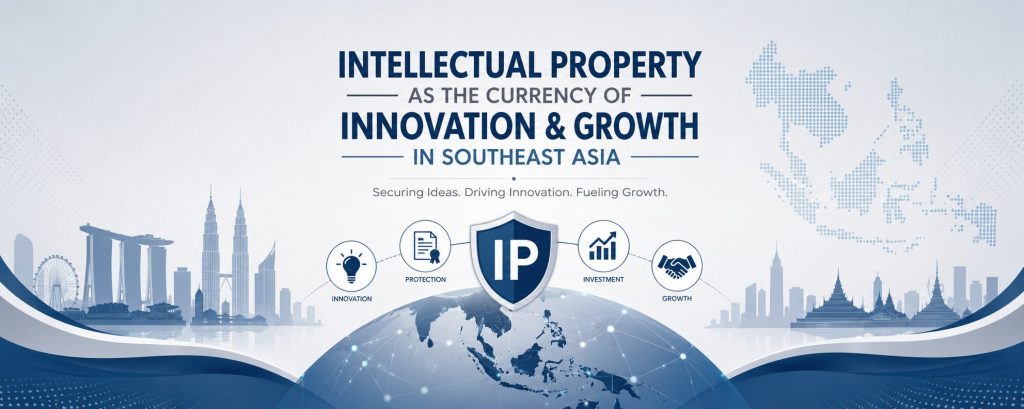
Introduction : For decades, economic progress and growth in a country was evaluated in terms of tangible assets like industries, machinery, infrastructure, and natural resources but today with the advancement of technology and development, the fundamentals of economic value are shifting. In an increasingly digital and knowledge-based economy, intangible assets like technology, branding, creative content, and proprietary know-how are important drivers of economic success. And, Intellectual Property (IP) being the central level. Across Southeast Asia, IP is increasingly being treated the way a bank treats a balance sheet: as an asset class capable of generating revenue, attracting capital, and signalling creditworthiness to investors. In a region racing to position itself as the next hub for creative and digital industries, the real test is no longer what is the status of legal rights and protection in ASEAN states, but whether those rights can be converted into usable economic value. The conversion from legal entitlement to tradeable currency is the story unfolding in Southeast Asia today.
The present blog examines the transition of intellectual property rights from legal entitlement into instruments of economic value within the ASEAN Economy Community.
Intellectual Property as an Economic Asset
Intellectual property has now turned up to be an economic asset as it converts the ideas into enforceable value. This shift is significantly visible in Southeast Asia, in different sectors i.e., policy, business strategy, and capital marking thinking wherein intellectual property i.e., designs, patents, trademarks, and copyright are treated as a currency for economic innovation and growth.
In the context of protection granted by law, Intellectual Property creates a proprietary right over intangible assets, providing the owner with the right to assign, commercialize, or license, or enforce that right for financial benefit. Thereby, a properly managed IP portfolio can strengthen bargaining
power, attract investments, trade and capital, and increase enterprise valuation. Practically speaking, different intellectual property rights perform different functions, i.e., copyrights can generate recurring revenue from creative works, a patent can protect technological advantage, and a trademark can build consumer trust, reputation and brand value.
The regional trend in Southeast Asia confirms this economic role. ASEAN has adopted the ASEAN Intellectual Property Rights Action Plan 2026 – 2030, which expressly focuses on strengthening national IP regimes, advancing regional harmonisation, and facilitating IP asset creation, management, and commercialization. That policy direction shows a clear move from viewing IP as a defensive legal system to treating it as a productive economic infrastructure.
ASEAN Policy Direction
The pace at which intellectual property is being recognised as a growth indicator in Southeast Asian nations is unbelievable. ASEAN’s intellectual property policy direction is moving decisively from a narrow enforcement model towards a broader development strategy. IP in ASEAN (Southeast Nations) is not just considered as a legal right, but also an enabling framework for innovation, industry growth, capital and investment, and trade.
At the centre of this shift is the ASEAN Intellectual Property Rights Action Plan 2026 – 2030, which aims to build an effective, enterprising, and inclusive IP ecosystem across the region. The plan is designed to strengthen the institutional capacity of national IP offices, improve the consistency of IP administration, and align domestic systems more closely with international standards and treaty obligations. This signals a clear policy intention: ASEAN wants IP systems that are not only protective, but also commercially useful and administratively efficient.
A second important feature of ASEAN’s direction is harmonisation. Because member states remain at different stages of legal and economic development, ASEAN has not pursued absolute uniformity. Instead, it has adopted a cooperative model that promotes convergence in procedure, examination standards, and regional platforms while preserving national sovereignty and flexibility. This “ASEAN Way” of gradual integration allows states to move together without forcing identical laws, which is especially important in a region marked by varied industrial capacity and enforcement infrastructure.
ASEAN’s new policy framework expressly recognises the need to facilitate IP asset creation, management, valuation, and commercialization. This is a major doctrinal and economic development, because it positions IP as an intangible asset that can support financing, licensing, technology transfer, and market expansion. The policy language also suggests a growing
recognition that innovation only becomes economically meaningful when legal rights can be translated into usable commercial value.
ASEAN’s policy direction further connects IP with inclusive and sustainable growth. The action plan highlights the role of IP in green technology, social innovation, traditional knowledge, geographical indications, and targeted support for women, youth, and persons with disabilities. This matters because it expands the meaning of innovation beyond high-technology sectors and places IP within a broader development agenda. In this sense, IP is being framed not merely as a private business tool, but as a public policy instrument for upgrading productivity and deepening regional resilience.
ASEAN’s policy materials emphasise awareness-building, education, inter-agency coordination, and stronger anti-infringement cooperation. This is significant because enforcement cannot be effective without public legitimacy and administrative coordination. The region’s current approach therefore combines legal certainty with behavioural change, aiming to normalise lawful use of IP while reducing counterfeiting, piracy, and misuse.
Overall, ASEAN’s policy direction shows that the region now views intellectual property as a strategic infrastructure for future growth. The legal systems of member states are being aligned not only to protect innovation, but to convert it into measurable economic advantage.
Recent Trends Across Southeast Asian Nations
In recent times, ASEAN has identified Intellectual Property (IP) as a fundamental element of the ASEAN Economic Community Blueprint 2025, which sets out specific steps to be taken by member countries to transform ASEAN into a highly innovative and competitive region. All southeast Asian nations are recognising the importance of intellectual property as a currency for innovation, and it is visible through the efforts taken up by them and these are
-
As per the WIPO Global Innovation Index 2025, the Southeast nations have performed exceptionally well, as the ranks suggest. Singapore fifth globally, Malaysia at 34th, Vietnam at 44th, Thailand at 45th and Philippines at 50th. Both Vietnam and Indonesia have been classified as innovation overperformers meaning thereby, that these both nations consistently deliver innovation outputs above the prediction in regards to their economic development. It indicates that IP-intensive activity is generating disproportionate economic returns in these jurisdictions which is precisely the dynamic that distinguishes a functional IP ecosystem from one that exists only on paper.
-
Vietnam established dedicated IP courts beginning operations in 2025 across Hanoi, Da Nang, and Ho Chi Minh City, with the objective of producing faster and more consistent resolution of IP disputes. Malaysia’s intellectual property office joined the WIPO Alert Data Sharing Platform to address online piracy and issued National Guidelines on Artificial Intelligence Governance and Ethics in 2024, laying the normative groundwork for more comprehensive AI-specific IP legislation.
-
Countries like Malaysia, the Philippines, Singapore and Vietnam have launched IP awards that lend prestige to their best innovators and innovative practices. By protecting original ideas and works, IP laws and regulations allow businesses, entrepreneurs, inventors, artists and creators to flourish in a fair environment that enhances public access to a competitive market of goods and services thereby generating revenue.
-
Indonesia has introduced several regulations recognising IP as an asset which can be used as collateral for financial, and is in a way to develop a system of “IP valuators” to support wider adoption by financial institutions. As per recent figures, Indonesia’s creative economy has expanded 6.86 percent in 2025 and generated nearly US $32 billion in exports, attracted US $10.3 billion in investment and employed more than 27 million people.
These recent data and figures show that South-east Asia being uniquely positioned between major economic and technological powers is using its position and power to strengthen its own competitiveness.
IP as a catalyst for capital attraction and commercial monetisation
Apart from just being a legal right, intellectual property has transitioned itself to an assertive commercial role throughout Southeast Asia, to attract revenue and capital, generating licensing revenue and indicating enterprise value to the investors across the globe. Investors no longer are solely concerned with the company’s physical assets, instead their decision to invest in a nation depends upon intangible assets too, i.e., intellectual property portfolio. Trademarks, designs, copyrights, trade secrets and patents act like an indicator of a business capacity to innovate, and commercialise the same. Therefore, the business’ intellectual property portfolio has become an important point for consideration for determining value, revenue, and profit. Stronger the intellectual property. Stronger the intellectual property portfolio of a nation, stronger the capability to produce future returns and profits. It is seen as a mechanism for reducing market risks, improving visibility, providing competitive advantages and asset holding capacity of business thereby attracting more revenue.
Certain factors including stronger and applicant friendly IP frameworks, and targeted incentive structures, has recognised Southeast Asian nations as a hub for IP-driven instruments. This proposition is reinforced by FDI data, as even though global FDI declined by 11 per cent, FDI inflows to ASEAN saw a surge, i.e, 8 per cent to USD 226 billion in 2024. Moreover, investment in R &D of different sectors including professional, scientific, and technical activities rose from USD 0.3 billion to USD 21 billion in 2023, reflecting growing investor appetite for IP-intensive operations. These figures confirm that it is not manufacturing cost alone but the depth of innovation infrastructure that drives ASEAN’s investment appeal.
Challenges in economic realisation of Intellectual Property
In spite of significant progress and development in recognising intellectual property as currency for innovation across Southeast Asia, there persists certain challenges to limit the effective conversion of IP rights into tangible economic value and these are:
- Absence of Standardised IP Valuation Frameworks
- Enforcement Gaps and the Rise of Digital Piracy
- Limited IP Awareness and Capacity Among MSMEs
- Regulatory Fragmentation Across Member States
- Emerging Technology and Regulatory Uncertainty
Conclusion
The area of intellectual property in Southeast Asia is no longer confined to registration offices and court dockets and transitioned itself now into areas i.e., boardrooms, investment term sheets, licensing negotiations, and national economic blueprints. The present blog has attempted to demonstrate that the region’s relationship with IP has undergone a fundamental reorientation from treating rights as ends in themselves to treating them as instruments of economic mobilisation.
ASEAN’s policy architecture, its rising innovation indices, and its growing FDI figures all point in the same direction: intellectual property is being taken seriously as productive economic infrastructure. Yet the distance between holding a right and deriving value from it remains considerable. Valuation gaps, enforcement inconsistencies, and the uneven capacity of smaller enterprises to participate in IP-driven markets are not peripheral concerns; they are the defining challenges of the next phase. The test for Southeast Asia, therefore, is not whether IP laws exist on paper. It is whether the systems built around those laws including financial, institutional, and administrative are mature enough to allow innovators at every level to extract real returns from
their creativity. This work is underway and keeping pace with ASEAN’s ambition is important for increasing the value of intellectual property as currency for innovation.
Author:-Tamanna, in case of any queries please contact/write back to us at support@ipandlegalfilings.com or IP & Legal Filing.
Endnotes
-
Association of Southeast Asian Nations, ASEAN Economic Community Blueprint 2025 (2015), available at: https://asean.org/book/asean-economic-community-blueprint-2025/ (last visited 25 June 2026).
-
Association of Southeast Asian Nations, ASEAN Intellectual Property Rights Action Plan 2026–2030 (adopted 2025), available at: https://aseanip.org/home/2025/12/17/asean-adopts-the-asean-intellectual-property-rights-action-plan-2026-2030-%28aiprap-2026–2030%29
-
World Intellectual Property Organization, Global Innovation Index 2025 (2025), available at: https://www.wipo.int/global_innovation_index/
-
World Intellectual Property Organization, Successful Development by ASEAN Member States of the Forthcoming ASEAN IPR Action Plan 2026–2030, News Release, 20 March 2025, available at: https://www.wipo.int/en/web/office-singapore/w/news/2025/successful-development-by-asean-member-states-of-the-forthcoming-asean-ipr-action-plan
-
United Nations Conference on Trade and Development, World Investment Report 2025: International Investment in the Digital Economy (2025). (Source for ASEAN foreign direct investment trends.)
-
World Intellectual Property Organization, Moving IP Finance from the Margins to the Mainstream (2025), available at: https://www.wipo.int/publications/
-
World Intellectual Property Organization, Intellectual Property Valuation Basics for Technology Transfer Professionals (2025), available at: https://www.wipo.int/publications/
-
Association of Southeast Asian Nations & World Intellectual Property Organization, Memorandum of Understanding between ASEAN and WIPO on Cooperation in Intellectual Property (2024), available at ASEAN Secretariat.