Personality Rights as Emerging Intellectual Property: The Indian Legal Position
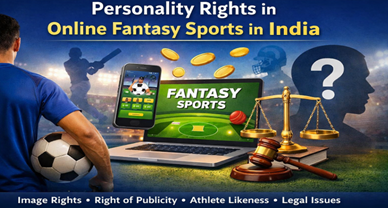
The domain of Intellectual Property (IP) is going through a paradigm shift as the personality itself is becoming a commodity important from the point of view of goodwill and commercial exploitation. With the widespread use of AI and AI content floating all over the internet, there is an anxiety that such unauthorised material may dilute the image and goodwill, particularly of famous personalities, by suggesting wrong associations. Traditionally, Indian IP jurisprudence has been centred around the protection of inventions, creative works, and trade symbols, but there is a need for a distinct branch for personality rights, an evolving form of proprietary interest. Although India does not yet recognise personality rights under a statute, the courts have progressively acknowledged these rights through a combination of privacy principles, misappropriation doctrines, and trademark and passing-off law.
Understanding Personality Rights
Personality Rights, which include the Plaintiff’s name, image, likeness, signature and all other elements of the Plaintiff’s persona, has acquired a unique distinctiveness and due to its inimitable nature, they also have a huge commercial value associated with them. Unauthorized exploitation of such attributes may lead to confusion among consumers and diluting the public image of the person.[1]
The jurisprudence of these rights roots from the idea that one’s identity is an intrinsic extension of his personality. When a person through effort and reputation, builds a valuable persona, the law seeks to prevent others from misappropriating or commercially exploiting that identity without consent.[2]
Personality Rights as Intellectual Property: An Emerging Interface
Just as trademarks symbolise brand goodwill, the name or likeness of a celebrity can function as a powerful source identifier. Brands frequently rely on such associations for marketing, making the persona commercially exploitable. However, if done without authorisation, might result in unjust enrichment by a third party and tarnishing of the image of the person. In the case of DM Entertainment Pvt. Ltd. v. Baby Gift House[3] the court granted an injunction against the sale of dolls resembling singer Daler Mehndi, holding that unauthorised commercial use of his persona amounted to passing off and false endorsement. Much like infringement of trademarks or copyright, unauthorised commercial use of persona can mislead consumers or unjustly enrich the infringer. Courts often rely on passing off, false endorsement, and misrepresentation principles to restrain such misuse.[4] In Titan Industries Ltd. v. Ramkumar Jewellers[5], the Court restrained the defendants from using images of Amitabh Bachchan and Jaya Bachchan in jewellery advertisements without consent, holding that such use amounted to passing off and unauthorised commercial exploitation of celebrity goodwill.
Moreover, the copyright law protects the expression of literary, artistic, dramatic and musical “work” but there is no protection for the creator wherein the skill so developed is a part of the creator’s personality. For instance, if we consider actors, the various skills developed by them are an extension of their personality and their personality traits such as voice, facial expressions, and acting skills, cannot be protected under the current legal regime even though these traits are unique and commercially valuable, they do not qualify as copyrightable subject matter because copyright protects expressed works, not inherent human attributes.
In today’s internet era, when AI has made it so easy to re-create the exact images, voice, expressions, and videos of famous personalities, it has paved the way for wrongful exploitation of their personality traits, and therefore, it is important to grant protection to personality rights. [6]Unidentifiable third-parties, who create, publish and make available the infringing content in the form of deep fakes featuring the celebrity amount to wrongful impersonation of a person.[7] Using a person’s name, voice, dialogues, images in an illegal manner, that too for commercial purposes, cannot be permitted.[8]
Gaps in Legislation
The Copyright Act safeguards the expression of creative works i.e., literary, artistic, dramatic, cinematographic or musical but not the inherent attributes of a performer. A celebrity’s voice, likeness, signature expressions, or mannerisms, no matter how distinctive, do not qualify as copyrightable subject matter. This leaves substantial aspects of personality outside the copyright framework.
Moreover, while celebrity names and likenesses may be registered as trademarks, the protection is confined to use in relation to specific goods or services and depends on the likelihood of consumer confusion. Trademark law does not prevent all forms of unauthorized exploitation, particularly non-commercial or AI-generated misuse that creates false associations without fitting neatly into traditional trademark categories.
Apart from the commercial aspects, the right to privacy, as affirmed in K. S. Puttaswamy v. Union of India[9], includes the control over one’s identity. As a result, privacy jurisprudence does not provide a structured mechanism for tackling digital impersonation and misappropriation. ICC Development (International) Limited v Arvee Enterprises[10] , Delhi High Court held that publicity rights are the facet privacy rights and any violation such rights would draw Articles 19 and 21 of the Constitution.
The Consumer Protection Act addresses misleading endorsements by imposing liability on endorsers, manufacturers, and advertisers. Yet it does not offer a remedy to the celebrity whose identity is used without consent. The framework is consumer-centric, leaving the proprietary interests of the celebrity unprotected.
Judicial recognition of Personality Rights
In the absence of underlying statute, the personality Rights suits are filed to secure permanent injunction restraining trademark infringement, passing off, copyright infringement, violation of common law rights, misappropriation of personality/publicity rights, performers’ right along with other ancillary reliefs. In the case of Amitabh Bachchan, who was aggrieved by the unauthorised use of his celebrity status for the promotion of their goods and services, the court granted an ad-interim ex parte injunction by the defendants therein.[11] Similarly, the Court protected the Personality Rights of Jackie Shroff by granting an ad-interim ex parte injunction in his favour, restraining the liable defendants therein from violating the plaintiff’s Personality Rights and causing prejudice to the plaintiff’s reputation. Further, the Court in suits filed for Aishwarya Rai Bachchan[12], Ajay Devgn[13] and Raj Shamani[14] has granted injunction from misusing the name, image, likeness and diluting public persona of the plaintiff therein through the use of technology including Artificial Intelligence, and protecting the dignity, reputation, goodwill and unauthorized commercial exploitation of the Personality Rights of the plaintiff. The Madras High Court, in Shivaji Rao Gaikwad v. Varsha Productions[15], protected Rajinikanth’s well-known personality traits, emphasising that a widely recognised public figure’s name, image, and style cannot be commercially exploited without permission.
Conclusion
As identity becomes central to commercial communication, personality rights are emerging as an essential component of India’s IP ecosystem. Judicial recognition has advanced considerably, especially in response to digital impersonation and AI-driven misuse. Nevertheless, the absence of a dedicated statutory framework leaves significant ambiguities concerning scope, duration, post-mortem protection, assignability, and enforcement. With identity functioning as a powerful economic asset, personality rights now intersect deeply with trademark, privacy, and unfair competition law. Codifying these rights would not only protect celebrities and public figures but would also promote responsible digital practices among platforms and advertisers. Given the accelerating influence of AI, the transition from fragmented judicial protection to comprehensive statutory recognition is no longer optional but essential.
Author:– Gauri Patil, in case of any queries please contact/write back to us at support@ipandlegalfilings.com or IP & Legal Filing.
[1] Abhishek Bachchan v. The Bollywood Tee Shop 2025 SCC OnLine Del 5944
[2] Sreenivasulu NS, Intellectual Property Rights: A Master Glance, MIPR, April 2007, Vol 1, Pt 4, P
A-185.
[3] DM Entertainment Pvt. Ltd. v. Baby Gift House CS(OS) 893/2002
[4] Abhishek Bachchan v. The Bollywood Tee Shop 2025 SCC OnLine Del 5944
[5] Titan Industries Ltd. v. Ramkumar Jewellers 2012 SCC OnLine Del 2382
[6] Akkineni Nagarjuna v. WWW.BFXXX.ORG and Others 2025 SCC OnLine Del 6331
[7] Anil Kapoor v. Simply Life India, 2023 SCC OnLine Del 6914
[8] Anil Kapoor v. Simply Life India, 2023 SCC OnLine Del 6914
[9] Justice K.S.Puttaswamy(Retd) vs Union of India 2019 (1) SCC 1
[10] ICC Development (International) Limited v Arvee Enterprises 2003(26) PTC 245 (Del)
[11] Amitabh Bachchan v. Rajat Nagi, (2022) 6 HCC (Del) 641
[12] Aishwarya Rai Bachchan v. Aishwaryaworld.com 2025 SCC OnLine Del 5943
[13] Ajay alias Vishal Veeru Devgan v. The Artists Planet & Ors. CS(COMM) 1269/2025
[14] Raj Shamani v. John Doe 2025 SCC OnLine Del 8540
[15] Shivaji Rao Gaikwad v. Varsha Productions 2015 SCC OnLine Mad 1582