Gig Workers’ Rights Under New Labor Codes: What Platforms Must Do Now
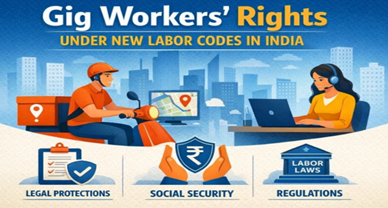
India’s new labor codes promise gig workers with access to traditional employee benefits and more, but are these codes limited to promise, or will they revitalize the employment scenario in our country? With millions of Indians now relying on platform work for their livelihood, the impact of these reforms extends beyond policy debates. This article will explore how the introduced labor codes will affect the gig economy and what the way forward should be for the platforms to navigate through this transition and get the best out of it.
Background
India’s employment landscape went through its biggest revamp since independence with the introduction of four new labor codes with effect from 21st November 2025. These four new codes, namely, Code on Wages, Industrial Relations Code, Code on Social Security, and Occupational Safety, Health and Working Conditions Code, consolidated the previously governing 29 central labor laws.
This was a long-standing necessity as the previously governing laws were fragmented and could not keep up with the changing times. With India having the largest youth population of approximately 420 million in the world, it becomes pertinent to build a framework that adequately represents the youth and reflects how the job market actually is. A huge section of this workforce is now associated with platform-based work, better termed as the gig economy, which is expected to grow from 7.7 million to 23.5 million (approximately an increment of 67%). At this rate, it again becomes extremely important to clear the fog and define this economy and the benefits associated with it, which these newly introduced codes aim to do.
The Centre has laid down the overarching framework; however, implementation at the state level still depends on state notifications since employment falls under the Concurrent List. This also does not mean that the old laws are no longer in effect, the government has designated a transition period for the employers to get acquainted with the codes.
For these codes to create “a strong foundation for universal social security, minimum and timely payment of wages, safe workplaces and remunerative opportunities” and “accelerate our journey towards a Viksit Bharat”, a great deal of importance needs to be placed on the execution of these consolidated laws in the entirety of India.
From Traditional Workplaces to Algorithms: Why the Gig Economy Matters Now
In recent years, with the boom of entrepreneurial platforms, the employment structure has drifted away from a traditional office setup. Millions now prefer and earn through apps rather than through conventional employers, largely because it offers a level of flexibility which was previously only fathomed by businessmen or freelancers. Apart from this, the growing prominence of technology has also pushed workers to adapt so that they don’t risk becoming redundant.
The Niti Aayog’s policy brief on “India’s Booming Gig and Platform Economy” estimates the current dominating medium skill profile (47% )to decline, and high skill and low skill gig jobs are on the rise. At the very least, this highlights the appeal that gig employment has on the youth with at least a secondary education.
For a fast-growing economy like India, it automatically becomes important to note these changes and remove the vulnerabilities associated with gig work for their work to get out of the grey area and become conspicuous. The new labor codes that attempt to define and protect gig workers, should be one of the closely watched reforms today, especially by the platform owners, as their entire model relies on this workforce.
What the Labor Codes Actually Offer Gig and Platform Workers
A long-overdue action, the new codes describe gig workers, landing them in the purview of a formal labor framework. The catch-all definition does not clearly paint a picture of what gig work is, but it is a move in the right direction. In the code for social security 2022, platform owners and aggregators must contribute at least 1-2% ( capped at 5%) of their total annual turnover to the social security fund for gig workers.[1] To ensure traceability and benefit portability, the code has mandated registration of platform-based workers on a centralized portal.[2]
However, the codes have fallen short of classifying gig workers as employees or bringing them within the ambit of labor protections beyond social security. Consequently, protections linked to minimum wages, job security, and occupational safety remain limited. Much of the promised social security measures continues to depend on corresponding central rules, state-level implementation, and the willingness of platforms to comply in good faith.
Real-World Impact: How These Codes Could Change Gig Work
In a move which merged 29 fragmented laws to 4 consolidated codes, the government created uniform employment rights, mandatory appointment letters, and extended social security benefits to the earlier shadowed part of our workforce. The government has emphasized to create Aadhar linked centralized identification system, which will make the benefits more accessible and the process more transparent. This national database will also help in mapping skills, tracking employment histories and growth, and preventing benefit loss in case of multi-platform or episodic work. But as far as Aadhar linked system goes, it also becomes pertinent for the aggregators to uphold the proportionality with minimal data usage and explicit consent.[3]
Now that they are defined, gig workers will gain structured benefits ranging from insurance to retirement. With a legal backing and formal recognition, the gig economy is likely to gain real momentum, which will help India to grow in a more sustainable way and further open up avenues for economic participation and innovation across the country.
If implemented properly and with a comprehensive digital administrative system, this will also open doors for further policy reformation with more detailed and targeted policies. Once the real gaps and challenges in implementation are identified, designing effective solutions will become much easier.
Subsequently, most states have produced drafts for one or more codes, but not all have finalized or notified their rules. Certain states, like West Bengal, are still lagging with the draft aspect of it. Given the indolent situation, this might create practical challenges, delaying uniform implementation. Thus, creating inconsistent compliance, with each state having its own timeline for enforcement.
What Platforms Must Do Now: The Roadmap for Compliance and Fairness
The partial notification has created a predicament. The shift puts these platform aggregators at a critical point where they need to keep track of provisions that are effective, pending, or which legacy laws continue to apply, and act accordingly. But while they have the time, paving the way for certain changes might put them at an advantage. Since the registration of all platform workers is mandatory, aggregators must make the best use of the technology and create an automated e-Shram registration, integrating Aadhaar KYC for instant portability.
Platforms can also enable a “Skill Certificate” feature for workers, wherein they get an opportunity to upskill. This can be envisaged as a skill badge which will help keep aggregators track of their workforce and give gig workers a chance for career progression.
To increase transparency and working environment, aggregators can also build an in-app grievance redressal system, where each worker has their own dashboard, to track the number of hours or delivery, and in case of any friction, the worker will have a forum they can turn to.
For fair and sustainable growth of this economy aggregators have to consider the requirements of gig workers and provide for such an environment which allows both the parties to thrive.
Conclusion
The gig economy is no longer isolated, it is an integral part of India’s employment structure and has gotten the recognition it deserves. Now that, in theory, everything is laid down, what would truly make these labor codes revolutionary is not their intent but their execution. What will decide the success of these codes is not how they look on paper, but how many resources are allocated for the furtherance of the cause and whether states have the independence for relative applicability or not. The government needs extensive digital infrastructure to ensure proactive compliance, and platform aggregators require profound databases and an identification system so that the benefits are accessible.
Gig workers are rightly described as the invisible wheels and deserve the visibility they can get through being a part of worker unions or some sort of organized solution. At the same time, flexibility defines gig work, and the new code must strive to provide security without compromising the flexibility that is inherent to gig work. The code will only be a historical success if it solves this paradox and not just theoretically extends the benefits.
Author:– Hiteshi Chugh, in case of any queries please contact/write back to us atsupport@ipandlegalfilings.com or IP & Legal Filing.
References–
- https://www.niti.gov.in/sites/default/files/2023-06/Policy_Brief_India%27s_Booming_Gig_and_Platform_Economy_27062022.pdf
- https://www.medianama.com/2025/11/223-gig-workers-legally-recognised-indias-labour-codes/
- https://www.indiatoday.in/business/story/labour-codes-laws-explained-from-gratuity-to-gig-worker-insurance-2824221-2025-11-22
- https://www.price360.in/articles-details.php?url=indias-young-harbour-big-plans
- https://www.niti.gov.in/sites/default/files/2023-06/Policy_Brief_India%27s_Booming_Gig_and_Platform_Economy_27062022.pdf
- https://www.pib.gov.in/PressReleasePage.aspx?PRID=2192540®=3&lang=2
- https://www.niti.gov.in/sites/default/files/2023-06/Policy_Brief_India%27s_Booming_Gig_and_Platform_Economy_27062022.pdf
- https://www.pib.gov.in/FactsheetDetails.aspx?Id=150554®=3&lang=1#:~:text=Key%20Takeaways,making%20benefits%20portable%20across%20platforms.
- https://www.obhanandassociates.com/blog/implementation-of-indias-four-labour-codes-key-changes-and-the-road-ahead/
[1] The Code on Social Security 2020, s 114(4).
[2] The Code on Social Security 2020, s 113.
[3] K S Puttaswamy (Aadhaar–5J) v Union of India (2019) 1 SCC 1