Zomato and Swiggy Workers Strike Back: Invisible Employers and Legal Accountability
Introduction
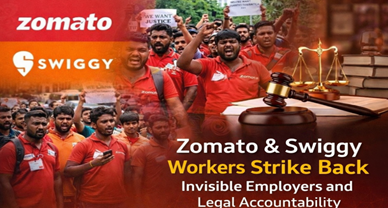
On 31st December 2025, gig workers associated with delivery platforms like Swiggy, Zepto, Blinkit and Zomato called for strikes during peak demand hour. This was due to numerous reasons like declining earnings, long hours, lack of social security and safety issues arising from unachievable delivery targets like the 10-minute delivery promise. The strike was called on by Telangana Gig and Platform workers Union and the Indian Federation of App-based Transport Workers. Support was given by regional worker groups in Maharashtra, Karnataka, Delhi-NCR, West Bengal and parts of Tamil Nadu. While the concerned platforms did respond by offering short term surge and completion-based incentives a deeper issue is brought forth which is a gap in Indias regulatory framework for lack of accountability for gig workers.
This blog aims to put forth the question of how the platform workers are recognized under the Indian Law, while still highlighting how it fails to assign responsibility for safety and wages.
The significance behind the strikes
In a letter sent to Union Labour Minister Mansukh Mandaviya, IFAT raised demands like transparent wage systems, social security benefits, safer working conditions and recognition for workers. This mirrors traditional labour law claims however, these delivery partners are constantly classified as independent contractors by the platform companies and therefore they rely on contractual flexibility as well as fixed working hours are absent to avoid employers obligations.
Algorithmic control centres delivery work in practice. As order allocation, ratings, penalties, pricing and incentives are all determined by the platform system. The conditions under which the work is done is governed by the platform and a human supervisor is absent. This raises the unresolved legal question of whether contractual labels should prevail over economic dependence and operational control.
The Social Security Code 2020
The Social Security Code, 2020 which focuses and recognises platform and gig workers is primarily India’s statutory framework involving platform work which empowers the government to draft welfare schemes for these workers. This makes it a significant policy for development however a welfare centric approach rather than one which involves a rights based approach is adopted. Working conditions are not regulated neither are minimum wages prescribed. Clarification on when a platform may be treated as an employer is also not given and at the same time even though the workers are recognised as a distinct class, they do no have enforceable mechanisms to challenge the working conditions they are put through. The gap in the statutory framework explains why collective action like strikes are one of the few effective tools available to platform workers.
Labour Law
The existence of an employer employee relationship usually determines labour protections, following Industrial Disputes Act, 1947. This is avoided by platform companies as they design contracts which emphasise flexibility in terms of working hours and the ability to work across multiple platforms. Control is still not negated by this flexibility as these delivery partners are subjected to constant performance evaluations through algorithms. They lack power as these platforms act as a primary source of income for them. The Indian courts have still not conclusively determined the classification of such arrangements but increasing judicial scrutiny is suggested as the Supreme Court interacts with gig workers claims regarding social security.
Progress within States
Various States have started adopting Legislation to target this issue like the Rajasthan Platorm Based Gig Workers (Registration and Welfare) Act, 2023. This highlights a step towards benefits for the workers as well as visibility as it establishes a welfare board, fund and requires registration of the platform workers. Though progress is showcased the key issue raised which was who is responsible for the wage structures and safety while working is still not addressed. Without addressing these the welfare mechanism remain supplementary instead of being corrective.
Legal Reform
The strikes clearly showcases that the issue is not the absence of a statutory framework but one of distinct legal accountability. To address this narrowly structured reforms will be helpful to attack the core concerns instead of having a reclassification of platform workers as employees.
Firstly, transparency in statutory frameworks regarding algorithmic wage computation is extremely necessary as platforms should be required to disclose how base pay, surge pricing penalties and incentives are calculated. Having such obligations to disclose can be introduced through State legislation or by introducing rules under the Social Security Code and would empower workers by potentially reducing arbitrariness without disrupting the business model of the platform.
Secondly, recognition must be given to safety by design obligations as when fast delivery promises are made by platforms, it creates a systematic risk. Realistic delivery timelines must therefore be added to as a part of Legal duties. In addition to that there should be a removal of penalties for unavoidable delays and insurance coverage should also be given for accidents which helps shift the focus from individual fault to platform created risk.
Lastly, the platform workers should be allowed to have limited collective representation rights even if they do not have a full employee status. They should have the ability to engage in issues related to grievance mechanisms, revisions of pay structures and safety noms which in tun would reduce the need for constant disruptive strikes while still preserving operational flexibility.
Conclusion
The strikes by Swiggy and Zomato workers were not simply labour protests but highlight the deep legal issue between labour categories that are traditional in nature and gig workers. There has been mild recognition of platform workers by the Indian Law but assigning responsibility in terms of fair pay and safer working conditions remains absent even today. Strikes will remain a constant aspect of the gig economy unless enforceable standards are put into place and the gap is addressed. This requires carefully crafted legal measures that bridge responsibility and control and not reclassification.
Author:–Anya Salukhe, in case of any queries please contact/write back to us atsupport@ipandlegalfilings.com or IP & Legal Filing.
Works Cited
- Government of India. Code on Social Security, 2020. Ministry of Labour and Employment, Government of India, 2020.
- Government of Rajasthan. The Rajasthan Platform Based Gig Workers (Registration and Welfare) Act, 2023. Rajasthan Gazette, 2023.
- Rosenblat, Alex. Uberland: How Algorithms Are Rewriting the Rules of Work. University of California Press, 2018.
- The Hindu. “Gig Workers Call for Nationwide Strike Over Pay and Safety Concerns.” The Hindu, Dec. 2025, thehindu.com.
- Indian Federation of App-Based Transport Workers. “The Indian Federation of App-Based Transport Workers (IFAT) Has Written to the Hon’ble Union Labour Minister Raising Demands on Pay, Social Security and Working Conditions.” Facebook, Dec. 2025, facebook.com/indianlabournews/posts/1289170463229736/.
- “Gig Workers Protest on NYE; Delivery Platforms Offer Bonus to Meet Demand.” The Times of India, 31 Dec. 2025,
timesofindia.indiatimes.com/city/pune/gig-workers-protest-on-nye-delivery-platforms-offer-bonus-to-meet-demand/articleshow/126278426.cms.