Urgency Vs. Formality: Pre-Litigation Mediation and Urgent Interim Relief in Ip Proceedings
Introduction
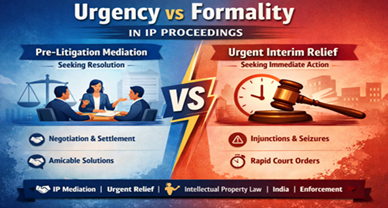
The concept of IP deals with exclusivity. They are both supplementary to each other. The moment infringement occurs, his proprietary rights are jeopardised, often resulting in irreparable market damage. As a result, a recurring question has usually lingered: whether pre-litigation mediation is mandatory when urgent interim relief is sought in trademark and patent infringement suits.
According to Section 12A of the Commercial Courts Act, 2015[1], urgent interim relief is considered as an exclusion in mandatory pre-litigation mediation. While the purpose of the legislature was to promote amicable and peaceful settlement, its execution in IP has inflicted significant debate. Courts on several occasions have recognised that where the suit seeks an urgent interim relief, irrespective of whether it’s a case of pending infringement, the pre-litigation mediation cannot be served as a mandate on the ground of procedural irregularity.
This blog examines the stance of various statutory and judicial interpretations on this particular issue. Additionally, it refers to several policy recommendations and the court’s approach, prioritizing urgency over formality. Moreover, the blog argues that the “urgency” of the injunction must be assessed on the basis of the gravity of the harm to the proprietor’s rights and in the public interest, rather than mere procedural irregularity.
Procedural Mandate Under Section 12A Of the Commercial Courts Act, 2015
Clause (1) of Section 12A of the Commercial Courts Act, 2015[2] mandates that a party must not initiate a suit unless they have resorted to their remedy under pre-litigation mediation. The proviso states that the suit excludes urgent interim relief. The section aims to ensure that such disputes are settled amicably rather than dragged out in prolonged litigation.
The Hon’ble Supreme Court in Patil Automation Pvt Ltd v Rakheja Engineers Pvt Ltd[3] has made it clear that Section 12A uses the word “shall” and is mandatory. The Court has also specifically stated that non-compliance with Section 12A will render the plaint liable to rejection under Order 7, Rule 11, of the Code of Civil Procedure, 1908[4]. However, the court has also applied the rules of interpretation and held that, in urgent interim relief cases, this provision can be considered flexible.
Now, the major issue is under what circumstances this “urgent interim relief” can be considered, particularly in patent and trademark infringement cases.
The Concept of Urgent Interim Relief in IP Litigation
Like any other civil suit for an interim injunction, the IP Litigation for Trademark and Patent Infringement also lays down the three golden test criteria for considering an interim injunction, or, here, urgent interim relief. They are: –
(a) A Prima Facie must be made;
(b) There must be a balance of convenience between the parties;
(c) The party must have suffered irreparable harm or damage[5]
In Trademark Litigation, an infringement can have various consequences, including impact on brand identity, consumer confusion, and, most importantly, the erosion of goodwill. Such damage can be deemed grievous, as it is mostly irreversible. Likewise, in patents, an infringement can cause similar issues, but one such issue that is highly emphasized is the invention’s exclusivity.
The Apex Court in Laxmikant V Patel[6] has stressed that, in cases of trademark infringement, if a prima facie case is made out between the parties, the injunction must be granted to prevent irreparable harm or damage to goodwill. The court clarified that a delay in seeking an injunction cannot, in itself, constitute a strong ground if the harm is ongoing.
Henceforth, it can be safely stated that “urgency” is inherent in trademark and patent infringement cases.
Judicial Interpretation of Section 12A In IP Disputes
High Courts have on many occasions dealt with cases in which defendants contend that the suit is barred for non-compliance with Section 12A, as the plaintiff is still seeking an interim injunction for ongoing infringement. In the case of the Delhi High Court, which deals with a great volume of IP litigation, it has, for the most part, held that where a plaintiff clearly puts forth a request for prompt interim relief, for example, an ex parte injunction, Anton Piller orders, or appointment of local commissioners, pre-suit mediation is not a requirement. Also, the Court has said that the plaintiff’s claims in the plaint must put forth urgency and that this is not to be a formal exercise.
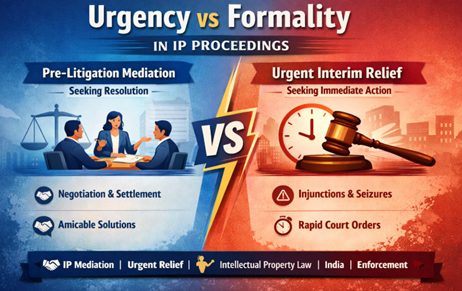
Following the Patil Automation case[7], Courts have closely examined whether a case actually involves an issue warranting urgent relief. If the prayer includes an interim injunction for ongoing infringement and the accompanying pleadings articulate an instance of imminent or continuing infringement, s. 12A is no impediment. Such a stance is also consistent with the statute, which provides an express exception for urgent interim relief.
The Meaning Of “Urgency”: Nature of Harm Over Time
The Defendants’ claims that the plaintiff should be precluded from arguing that the case involves an issue of urgency because of a self-imposed delay in bringing the case are quite common. But the courts have increasingly been able to bridge the gap between a delay and a lack of urgency.
The main focus is not on how long the plaintiff has waited to commence proceedings, but on how long the infringement has persisted and whether further action would cause irreparable harm.
In Midas Hygiene Industries Pvt Ltd v. Sudhir Bhatia[8], the Hon’ble Supreme Court of India mentioned that in trademark cases, it is almost a rule that injunctive relief should be granted, even in the presence of delay, especially when there is a suggestion of dishonest use. The Court has said that the delay does not legitimize the infringement. The same applies to patent cases, where continued unauthorized production and/or distribution cause irreversible changes to the economy. The driving factor is the need to stop further damage, not a mere immediate response after discovering the infringement.
Henceforth, impulse and “urgency” under s.12A should be construed to mean a particular type and degree of harm, rather than an arbitrary time interval.
Rights of Proprietor and Public Interest
Trademarks and patents, which are statutory monopolies, are put in place to encourage innovation and, at the same time, protect the interests of consumers. Infringement not only harms the proprietor but may also mislead the public or degrade product quality.
For instance, if we cite pharmaceutical patent cases, we see courts emphasize the public interest in their decisions. In the landmark case of Novartis AG v. Union of India[9], although the issue concerned the patentability standards set forth in Section 3(d) of the Patents Act[10], the Hon’ble Supreme Court of India brought to the fore the public element, a part of patent law. Although that case did not directly address interim injunctions, it did show that patent enforcement has wide social implications. When counterfeits or infringing products hit the market in areas such as medicine, electronics, or automotive parts, the issue goes beyond private disputes. We see here that consumer safety and market integrity are at stake.
Section 12A acknowledges a dispute that requires a rights holder to accept mediation as a remedy when infringement affects both public interest and proprietary rights, and therefore seeks to mitigate this risk.
Procedural Compliance Versus Equity Under Substantive Law
The objective has set the bar that mediation is a mandatory requirement before seeking urgent interim relief. However, in IP Cases, it shouldn’t be held applicable as an infringer can still infringe another proprietor’s trademark or patent, as mediation has no powers of judicial compulsion. It is because it is considered to be a form of amicable settlement, and by the term “amicable”, it is understandable that the dispute must be resolved peacefully and not coercively[11].
Such a method is ineffective, as it will not make the infringer liable for his own actions; rather, it will provide an additional period to infringe another proprietor’s Intellectual Property.
Therefore, the Hon’ble Supreme Court in Patil Automation case has applied the doctrine of harmonious construction and ensured that although a statutory mandate is necessary to safeguard the virtue of the legislature[12]. However, interim reliefs are also considered as equitable reliefs and can be granted if the court deems necessary. This is a harmonious construction between procedural requirement and substantive justice.
Abuse Of “Urgency”
The dispute may have arisen over whether the plaintiffs have the privilege to insert a prayer clause seeking urgent interim relief in a particular case. This can be a question, as in the Post Patil Automation case, the court has made it clear that urgency will prevail over formality, that is, the procedural requirement under s. 12A. However, this is not so facile as the party seeking urgent relief has to prove why he requires it as per the civil evidentiary principle on “preponderance of probabilities.” This reflects that, until the court is satisfied, the principle of urgency cannot prevail over compliance with s.12A, thereby eschewing abuse.
In the case of Yamini Manohar[13], the matter relates to a commercial suit in which the application filed by the petitioner was rejected as per Order VII Rule 11 of Code of Civil Procedure, 1908. The Hon’ble Apex Court reiterated on Section 12A of Commercial Courts Act, 2015 regarding pre-mediation litigation mandate. It mentioned that Section 12A is a mandatory and exhaustive remedy unless the suit involves urgent interim relief. The court mentioned that an urgent interim relief was pleaded in the prayer so pre-litigation mediation under Section 12A was not held applicable. On this basis, the Special Leave Petition stood rejected along with the plea of condonation of delay. The Hon’ble SC in its words mentioned that “Mere Contemplation of Urgent Relief should not be a guise to bypass statutory pre-litigation mediation and the sole intention of legislature for inserting Section 12A should not get defeated.” Therefore, this case contemplates that urgent interim relief can only be given according to the satisfaction of the commercial court and if it not qualifies urgency, then the parties have to mandatorily go under pre-litigation mediation as per Section 12A.
Conclusion
Therefore, Section 12A of the Commercial Courts Act, 2015, is a significant legislative step, as it explicitly provides that mediation is not required for suits involving urgent interim relief. In cases of Trademark and Patent Infringement, the urgency is clear. So, this becomes the duty of courts to assess the dispute with urgency or with formality. Courts consider several factors, such as the gravity of the harm, the impact on proprietary rights, and public interests, indicating that they don’t rely solely on chronological delay.
The court in Patil Automation ensured nullus commodum capere potest de injuria sua propria so that the infringer doesn’t get any privilege of doing wrong[14]. This replicates a balanced approach, as it ensures that procedures can be complied with in any ordinary commercial dispute, but when it involves a suit for urgent interim relief, the court has to consider several factors before reaching a conclusion. This replicates the power of judicial review and the virtue of ensuring IP Rights are not infringed.
Author:– Alok Ranjan, in case of any queries please contact/write back to us atsupport@ipandlegalfilings.com or IP & Legal Filing.
[1] Commercial Courts Act 2015, s 12A.
[2] Ibid s 12A cl (1).
[3] Patil Automation Pvt Ltd v Rakheja Engineers Pvt Ltd, (2022) SCC OnLine SC 1028 (SC).
[4] Code of Civil Procedure 1908, Order VII r 11.
[5] Mandati Ranganna v T. Ramachandra, (2008) (11) SCC 1 (SC).
[6] Laxmikant V Patel v Chetanbhai Shah, (2002) 3 SCC 65 (SC).
[7] Patil Automation Pvt Ltd v Rakheja Engineers Pvt Ltd, (2022) SCC OnLine SC 1028 (SC).
[8] Midas Hygiene Industries Pvt Ltd v Sudhir Bhatia, (2004) 3 SCC 90 (SC).
[9] Novartis AG v Union of India, (2013) 6 SCC 1 (SC).
[10] Patents Act 1970, s 3(d).
[11] The Law Dictionary, ‘Amicable’ https://thelawdictionary.org/amicable/#google_vignette accessed 16 February 2026.
[12] Patil Automation Pvt Ltd v Rakheja Engineers Pvt Ltd, (2022) SCC OnLine SC 1028 (SC).
[13] Yamini Manohar v T.K.D. Keerthi, (2023) SCC OnLine 1382 (SC).
[14] BNB Legal, ‘Nullus Commodum Capere Potest de Injuria Sua Propria’ https://bnblegal.com/nullus-commodum-capere-potest-de-injuria-sua-propria/ accessed 16 February 2026.